











































Are Gender-Sensitive Evaluations and Feminist Evaluations Different?
Author: Ranjani K. Murthy, cross-posted from the Gender and Evaluation international community of practice, August 21 2014 - In evaluation conferences, at times I hear "I do feminist evaluations, and not gender evaluations. Feminist evaluation places issues of power at the center of defining scope of evaluation, evaluation process and, how findings are used. They look at intersections between gender and identities, and examine how the project/programme change social structures. Gender evaluations do not deal with issues of power and structures."
Having been taught about gender relations through reading “Preliminary notes on Women's Subordination" (Ann Whitehead, 1979) as my bible, which emerged from collective reflection of women activists from different parts of the world on women's subordination it has been ingrained into me that gender relations are power relations which interlock with race, caste, class, ethnicity, religious identity etc to keep women in a subordinate position. Naila Kabeer, through her book Reversed Realities (1994), added that these power relations are shaped by the institution of household, community, market and state. Murthy and Rao (1997) added inter-state institutions to this list. The focus is on both so called "traditional" barriers to women's emancipation as well those imposed by "neo-liberal" policies. When those of us who work with this paradigm on gender and social relations facilitate evaluations we are aware of how power gets contested at each stage of evaluation, and also try to capture marginalised women's perception of what extent power relations in different institutions are changing to the advantage of women and marginalised groups.
Yes, the term gender-aware evaluations since the 1990s has been used in other ways, too. The term gender-aware has been used to mean (adapting Kabeer, 1994):
- Gender-neutral evaluations: Such evaluations examine how far the project/programme has used the traditional roles of women and men for the success of project objective (e.g increasing child health, improving agricultural productivity). Women in such evaluations are asked evaluate soft aspects while financial viability, project management etc are allocated to a male facilitator
- Gender-specific evaluations: Such evaluations examine how far the project/programme has contributed to meeting women's sex/gender specific needs. (e.g. improving maternal health, seed preservation). Like in the case of gender-neutral evaluations, women in such evaluations are asked evaluate soft aspects while technical viability, financial viability, project management etc are allocated to a male facilitator.
- Gender-redistributive evaluation: Such evaluations examine how far the project/programme has contributed to changing power relations within institutions based on gender and other identities (e.g. strengthening women's asset base, decision making in institutions). Women in such evaluations are often the team leaders, and include facilitator from marginalised groups in the team. Like in the case of feminist evaluations, issues of power are placed at the center both on the ground, within the evaluation team, between the evaluation team and implementing agency and implementing agency and donor.
To conclude, gender-redistributive evaluations and feminist evaluations are similar, while gender-neutral and gender-specific evaluations are not.
Reference
Whitehead, A. (1979) Some preliminary notes on the subordination of women. Institute of Development Studies Bulletin, No. 10: (3).
Kabeer, N. (1994) Reversed Realities: Gender Hierarchies in Development Thought. Verso, United Kingdom
Click here to access the original blog on the Gender and Evaluation website.
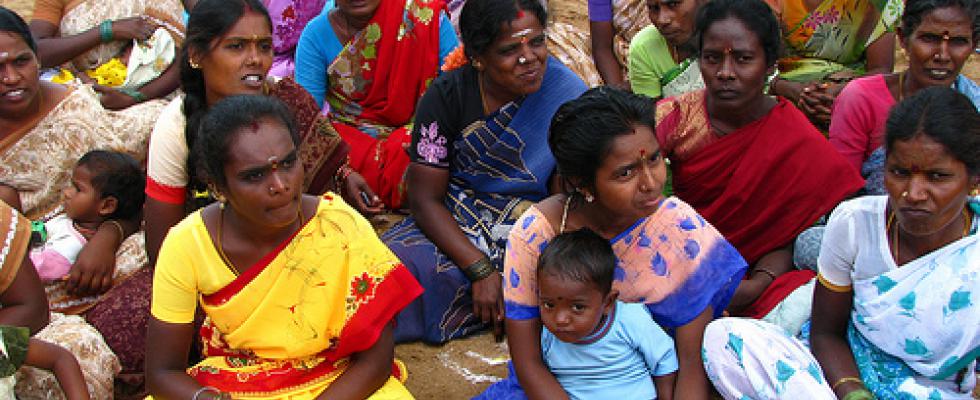
Image caption and credit: India - Faces - Rural women driving their own change by Mckay Savage
- Log in to post comments