










































Climate Change in Our World
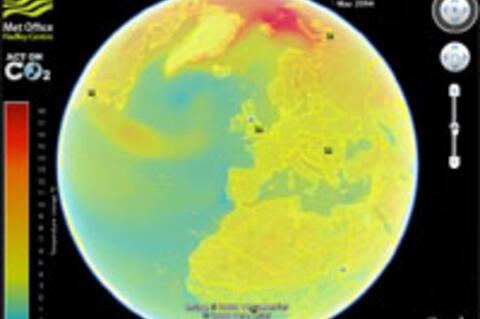
Using information and communication technology (ICT) to explore and disseminate information about climate science, Climate Change in Our World shows global temperatures over the next 100 years, along with stories of how people in some of the world's economically poorest countries are already being affected by changing weather patterns. One official associated with the project commented: "Google Earth maps allow us to see first hand accounts of poor people coming to terms with everything from floods and droughts to melting glaciers. Amidst the massive impact on the world's environment the initiative highlights the personal costs to people least able to withstand the changes." The project includes present-day human impact case studies provided by DFID, as well as examples of possible future climate change impacts.
A key strategy shaping this effort is the collaboration between a bilateral organisation, various governmental branches, non-profit organisations, and a new technology provider (Google Earth Outreach), which supports non-profit organisations that share a commitment to providing community service in areas such as education and culture, environment and science, current affairs, global development, public health, and social services. Through this partnership, non-profit organisations are invited to use Google Earth Free to view and create Keyhole Markup Language (KML files), for posting on their own website or for emailing to partners, donors, volunteers, and beneficiaries.
Specifically, as part of Google Earth Outreach, Google grants "Google Earth Pro" licenses to qualifying organisations. Google Earth Pro has authoring features which allow for geographic information system (GIS) data importation such as .shp and tab files, a movie making module, and a high-resolution printing feature. Also, qualifying organisations can apply for a Google SketchUp Pro grant, which centres around software that can be used to create, share, and present three-dimensional (3-D) models. Those who have access to this software may create Maps using the My Maps Tab, create a personalised map to plan an organisation's events, view videos and starter templates, and/or collaborate with other users related to online maps.
For example, one animation uses climate-science capabilities from the Hadley Centre to show global temperatures throughout the next 100 years under medium projections of greenhouse-gas emissions, along with reports of how people in the UK and in some of the world's economically poorest countries are being affected by changing weather patterns. Visitors to the website are urged to contribute by, for example, submitting stories about "heroes" who have worked to make the lives and jobs of people in information technology (IT) easier by fostering a sense of community. Users can also find information on actions that individuals, communities, businesses, and governments can take to tackle climate change, and highlights work already underway.
Environment, Technology
DFID, DEFRA, Google, the Environment Agency, the Met Office Hadley Centre, and the British Antarctic Survey.
DFID e-bulletin: New Vision of Climate Change through Google Earth, May 22 2008; and Climate Change in Our World weblog (blog).

- Log in to post comments