











































COP15 Editorial Leader Project
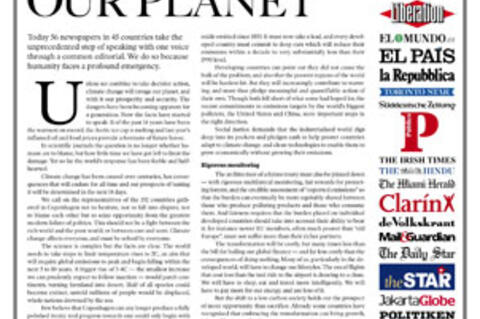
The text of "Fourteen Days to Seal History's Judgment on this Generation" was drafted by a Guardian team during more than a month of consultations with editors from more than 20 of the papers involved. Alan Rusbridger, editor-in-chief of the Guardian, said: "No individual newspaper editorial could hope to influence the outcome of Copenhagen but I hope the combined voice of 56 major papers speaking in 20 languages will remind the politicians and negotiators gathering there what is at stake and persuade them to rise above the rivalries and inflexibility that have stood in the way of a deal." Within the text itself, collaboration is a core recommended strategy: "Climate change has been caused over centuries, has consequences that will endure for all time and our prospects of taming it will be determined in the next 14 days. We call on the representatives of the 192 countries gathered in Copenhagen not to hesitate, not to fall into dispute, not to blame each other but to seize opportunity from the greatest modern failure of politics."
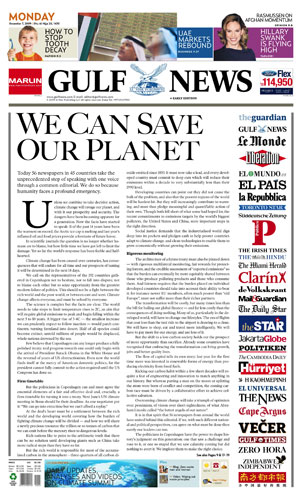
Like the Guardian, most of the participating newspapers featured the editorial on their front page. (The editorial is free to reproduce under Creative Commons.) The text also ran on several high-profile blogs and sites on the Guardian Environment Network.
This initiative sought to invite participation. The Guardian asked readers to write their own versions of the editorial, 5 of which were published online here.
Environment.
According to organisers, "Climate change poses a particular challenge to journalists....[H]ow do we reflect the scale and urgency of the issue in the normal register of journalism?....At the Guardian, we have tried to answer the challenge by covering the story in ever greater depth, devoting more space and resources - six specialist reporters - as well as a dedicated environment website. But this approach has its dangers too:...So intense has been the blizzard of climate change coverage in the months leading up to the Copenhagen summit that at times even the most shocking stories have barely cut through the white noise."
In the words of the Guardian's Ian Katz: "Given that newspapers are inherently rivalrous, proud and disputatious, viewing the world through very different national and political prisms, the prospect of getting a sizeable cross-section of them to sign up to a single text on such a momentous and divisive issue seemed like a long shot....Of course, getting papers to agree in principle was the easy bit. The trickier job would be producing a text that everyone could sign up to. After a series of discussions with scientists and other experts, we circulated a skeleton argument to the group of papers who had signed up early, and the comments that came pouring back quickly offered a taste of what the real Copenhagen negotiations must be like....Some thought the editorial's assessment of the consequences of inaction was too gloomy; some not gloomy enough. The text went through two more drafts, as our leader writers Tom Clark and Julian Glover sought to reflect each partner's requests without alienating another..."
World Association for Christian Communication (WACC) News Alert, December 7 2009; "Global Media Unite over Copenhagen Climate Change Conference Editorial", The Guardian, December 7 2009, by Adam Vaughan; "How the Climate Change Global Editorial Project Came about", The Guardian, December 6 2009, by Ian Katz.
- Log in to post comments