










































Focus on Medellín: From fear to hope… - Part II of II
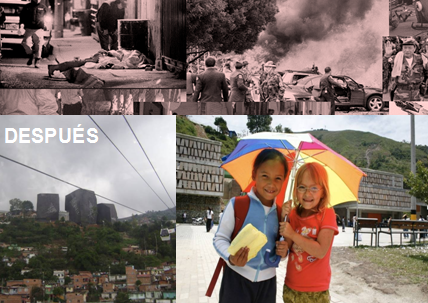
Author: Adelaida Trujillo Caicedo, April 18 2019 [continued from Part I] - Because of my professional and personal connections with Medellín, I was involved in coordinating Federico Restrepo's invitation to share his thinking and strategies about "one of the most remarkable urban turnarounds in modern history" (Urban Land Institute - ULI). Once the stronghold of the powerful and cruel Medellín cartel, the city (Colombia's second largest) counted more than 6,300 killings in 1991. Since then, the homicide rate has fallen by 85% and poverty levels by 86%. In 2013, Medellín was named the "most innovative city" out of 200 (ULI), amongst the many awards and recognitions that a string of three administrations has received since its extraordinary change began in 2004. The question we've been trying to answer is: How was the integrated, multidimensional, multisector social and economic change designed and implemented, and what is/was the role of communication and media, public dialogue and participation, social mobilisation, and community engagement?
Who is "we"? The Communication Initiative Latin America (CILA) has been documenting and expanding the discussion on Medellín from a communication for social change (CSC) perspective since we invited The CI's Executive Director Warren Feek to visit the city 10 years ago. He was deeply struck by the "miracle" in the most violent city in the world (ranked #1 for many years), famous because of Pablo Escobar, cocaine, and bombs (and fractured by massive internal displacement of victims fleeing to the city to escape the guerrilla and paramilitary conflict). See Warren Feek's 2008 blog, which is still up to date.
We finally "road tested" the power of Medellín's social change story at the 2018 Social and Behavior Change Communication (SBCC) Summit in April 2018, which featured an inspirational keynote address from Aníbal Gaviria (former Medellín mayor, 2011-2015) at the closing session chaired by Warren Feek. Despite skepticism from a few "orthodox" SBCC colleagues (who, to be convinced, need to see a prescriptive model, the connections clearly identified, and hard data and evidence), I dare say we made the case that Medellín is a "world-class" example of complex, sophisticated social change processes and policies that deserve much more attention from the SBCC field and the Sustainable Development Goals (SDGs)/United Nations (UN) 2030 Agenda. So, exploring how this story resonated in the High-Level Political Forum (HLPF), in a context of non-communicators with a laser focus on SDG 11 [make cities and human settlements inclusive, safe, resilient, and sustainable], was the main challenge. In fact, as Doug Storey of the Johns Hopkins Center for Communication Programs points out, retrospectively documenting which SBCC processes made a difference in the Medellín experience provides an interesting example for the field.
Medellín has been praised mainly because of its social urbanism interventions (more tangible, I suppose, than creating dialogue and environments of trust?): civic spaces; huge libraries; public WiFi; museums, art galleries, and concert halls; top-class schools and kindergartens with ludothéques (toy libraries); huge water tanks transformed into parks, music studios, and public meeting spaces; and innovation labs for everyone, etc. These interventions are made accessible thanks to Medellín's integrated transport infrastructure, which today includes a giant cable car system and electric escalators that allow the residents of the economically poor neighbourhoods (comunas) on Medellín's steep hillsides to easily commute to the city centre, in the valley. But there is much, MUCH, more to the infrastructure and cement, and this is what needs to be captured: We asked both speakers [Federico Restrepo and Michael Emerson Gnilo] to examine their experience of seeking to reduce poverty and integrate large marginalised areas, marked by years of severe poverty and violence, into the urban fabric.
It's important to note that Federico was a central strategist and decision-maker during the Fajardo administration (2004-2007). Sergio Fajardo Valderrama is a mathematics professor who was elected mayor, representing a non-partisan, civic movement. His diverse, eclectic government team (including a standup comedy actor who became communication director!) was the first to conceive a model that literally turned Medellín around and laid the solid ground for the two following administrations [Salazar (2008-2011) and Gaviria (2012-2015)], who understood the importance of continuity and of building on existing policies with a long-term perspective. Like Fajardo, they recognised that, above all, life is sacred, and people are at the centre of change.
Federico and his colleagues were confronted by a profound social and institutional crisis that meant the presence of drug trafficking, its impact on youth culture, and its infiltration into different spheres of Colombian public life. The examples shared at the HLPF focus on the Integrated Urban Projects (IUP) programme, one of a series of macro and micro interventions in the most vulnerable comunas of the city. Federico and his colleagues were direct in depicting the profoundly difficult context that needed to be transformed: people's sense of rupture, uprooting, and fracture from their rural villages and lands; the need to reconstruct lives; and a recognition of the dignity of victims of horrific violence and massive displacement (#2 after Sudan a few years ago), who need to reestablish solidarity and reconnect with others in a foreign city and culture. What were the core principles, the concepts that triggered the change? The words TRUST, CITIZENSHIP, PARTICIPATION, ENGAGEMENT, SELF-ESTEEM, DIGNITY, RESPECT, CAPACITIES, RECOGNITION, CONSISTENCE, and COHERENCE are at the heart of a new model of public intervention that emerged and was applied. But the genesis was the goal of transforming Politics (with a capital P) and strengthening local democracy: In 1999, 50 people (a powerful mix of students, artists, academics, businesspeople, and leading local non-governmental organisations - NGOs) crafted a new management model for Medellín, based on the following principles:
- Ethics
- Rigour in the identification of development gaps and issues
- Planning
- Transparency in the management of public resources (e.g., participatory planning and budgeting systems)
- Collective sense to examine the territory as a multidimensional project
- Public communication to trigger social pedagogic processes, social accountability, and citizen oversight mechanisms
"...This model involved not merely a transformation from politics but, rather, 'a political transformation to form citizens and build up citizenship in order to break down with the patronage structures of power.' What did it take to make this happen? The creation of trust environments, says Restrepo-Posada. This model proposes respect and recognition for citizens' actions and 'promotes the recovery of self-esteem, talent, pride and dignity of people in those peripheries.' Certainly, the transformation involves social, territorial, and economic shifts, but, to reiterate, the central element is TRUST..." (my highlights from The CI's summary).
To further comprehend Federico's perspectives, it is worth recalling some of Aníbal Gaviria's reflections at the 2018 SBCC Summit in Nusa Dua, Indonesia. Twelve years after Federico and his colleagues transformed the way democracy happens, public funds are spent, and people engage in dialogue, Aníbal provided insights on the background planning and thinking around the cultural, educational, and recreational infrastructure itself: Cities (where the majority of this planet's future generations will live) need to be seen as the tools to construct equity; inequality needs to be tackled as the main backdrop to violence; and the public sphere needs to be conceived as THE space of equality and dignity. And to reinforce equitable and rights-based development, transparency in public decisions and expenditure is at the core of the dialogue, which in turn strengthens a culture of citizenship and sense of ownership. Public space interventions are co-created by consensus and dialogue with communities, with high-quality and striking symbolism, and themselves become public communication spaces. His overarching leitmotiv: to govern is to communicate. But he clearly pointed out that it needs to be always a two-way process: horizontal communication back and forth between citizens and their government and public servants, supported by academia and the media and communication networks' awareness of their transformative potential, guaranteeing and strengthening public accountability processes.
Click here to watch Aníbal Gaviria’s presentation at the 2018 SBCC Summit.
Some questions come to mind...:
- What is the best approach to demonstrate the connection in Medellín's turnaround (violence and poverty reduction) with an informed and engaged societies "lens" (most probably the "glue" that held it together)?
- How can we document the Medellín change story and its huge complexities: "connecting the dots", identifying the flows between, on the one hand, public policies and investments in health, education, security, culture, and sports, and, on the other hand, population-specific interventions (geared toward youth, women, ex-combatants, lesbian, gay, bisexual, transgender, and intersex (LGBTI) individuals, etc.) with key concepts like public communication spaces, which in turn play a pivotal role in connecting engagement, participation, social mobilisation, multilevel dialogue processes, etc.? (As an example, see slide 36 within the PowerPoint presentation from Restrepo-Posada's talk at the HLPF. See the "dots" in the intervention in the Comuna Nororiental.)
- How to capture the symbolism of public spaces and the connection with notions of dignity and equity, as well as public spaces as the site of equity, social equality, coexistence, inclusion, and integration?
- How to reconstruct the dialogues, participation, and community engagement debates that defined the policies and investments and that triggered a sense of ownership?
- What were the negotiations behind the private-public-academia-community dialogues and partnerships built? Who brought to the table the perspectives of social movements, governance, and politics for social change?
- How were processes like citizen oversight mechanisms amplified through the media, from the very local TV stations and community media (print, radio, and digital) to TeleMedellín (owned by the city of Medellín), the hugely popular regional public channel TeleAntioquia (part of the Colombian national public TV system), and the big newspapers El Colombiano y El Mundo?
- How to best explain the role of the public utilities company EPM (Empresas Públicas de Medellín)? It is the largest public company in Colombia and the main source of funds for interventions in the city. Colombia is a country where international cooperation funds do not dominate: In the case of Medellín, EPM, local taxes, and some central government and a few bilateral (Inter-American Development Bank (IDB)-World Bank (WB) loans) funds are the main source for social and economic investments.
- How to understand descentralisation, local public sector, and private sector influence (businesspeople and civil society organisation (CSO) leaders in Medellín are key role models and central to the identity of this region)?
- How to systematically review 12 years of innovation in governance with 3 different administrations (the "raw" data is there but the task is huge)? Understanding how continuity was sustained throughout is critical, and we know they shared a common objective: eradicate poverty, stop the violence, and reinforce the importance of LIFE as sacred and dignified.
Epilogue: My 2 weeks in New York started with an invitation by our Brazilian colleague Guilherme Canela, UNESCO's Latin American Regional Adviser for Communication and Information, to contribute to an HLPF side event co-organised with the Argentinian mission, the Brazilian Network Information Center (NIC.br) and its Regional Centre of Studies for the Development of the Information Society (Cetic.br), and the SDG Academy on the role of information and communication technologies (ICTs) in promoting inclusive, safe, resilient, and sustainable cities - SDG 11.
Discussions included Smart Cities and the relationship of SDG11 with SDG16 [peace, justice, and strong institutions], particularly: "...regarding the role of access to information for smart cities, a 21st Century style urban development in line with core values such as democracy, sustainable development and human rights as well as possible lines of action for raising awareness and engaging key stakeholders..."
So, of course, other key organisations are discussing and acting upon the role of information and communications in achieving the SDGs, and we need to learn from each other! Another coincidence in this UNESCO HLPF side event was that Medellín's case was included, addressed by our colleague Warren through a few examples and my additional comments from the "floor". This triggered ideas on how to further improve the articulation with UNESCO (UN agency responsible for the communication for development (C4D) debate), other sectors, networks, initiatives, and global/regional partnerships. Let's move this idea forward sooner rather than later!
Editor's note: Click here to go back to Part I of this blog.
Image credit: Federico Restrepo-Posada
As with all of the blogs posted on our website, the content above does not imply the endorsement of The CI or its Partners and is from the perspective of the writer alone. We do not check facts and strive to retain the writer's voice, as is detailed in our Editorial Policy.
Adelaida Trujillo is an award-winning documentary filmmaker and communication practitioner from Colombia, with 30+ years of expertise in TV and +10 in edutainment. Since 2000, she has directed The Communication Initiative Latin America (CILA) and, in 2018, supported The CI's Secretariat role in the Global Alliance and was part of the 2018 SBCC Summit's Steering Committee.
- Log in to post comments