











































Leve-toi, Afrique! (Wake Up Africa!)

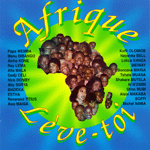
The Wake-Up! campaign used an entertaining, positive strategy to motivate listeners to take personal responsibility to prevent the spread of HIV/AIDS by protecting themselves. Inspired by 'We Are the World', the behaviour change communication (BCC) division of SFPS worked with Artistes Contre Le Sida (ACS) to produce the song that combines the talents of West and Central Africa's musicians. Participants included Papa Wemba, Koffi Olimide, Tshala Muana, Meiway, Aisha Kone, and Nayanka Bell - all of whom dedicated their time and contributed their talents to the project.
The song's tone is one of hope and resilience. Recorded in French and local African languages, the song's lyrics call on listeners to become aware of the risks of HIV/AIDS, to minimise those risks by taking specific actions (practicing fidelity, using condoms, knowing their HIV status), and to increase acceptance of and compassion for people living with HIV/AIDS (PLWA). The music draws on West and Central Africa's cultural heritage, with beats of the Congo providing the underlying rhythm.
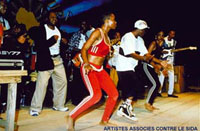
The campaign included a music video, seven TV and radio spots, and a "behind the scenes" magazine/documentary. The music video (click here to view it) shows scenes of the artists in the recording studio, demonstrators demanding better care for PLWA, street scenes of Abidjan, and highlights of the 10th International Conference on AIDS and STIs in Africa (ICASA), where the song had its debut. The TV and radio spots contain a key section of the song and testimonials edited from lengthier interviews with the artists. Since the spots were not scripted, the musicians can be heard speaking from their hearts about an issue that is near to many of them. Each spot addresses one of the Wake-Up! messages: promotion of condom use (three spots), mutual fidelity (one spot), importance of the well-being of PLWA (one spot), and importance of HIV testing/knowing one's status (two spots). Additional portions of the interviews with the musicians can be heard during the magazine programme, which gives viewers insight into the process of making the song as well as why the musicians chose to participate.
Copies of the music video, TV spots, and magazine programme were distributed to national television stations. While most stations chose to broadcast the video during music-related programming, some used it for transitions between programmes and before special programming events. The spots were often aired before the evening news or other prime time programming. During the broadcast of the All Africa Soccer Cup matches, which captures the attention of hundreds of thousands of viewers each year, sports fans were exposed to the Wake-Up! spots. In addition to these traditional forms of mass media, viewers in several of the SFPS countries saw the video at their local video clubs and cinema halls before the main feature was shown.
HIV/AIDS
Wake-Up! Africa was first heard on opening night of ICASA in Cote d'Ivoire, December 1997. Many of the participating artists traveled to Abidjan to perform in front of conference participants, including several African Heads of State and French President Jacques Chirac.
SFPS/BCC, United States Agency for International Development (USAID), Johns Hopkins University/Center for Communication Programs, Academy for Educational Development (AED), Artistes Contre Le Sida.
JHUCCP website on August 4 2005, June 29 2006, and September 8 2009; and email from Amelie Sow-Dia to The Communication Initiative on September 8 2009.
- Log in to post comments