










































Locating men in women's development: Regressive, benevolence, efficiency, welfare to rights
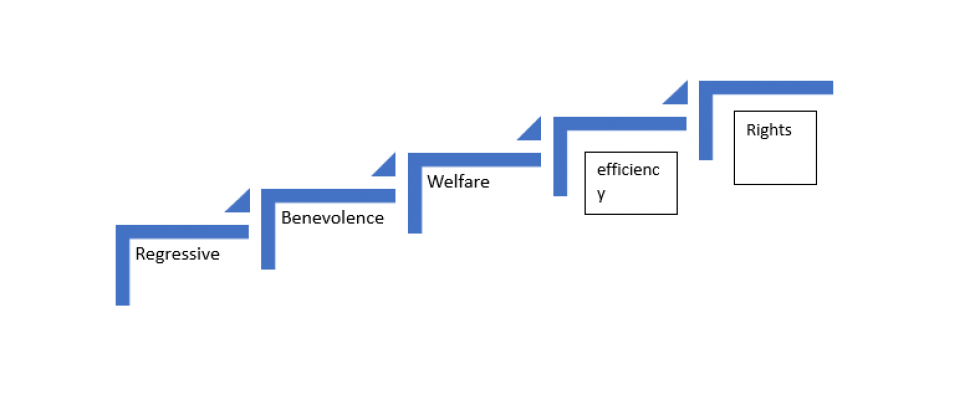
Author: Ranjani K. Murthy, January 11 2022 - While there has been considerable conceptualisation of approaches to women's development, there has been limited thinking on role of men in women's development. Men's role in women's development can be distinguished between the following: regressive, benevolence, efficiency, welfare and rights (see Figure 1, above).
In Afghanistan, women are banned by the Taliban government from traveling alone long distances without being accompanied by a male relative.1 Here, the government is pushing men to be part of the process of policing of women, which can be seen as a regressive move. In India, men on whom cases of dowry harassment and cruelty have been fielded by their wives or their families came together to successfully lobby in 2017 with the Supreme Court to modify Section 498A of the Indian Penal Code, which makes 'cruelty by husband or relatives of husband' a cognisable and non-bailable offence.2 However, the number of false cases was far less than the number of women denied justice. Again, this is a regressive role of men in women's development, this time unleashed by men's groups and the judiciary.
Post-independence, many south Asian governments targeted men as heads of households in poverty reduction programmes. The Integrated Rural Development Programme in India is an example, which gave loans with subsidy in the 1980s to heads of households, with the hope that benefits would trickle down to all household members in terms of improvement in food, nutrition and wellbeing. This approach can be seen as the "benevolence" positioning of men in women's development.
A variant of this approach is the "welfare" approach of men towards women's development. This approach is reflected in work globally with men (and mothers-in-law) on women's maternal health and safe delivery. Unlike the benevolent approach, where men earn for women, here they are to help pregnant and breastfeeding women with housework, to ensure they eat nutritious food and take rest, to take them for antenatal checkups, and to ensure they adopt family planning methods, etc. The involvement of men in maternal and child health (MCH) adopted by several agencies, including UNFPA, ties in with the welfare approach.3
The "efficiency" approach coincides with neo-liberal development, based on rolling back the state, expanding the market economy, and relying on growth in the tertiary and secondary sectors. Rural men leave for urban areas in search of work, and women are left behind in rural areas to engage in agriculture. Women are seen as having a comparative advantage in agriculture operations, with men at times return for harvesting and ploughing. In Ethiopia, land title deeds were given jointly in one province to aid women farmers' access to inputs. In India, this efficiency approach made migrants (majority men in India) vulnerable to COVID-19.
The rights approach to working with men on women's development entails facilitating dialogues with men and boys on their deep-rooted sense of hegemonic masculinities, which make them feel superior to women and girls - with rights to act violently when women and girls transgress norms.4 The rights-based approach entails men standing for rights of sisters, mothers, wives, and partners, and giving up some of their privilege at individual, interpersonal and collective levels. At the same time, men and boys do not act on behalf of women and girls, but with them, ensuring that women and girls are the leaders.
It is crucial that development agencies engage men in promoting women's rights, rather than adopt the regressive, benevolent or efficiency approach. The welfare approach can be adopted in emergencies and cannot be the dominant one. Sustainable Development Goal (SDG) 5 can only be reached when policies and programmes are evolved to engage men and boys with a perspective that promotes rights of women and girls. A global review of policies and programmes is called for.
1 BBC News, 27 December 2021, "Afghanistan's Taliban ban long-distance road trips for solo women". https://www.bbc.com/news/world-asia-59800113
2 Phophalia, Z, 2021, "No Automatic Arrest in Dowry Cases Until Allegations are Verified", LawQuest. https://www.lawquestinternational.com/no-automatic-arrest-in-dowry-case…
3 UNFPA, 11 July 2007, "It Takes Two: Men as Partners in Maternal Health". https://www.unfpa.org/news/it-takes-two-men-partners-maternal-health
4 Centre for Health and Social Justice (CHSJ), 2021, Draft: What Impact do Interventions with Men and Boys have on the prevention of Gender Based Violence: A Synthesis of Experiences from India. https://chsj.org/what-impact-do-interventions-with-men-and-boys-have-on…
As with all of the blogs posted on our website, the content above does not imply the endorsement of The CI or its Partners and is from the perspective of the writer alone. We do not check facts and strive to retain the writer's voice, as is detailed in our Editorial Policy.
- Log in to post comments