










































Modeling the Effect of Observational Social Learning on Parental Decision-making for Childhood Vaccination and Diseases Spread over Household Networks
"...demonstrate how certain levels of social learning about vaccination preferences can converge opinions, influencing vaccine uptake and ultimately disease spread..."
Social learning has been shown to play a vital role in people's decision-making. Social learning occurs through various channels of information exchange. Parents learn about the vaccination choices and attitudes of other parents and look for consensus as signals for vaccination decisions. When parents openly share their opinions about vaccinating their children, it can exert pressure on other parents. Incomplete information about vaccines, combined with the opinions of friends on social networks, can lead to challenges in vaccine acceptance, which can subsequently affect vaccine uptake and the spread of diseases. This paper introduces a model for parental decision-making about vaccinations against a childhood disease that spreads through household networks. The approach considers "socially bounded agents" - specifically, parents who promote their children's wellbeing - who have imperfect information regarding the vaccination choices of their neighbours in the network.
This model considers a bilayer network comprising two overlapping networks, which are either Erdős-Rényi (random) networks or Barabási-Albert networks. These different models of networks represent a range of real-life systems. The model also employs a Bayesian aggregation rule for observational social learning on a social network. This new model encompasses other decision models, such as voting and DeGroot models, as special cases.
Using this model, the paper explores the cascading effect of opinions on vaccination within the context of boundedly rational observational social learning, comparing findings to other models of social pressure. Furthermore, it examines how two different cultures of social learning affect the establishment of social norms of vaccination and the uptake of vaccines. In every scenario, the interplay between the dynamics of observational social learning and disease spread is influenced by the network's topology, along with vaccine safety and availability.
The paper finds that mixed populations, featuring two different cultures of sharing and perceiving opinions about vaccination, can greatly affect vaccine uptake. In a population where a fraction has a lower learning probability compared to the rest, the total uptake of vaccines may decrease, and the size of the epidemic may increase, compared to a homogeneous population with a consistent learning probability.
Thus, to effectively increase vaccine uptake, it is insufficient to only consider the degree of parental linkage in the information network to spread awareness. Enhanced efforts to promote social information exchange and social norm interventions are necessary to encourage prosocial vaccination decisions. According to the model, such efforts can lead to a consensus on vaccination opinions and increase vaccine uptake, even in scenarios with a significant presence of never-vaccinators and despite challenges related to vaccine safety and availability.
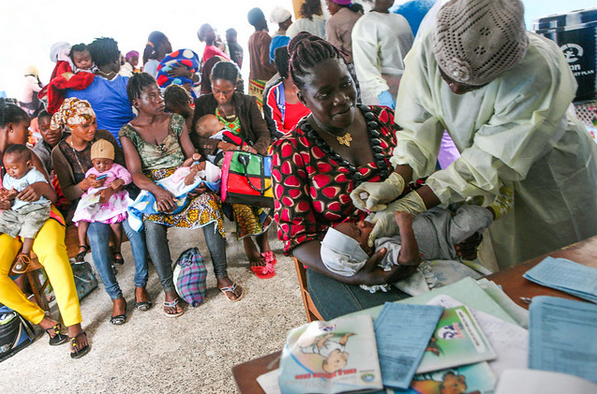
Frontiers in Epidemiology 3:1177752. doi: 10.3389/fepid.2023.1177752. Image credit: UNMEER/Aalok Kanani via Flickr (CC BY-ND 2.0 Deed)
- Log in to post comments