











































Research Makes the News: Strengthening Media Engagement with Research to Influence Policy
Panos London
This document from Panos London, funded by the United Kingdom Department for International Development (DFID), begins from the premise that: "If knowledge created by researchers is shared and debated publicly, it is more likely to be adopted by policymakers and practitioners." It assumes the stance that "media have the capacity to speak to policymakers, civil society, and the general public, and therefore have an important role to play in keeping debate and awareness of particular issues in the public domain. Research that supports existing debates can also bring evidence and corroborated facts to a debate where they might otherwise be absent."
Media involvement of research-into-policy can take the form of newspapers as information sources for policymakers, who may then present positions to government bodies and the public through speeches, radio, and television. They may use radio phone-in programmes to gauge opinion, or engage in public debate. This brief examines media capacity to generate public debate by using research to influence policy outcomes. "It provides insights on how to strengthen that capacity, drawing on commissioned case-study research from Uganda and Jamaica."
First, it provides a conceptual framework in which to interpret the findings from four case studies in which it reflects on media’s capacity to generate public debate using research to influence policy outcomes. The brief cites both evidence from the Overseas Development Institute (ODI)'s Research and Policy in Development (RAPID) programme and the case studies to support the fact that "the political and institutional context is the most important factor affecting how and why research is taken up by policymakers. Specifically, the findings indicate that more open democratic political systems generally better support evidence-based policy-making. ODI’s RAPID programme identifies two further areas that are important to understanding the linkages between research and policy. The first is the evidence itself, including the quality and packaging of the research for communication to different audiences. The second is the nature and strength of the linkages among all the different actors involved in the research-policy nexus, which includes but is not limited to policymakers, researchers, civil society activists and the media." The findings indicate that there is not a clear trajectory from research to policy outcomes or a single actor producing an outcome; but, rather, each of the actors and institutions has a role to play, and their relationships with each other are key to ensuring a successful outcome.
The case studies cover media treatment of research on: 1) working conditions of women in Jamaica; 2) early child development related to parenting and childcare in Jamaica; 3) the banning of plastic bags in Uganda; and 4) the fate of a protected forest in Uganda. The brief analyses the possible links between media coverage and government action. It finds that "the political and institutional context, including the degree of representativeness of government and the vibrancy of civil society, is important to understanding the capacity of the media to generate public debate around research and evidence, and to influence policy outcomes. The following factors strengthen the capacity of the media to do so:
- the capacity of journalists to use research to create stories that capture the public’s interest and are related to existing and emerging policy-making agendas
- the capacity of researchers to produce policy-relevant research and to work with intermediaries to present such research in a way that the media can use
- the capacity of civil society activists to pick up policy-related research and drive public debate around it
- the strength of the relationships among these actors - journalists, civil society activists and researchers - and their associated organisations, and the degree of openness and trust among them....The strength of existing relationships among journalists, researchers and civil society activists, and their associated organisations, is an important indicator of the likelihood of research being taken up and influencing policy...."
The final section provides conclusions and outlines some of the main implications of the briefing, including the main activities that need to be supported to increase the likelihood of research being taken up in policy processes:
- "support of relationship-building and strengthening of trust among researchers, journalists and civil society activists;
- creation of the conditions for stronger institutional linkages and networks to develop among researchers, civil society and policymakers;
- development of journalists' capacity to report on research findings, and their capacity to work more closely with civil society who can act as mediators with policymakers and researchers;
- development of researchers' capacity to work more closely with the media, and with civil society advocates who can promote their work to the media and to policymakers."
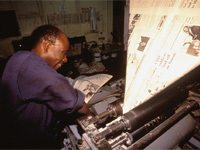
Email from Christoph Dietz to The Communication Initiative on July 30 2010. Image source: Trygve Bølstad - Panos Pictures
- Log in to post comments