











































Soap Operas for Social Change to Prevent HIV/AIDS: A Training Guide for Journalists and Media Personnel
Image
SummaryText
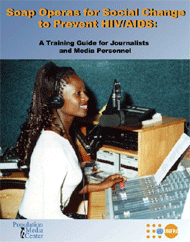
This guide is designed to be used by journalists and media personnel to plan and execute the production and broadcast of entertainment-education serial dramas for HIV prevention. It focuses on the social-content (educational) portion of such programmes and describes strategies that can overcome cultural and informational barriers to accessing health services. The guide provides a detailed explanation of a methodology, created by Miguel Sabido, to reach and change the behaviour of large numbers of people. It takes a step-by-step approach, from research through monitoring and evaluation. An appendix describes the theoretical underpinnings of the Sabido methodology.
From the preface by Miguel Sabido:
"The entertainment element should account for about 70 percent of the story. The methodology I created (which has become known as the “Sabido methodology”) uses two of three sub-plots in a long-running serial drama to create entertainment - through changes of fortune, use of a range of human emotions, cliffhangers, compellingly well-written drama, strong acting, realistic productions, and the appropriate "tone" of the drama. The story can be boy-meets-girl, or rags-to-riches (or whatever the producer and the scriptwriters agree upon). The other 30 percent should be devoted to the “third plot” with the social content and the role models for the behavior we are trying to teach/reinforce. This training guide is intended to focus on this part of a program’s design. The guide is based on the assumption that the writers know what they are doing - i.e., that they have received previous training in drama and have experience in writing melodrama. Writing is important, but so is professional directing and production, acting, use of music, sound effects and lighting, and other elements that go into making a program interesting to the audience. The audience has to be captivated through a very intensive and emotional tone."
The document includes journalistic guidelines on mainstreaming gender and HIV/AIDS in the news, useful HIV/AIDS terminology, and guidelines on language for HIV/AIDS reporting, as well as the following information and steps on the Sabido system of writing for entertainment-education:
How the Sabido Methodology differs from other forms of Entertainment-Education Steps in the Development of a Sabido-Style Drama: Step One - Formative Research Step Two - The Issues List, Moral Framework and Values Grid Step Three - Advisory Committee and Technical Review Committee Step Four - Training of Producer and Scriptwriters Step Five - Pre-Testing of Pilot Episodes Step Six - Writing and Production Step Seven - Monitoring Step Eight - Summative Research (Impact Evaluation) Theories Underlying the Sabido Methodology
From the preface by Miguel Sabido:
"The entertainment element should account for about 70 percent of the story. The methodology I created (which has become known as the “Sabido methodology”) uses two of three sub-plots in a long-running serial drama to create entertainment - through changes of fortune, use of a range of human emotions, cliffhangers, compellingly well-written drama, strong acting, realistic productions, and the appropriate "tone" of the drama. The story can be boy-meets-girl, or rags-to-riches (or whatever the producer and the scriptwriters agree upon). The other 30 percent should be devoted to the “third plot” with the social content and the role models for the behavior we are trying to teach/reinforce. This training guide is intended to focus on this part of a program’s design. The guide is based on the assumption that the writers know what they are doing - i.e., that they have received previous training in drama and have experience in writing melodrama. Writing is important, but so is professional directing and production, acting, use of music, sound effects and lighting, and other elements that go into making a program interesting to the audience. The audience has to be captivated through a very intensive and emotional tone."
The document includes journalistic guidelines on mainstreaming gender and HIV/AIDS in the news, useful HIV/AIDS terminology, and guidelines on language for HIV/AIDS reporting, as well as the following information and steps on the Sabido system of writing for entertainment-education:
How the Sabido Methodology differs from other forms of Entertainment-Education Steps in the Development of a Sabido-Style Drama: Step One - Formative Research Step Two - The Issues List, Moral Framework and Values Grid Step Three - Advisory Committee and Technical Review Committee Step Four - Training of Producer and Scriptwriters Step Five - Pre-Testing of Pilot Episodes Step Six - Writing and Production Step Seven - Monitoring Step Eight - Summative Research (Impact Evaluation) Theories Underlying the Sabido Methodology
Publishers
Publication Date
Languages
English, French, and Spanish
Number of Pages
88
Source

- Log in to post comments