










































Aao Baat Kare [Come Let's Talk]
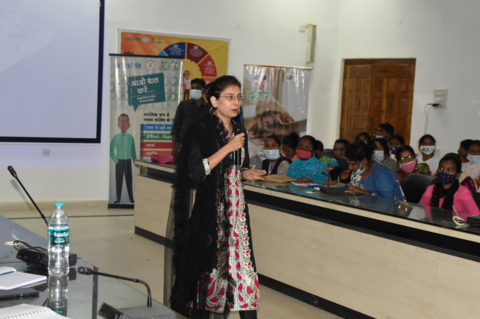
"Mental health: We have heard of it; we want to know about it. The trouble is nobody wants to talk about it. And that makes everything worse." - young Aao Baat Kare volunteer Jyoti, from Jagdalpur
"Aao Baat Kare" [Come Let's Talk] is a community-based awareness programme on mental health and wellbeing of children and adolescents that is being carried out in Chhattisgarh state, east-central India. The civil society organisation (CSO) Chhattisgarh Agricon Samiti (CAS), which has been working to promote sustainable development in Chhattisgarh since 2007, has partnered with the United Nations Children's Fund (UNICEF) India for this initiative, with the goal of fostering collective action to give mental health a voice and to catalyse change.
Community participation is at the heart of this initiative to get people talking about mental health in Chhattisgarh, a landlocked and heavily forested state with a population of about 30 million, of which more than 30% belong to Scheduled Tribes. The programme is being implemented in 4 districts: 3 blocks of Bijapur, 3 blocks of Bilaspur, 4 blocks of Kondagaon, and 7 blocks of Jagdalpur. The rural areas of Chhattisgarh state are governed under Panchayati Raj, a system of local self-government of villages in India. Every village has a village council or gram panchayat that acts as the cabinet of the village. 50 gram panchayats were identified from each block for carrying out awareness on mental health. Community volunteers were identified from the local population, self-help groups, and health workers; more than 2,000 volunteers were actively engaged in the initiative as of December 2021.
The first phase of the project implementation began in 20 gram panchayats from each block. Trainings were conducted periodically with Mitanins (female health volunteers), Anganwadi (early childhood care centre) workers, youth groups, school students, and teachers on basic modules of mental health. People who were motivated to work for development of their own village registered using a volunteer registration link and QR code.
These personnel led mental health workshops, awareness meetings, and discussion sessions on community mental health of all age groups. An audience comprised of volunteers, schoolteachers, villagers, and community workers participated in the workshops, where they were told about the steps required to take care of mental health and how doing so can help build a better society. The gatherings featured various playful activities like Bollywood dancing and stress-buster red balloon activities. They were structured around a 2-day training module that was outlined in a toolkit and disseminated in the workshops. (Click here in order to download the module in Hindi [42 pages, PDF].) The sessions cover various aspects of mental health, such as:
- What is mental health?
- Psychosocial disability
- Biomedical model and psychosocial model on mental health
- Pregnancy and mental health
- Children and mental health
- Adolescents and mental health
The emphasis is not only on learning and talking but on taking action. For example, in one session, a mental health counsellor from Bilaspur explained how an expectant mother can struggle with mental health problems during pregnancy and the role her husband and family can play in providing support.
The programme also uses the power and reach of social media to spread awareness and bring about change. A mental health helpline through WhatsApp Chatbot was launched to help the people in need. "Generally, people are not comfortable in sharing their problems if the problem is related to mental health but through this number, they will be able to ask for help," in the words of Manisha Motwani, a senior executive of CAS. A person can text "HELP" to the WhatsApp number, and they will receive a message in which they can select options in terms of what kind of information they need/desire.
Mental Health, Youth
According to organisers, creating an understanding of mental health amongst the community was not easy. Danish Khatoon Hussain, Programme Coordinator (Mental Health) of CAS says, "I told people that mental health is how you think, feel, behave in your day-to-day life, how you react to problems, how you cope with them. If you are mentally healthy, you will be able to help others, you will be able to do work well and live a happy and balanced life. People said that they used to think of mental health as a mental illness, but now they have understood the difference between mental health and mental illness."
Manas Bannerjee, Secretary of CAS, says, "We provided youth with this opportunity and resources. Today they are working towards a change in the form of volunteers." Gokul Mandavi is a young volunteer from a farmer family who finished his secondary schooling and decided to work as a volunteer on mental health. He believes that this decision proved to be a turning point in his life: "After my training, there have been a lot of changes in me. I donate my time to make people aware on mental health. I will help to connect the youth of my village along with me so that everyone can become aware and solve issues like domestic violence, unemployment, stress, suicide in our community."
Email from Sumita Thapar to The Communication Initiative on February 22 2022; and CAS on Facebook, February 22 2022. Image caption/credit: Programme coordinator Danish Khatoon discusses mental health with participants of the 2-day workshop (Aao Baat Kare), Bijapur, December 2021. UNICEF India
- Log in to post comments