










































Assessment of Risk Factors Associated with Oral Polio Vaccine Refusal in Rahim Yar Khan District, Pakistan (2017)
National Institute of Health (Chaudhry); Pakistan Health Research Council (Javed); Field Epidemiology and Laboratory Training Program (Wattoo)
Addressing refusal of oral polio vaccine (OPV) has become more challenging because of several myths circulating in Pakistan, which is one of the remaining polio-endemic countries (along with Afghanistan). Other challenges include security issues, difficulty in accessing hard-to-reach areas, and killing of frontline polio workers. The January 2017 National Immunisation Days (NIDs) programme suggested that a significant number of children were observed in the OPV refusal category in Rahim Yar Khan (RYK) district, which is located in Central Pakistan at the border of Sindh and Punjab provinces. This study aimed to determine the risk factors associated with OPV refusal in RYK.
The researchers conducted a 2-month (February and March 2017) case-control study among the 110 children who were recorded in the OPV refusal category during the January 2017 NIDs in RYK. The age- and sex-matched controls (1:1) were obtained from the same locality. Ratios were calculated, and odds ratios (ORs) were determined at 95% confidence interval (CI) and p < 0.05.
Selected findings:
- All age groups (aged 0-59 months) were affected by OPV refusal, and there was no significant variation among male and female children.
- Repeated campaigns (n = 91, 82.7%) were the major reason for OPV refusal, followed by fear of the side effects of OPV (n = 12, 10.9%) and the misconception that OPV includes contents that are haram (forbidden by Islamic law) (7, 6.3%).
- In the language and religion categories, OPV-refusing children were observed in all communities in accordance with the general population. Hence, it is relatively certain that the high-risk groups are not limited to certain languages or religions.
- The majority of the OPV-refusing children were observed in urban areas (74, or 67.2%), suggesting a new paradigm shift from the rural to the urban communities and a mixed pattern in ethnicity. ("Considering these facts, investigating new high-risk groups to establish targeted and successful efforts is required.")
- Living at a distance (more than 1 km) from a healthcare facility was significantly associated (OR, 2.5; 95% CI, 1.4-4.4; p < 0.05) with OPV refusal.
- Awareness about an upcoming door-to-door polio campaign (OR, 0.59; 95% CI, 0.34-1.03; p > 0.05) and routine immunisation status of children (OR, 0.96; 95% CI, 0.56-1.64; p > 0.05) were not significantly associated with OPV refusal.
- 33.7% of refusal statuses were converted after repeated counseling (more than 3 visits by healthcare workers) after the third day of the campaign, and 73 (66.3%) refusal statuses were converted following the district government officials' intervention.
Regarding the central finding - that the most common reason for OPV refusal was the repeated campaigns proposed in the National Emergency Action Plan (NEAP) - the researchers explain that having children vaccinated every month but still not totally eradicating polio can be exhausting (for both healthcare workers and parents) and raises resistance in communities. With repeated campaigns, pre-campaign preparation is short, resulting in poor communication and doubts about vaccine efficacy and the usefulness of repeated campaigns.
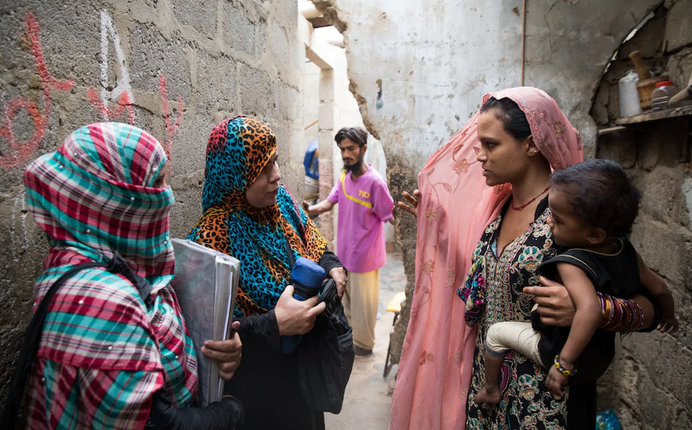
Thus, the researchers recommend door-to-door social mobilisation visits by healthcare workers - preferably, those from the community itself - to alleviate fear, misconceptions, and campaign fatigue. What is needed, they say, is the provision of timely and complete information to educate the parents about OPV and to answer their questions about the repeated rounds. "Therefore, frontline workers' knowledge and attitude are vital in addressing the parents' concerns...[S]ufficient time should be spent to address these issues through information, education, and communication..."
In light of the fact that mothers play a central role in their children's health, a final recommendation is that "Empowering and educating mothers to decide about their children's vaccination will help overcome vaccine hesitancy and refusal issues."
Journal of Biosafety and Biosecurity https://doi.org/10.1016/j.jobb.2020.02.003. Image credit: Insiya Syed
- Log in to post comments