

























Development action with informed and engaged societies

After nearly 28 years, The Communication Initiative (The CI) Global is entering a new chapter. 

Following a period of transition, the global website has been transferred to the University of the Witwatersrand (Wits) in South Africa, where it will be administered by the Social and Behaviour Change Communication Division. Wits' commitment to social change and justice makes it a trusted steward for The CI's legacy and future. 

On the transfer, co-founder Victoria Martin expressed her pleasure to see this work continue under Wits' leadership, knowing that co-founder Warren Feek (1953–2024) would have felt deep pride in The CI Global's Africa-led direction. 

As Wits, we honour the team and partners who sustained The CI for decades and look forward building from that strong base. This includes co-founders Warren Feek (1953-2024) and Victoria Martin as well as La Iniciativa de Comunicación (CILA), which continues independently at lainiciativadecomunicacion.com with links to The CI Global site. We are also eager to forge new partnerships and entertain new ideas as we consider how best to contribute to social and behaviour change in our rapidly evolving environment.

If you are joining the International Social and Behaviour Change Communication (SBCC) Summit in Panama, please join Wits and CILA on Monday, 22 June, to share your thoughts and suggestion for the relaunch of the Communication Initiative. We will be in Pacifica 5 from 12-1:25 for the Refuel, Reflect, and Renew Lunch Series: The Communication Initiative: celebrating a driving force for Communication for Social Change and the way forward. We will reflect on the legacy of Warren Feek and family in creating the Communication Initiative, consider the contributions of CI over the years and then turn our attention towards the future in this dynamic session. 

If you are unable to join us in Panama, we still want to hear from you. Please contribute your thoughts by following this link: https://redcap.link/CommunicationInitiative2026 or reaching out to ci_surveys@commint.com

You can also follow the QR Code:

 https://redcap.link/CommunicationInitiative2026

Time to read
1 minute
Read so far

Bakkar

0 comments
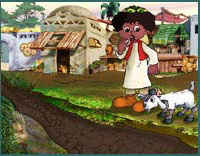
Bakaar is an Egyptian cartoon series which aims to incorporate environmental issues and values into its programming in order to increase environmental awareness among children in Egypt. The Academy for Educational Development (AED)'s Center for Environmental Strategies entered into a public-private alliance with Cairo Cartoon, a private animation studio, to promote sustainable development of the coastlines and protectorates of the Egyptian Red Sea through the cartoon series. This initiative forms part of the wider GreenCOM project which was run by AED.
Communication Strategies

"Bakkar", which according to the organisers was the first Egyptian cartoon to be broadcast on television, revolves around the adventures of a young Nubian boy called Bakkar. The series, which airs every evening during the 30 days of Ramadan, is said to draw 40 million viewers - two-thirds of the population of Egypt - including adults and children.

For three years, the AED Center for Environmental Strategies collaborated with the show’s producers to create two environmentally-themed episodes each year. In these episodes Bakkar encounters and deals with situations in a way that reinforces environmentally responsible behaviours. For example, one episode features Bakkar plotting the rescue of endangered animals from a greedy villain, with the purpose of exposing children to the negative effects of collecting marine life, fishing, and digging in protectorates.

The episodes also promoted some of the Center’s other initiatives in Egypt, such as the communications and training programme to increase the enforcement capacity of the Red Sea Rangers, a coast guard-like corps within the Egyptian Environmental Affairs Agency that monitors compliance with mooring and waste-disposal regulations.

Development Issues

Environment.

Key Points

Audience research conducted in late 2003 illustrated the show’s ability to communicate important environmental concepts to children between the ages of 7 to 11. An independent evaluation found that before the broadcast, none of the children surveyed were familiar with the Red Sea protectorates and only 2% had heard of the Red Sea Rangers. After the special episodes were aired, however, the percentages increased: 45% of the children knew about the protectorates and 42% understood the role of the Red Sea Rangers. In addition, their awareness of Red Sea coral and marine life also increased significantly.

GreenCOM also trained 150 teachers at 60 schools in the Red Sea area to increase knowledge and understanding of basic environmental issues, and how to incorporate them into their classrooms.

In partnership with the Egyptian Government, the Center distributed environmental education materials to 1,000 secondary industrial, hotel, and agriculture technical schools. The Ministry of Education subsequently trained 2,000 technical school teachers on environmental education.

Partners

Academy for Educational Development (AED)'s Center for Environmental Strategies, Cairo Cartoon, GreenCOM

Sources

AED website on August 12 2008 and October 21 2009.
Teaser Image
http://www.comminit.com/files/bakaar2.gif