










































Behavioural Determinants of COVID-19-Vaccine Acceptance in Rural Areas of Six Lower- and Middle-Income Countries
World Vision International (Davis, Yimam, Kanwagi, Bauler, Kulathungam); Helen Keller International (Kalam); World Vision Canada (Tolossa); London School of Hygiene and Tropical Medicine (Larson)
"[U]nveiling the underlying key social and behavioural determinants is a cornerstone in promoting COVID-19 vaccination."
Vaccine hesitancy toward or refusal of COVID-19 vaccines is a worldwide concern. Assessing how different behavioural attributes affect individual preferences about vaccination at a granular level is considered a critical step in understanding the barriers that contribute to vaccine refusal and designing activities and messages to promote vaccine uptake. This study identifies the behavioural determinants of COVID-19 vaccines in the rural areas of six lower- and middle-income countries (LMICs), which could help communication practitioners create culturally specific and contextual social and behaviour change (SBC) strategies to increase COVID-19 vaccine acceptance.
The barrier analysis (BA) was conducted in different rural areas of Bangladesh, India, Myanmar, Kenya, Tanzania, and the Democratic Republic of the Congo (DRC) from December 7-16 2020 to identify behavioural determinants of COVID-19-vaccine acceptance. Unlike most other BA studies, this study focuses on an intended rather than a currently practiced behaviour (since COVID-19 vaccines were not yet available in most study areas when data were collected).
A key feature of the BA is that responses from those doing a behaviour ("Doers" or "Acceptors") are compared with responses from those who are not ("Non-doers" or "Non-acceptors") so that the most important behavioural determinants can be identified. In all six countries, at least 45 interviews with those who intended to get the vaccine ("Acceptors") and another 45 or more interviews with those who did not ("Non-acceptors") were conducted, totalling 542 interviews. Data analysis was performed to find statistically significant (p < 0.05) differences between Acceptors and Non-acceptors of COVID-19 vaccines and to identify which beliefs were most highly associated with acceptance and non-acceptance of vaccination based on the estimated relative risk (ERR).
The results indicate that a "high" level of association (ERR or its reciprocal = 4.0-7.9) on responses regarding eleven of the behavioural determinants was found across the surveyed countries. Here are selected findings:
- Perceived social norms - "The study showed that close family members, friends, religious leaders, and political and social leaders are key in influencing people's decision to get a COVID-19 vaccine. A strong majority of Acceptors believed that most of their close family and friends would get a COVID-19 vaccine in Bangladesh (100%), Myanmar (100%), Kenya (91%), Tanzania (62%), and India (62%), whereas Non-acceptors were much less likely to believe that (38%, 84%, 36%, 0%, and 22%, respectively). Acceptors were also more likely to say that most of their community leaders and religious leaders want them to get a COVID-19 vaccine in four of the five countries (all but the DRC) where it was assessed. In four of the five countries where it was assessed, Acceptors were also more likely to say they would get a COVID-19 vaccine if a health worker recommended it."
- Trust in COVID-19 vaccines - Acceptors were more likely to say that they trust the COVID-19 vaccines "a lot" or "a moderate amount" in four of the five countries where this matter was assessed. The correlation between lack of trust in the vaccine and being a Non-acceptor was very high, especially in Kenya (ERR = 17.9) and Tanzania (ERR > 12).
- Perceived action efficacy of COVID-19 vaccines (i.e., does a respondent think the vaccine will work as intended to protect him or her from COVID-19) - Acceptors were more likely to say they would not be likely at all to get COVID-19 disease after vaccination in Bangladesh, Kenya, and Tanzania. Conversely, Non-acceptors were more likely to say they would be somewhat or very likely to get COVID-19 even after they were vaccinated in Bangladesh and the DRC.
- Safety of COVID-19 vaccines - Acceptors in five countries (except India) were more likely to say that the vaccines are "very safe" or "mostly safe". Non-acceptors in all five countries were more likely to say that COVID-19 vaccines are "not safe at all".
- Trust in sources of information on the safety of COVID-19 vaccines - Acceptors in five of the six countries (except India) were more likely to say: (i) they would have a very or somewhat high level of trust in the information government representatives and politicians provide on the safety and effectiveness of COVID-19 vaccines, and (ii) they would have a very or somewhat-high level of trust in the information religious leaders provide on the safety and effectiveness of COVID-19 vaccines.
- Perceived positive and negative consequences (advantages and disadvantages) of getting a COVID-19 vaccine - For example, Acceptors were more likely to cite prevention of COVID-19 as an advantage in five of the six countries. Non-acceptors were more likely to say there were no advantages in four of the six countries (all but Kenya and Myanmar).
- Perceived susceptibility of getting COVID-19 - In Bangladesh, India, and the DRC, Acceptors were found to be more likely to believe that more people have had COVID-19. When asked about the likelihood of someone in their household getting COVID-19 over the next three months, Acceptors in Bangladesh, India, the DRC, and Tanzania were more likely to say the likelihood was very or somewhat likely.
- Perceived severity of COVID-19 - Acceptors were more likely to believe that it would be very serious if they or someone in their household contracted COVID-19 in four of the six countries (Bangladesh, Kenya, the DRC, and Tanzania); conversely, Non-acceptors in India were more likely to believe that COVID-19 was not serious at all.
- Perceived access to COVID-19 vaccines - For example, in Bangladesh, India, Myanmar, and Tanzania, Acceptors were more likely to say they believe vaccines would be available 30 minutes from their home.
- Perceived self-efficacy (what might make it easier to get a COVID-19 vaccine) - Acceptors were more likely to mention providing the vaccine close to their homes (India); providing it through satellite clinics, primary healthcare sub-centres, and health facilities and avoiding stockouts (Bangladesh, India and Myanmar, and Kenya, respectively); using convincing and clear information on the vaccines and their effects (the DRC); and knowing that COVID-19 is dangerous and offering the vaccine free of charge (Tanzania).
- Perceived divine will - Acceptors from five of the six countries (except India) were more likely to believe that a deity (God, Allah, or the gods) approves of getting a COVID-19 vaccine. Respondents were also asked whether or not they agreed with the statement, "Whether I get COVID-19 or not is purely a matter of God's will or chance - the actions I take will have little bearing on whether or not I get COVID-19." Findings for this question varied by country.
The study revealed a "very high" association (ERR or 1/ERR of 8.0 or greater) between responses regarding eight of those determinants in Bangladesh, Kenya, Tanzania, and the DRC: perceived social norms, perceived positive consequences, perceived negative consequences, perceived risk of getting COVID-19, perceived severity of COVID-19, trust in COVID-19 vaccines, expected access to vaccines, and perceived safety of COVID-19 vaccines. Additional behavioural determinants found to be significant in Myanmar and India were perceived self-efficacy, trust in COVID-19 information provided by leaders, perceived divine will, and perceived action efficacy of the COVID-19 vaccines.
Specific SBC recommendations can be gleaned from the study's findings. For example, with regard to the first item in the list above, on social norms, it will be important that people see or hear that most people around them are planning to get vaccinated as the vaccines are made available to more and more people in these countries. In addition, accurate and reliable information on the safety and effectiveness of COVID-19 vaccines will need to be made available through a variety of trusted channels and leaders to increase COVID-19-vaccine acceptance.
The researchers also reinforce the importance of community mobilisation for vaccine acceptance, suggesting that "[n]ational and local plans for COVID-19 vaccination should include the participation of community and faith leaders, health workers (including community health workers), and others to mobilize communities for COVID-19 prevention, case detection, and referral, including promotion of COVID-19 vaccination. It is crucial to empower these leaders with trustworthy information on COVID-19 and the safety and effectiveness of COVID-19 vaccines, but also on the probable and varied behavioural determinants of COVID-19 vaccination in their area....Tools and resources for these leaders and workers should be contextualized using data on the determinants of vaccine hesitancy in a given area or country."
In conclusion, this study has identified many behavioural determinants associated with vaccine acceptance in select LMICs that the researchers say "need to be regularly explored through formative research to understand better which messages and activities should be used to counter vaccine hesitancy and refusal. These determinants can vary from country to country, and from phase to phase of a pandemic, but certain ones (e.g., perceived social norms, perceived severity of COVID-19, and perceived divine will) may be reliably found to be important in many countries."
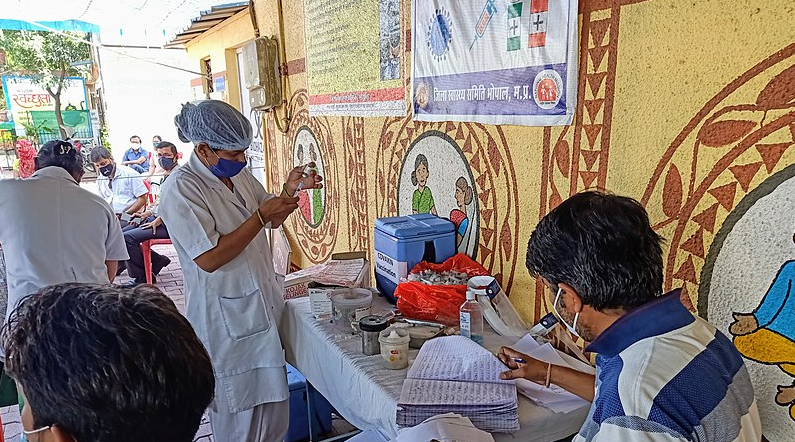
Vaccines 2022, 10(2), 214; https://doi.org/10.3390/vaccines10020214. Image credit: Suyash Dwivedi via Wikimedia (CC BY-SA 4.0)
- Log in to post comments