










































Bus School Project

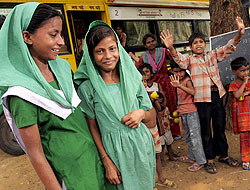
Equipped with a TV screen, books, puzzles, and toys, the bus travels to four slums every morning. The teacher guides students as they play games, read books, and study math and English.
The parents first have to be encouraged to let their kids join the Bus Schools. Community mobilisers go into the slums to identify children who should be at school and talk to the parents. Reportedly, it takes time to build their trust; parents often need the children to look after younger siblings, perform household chores, or help them at work. Also, their experience of the school back in the village has often been unsatisfactory (absentee teachers, dingy classrooms, uninspired teaching, etc.). "I have to reassure them that their kids will actually learn the skills they need," said one mobiliser. "Another powerful incentive is that the books are free and the children get a piece of fruit every day."
Education.
In April 2006, the UK Government committed to spend £8.5 billion over 10 years in support of efforts by economically poor countries in Africa and Asia to achieve the education targets of the Millennium Development Goals (MDGs) by 2015.
India passed the Right to Education Bill in August 2009, promising primary education to children between 6-14, but obstacles in the way of implementing the policy exist. Children invariably migrate to big cities with their parents to escape rural poverty, and end up living in slums. The parents find work as day labourers on construction sites and usually try to enrol their children at the nearest school. But the admissions procedure can be daunting for those illiterate parents who are unable to make sense of the paperwork. Also, without an education themselves, they may not see the benefits school can bring.
More than 400 of the hardest-to-reach children have been reached by the Bus School project so far, with 200 going on to join formal primary schools. With DFID support, the Indian government plans to increase the number of Delhi bus schools to 25 - providing an education for an estimated 5,000 more children a year.
DFID, Salaam Baalak Trust, Indian government.
Email from DFID to The Communication Initiative on September 3 2009; and DFID website, accessed on September 22 2009. Image(s) credit: Department for International Development / Nick Cunard

- Log in to post comments