










































Can a Radio Series Change Attitudes and Norms on Violence Against Women?
Oxfam Novib
"...impact is likely produced through engaging in the discussions...rather than exposure to the series alone..."
In 2015, Oxfam Novib's impact measurement unit conducted a rigorous (randomised) evaluation of an edutainment pilot project aiming to change attitudes, norms, and behaviour related to violence against women and girls (VAWG) in Tunisia. A 2006 study found that almost half of women in Tunisia have experienced at least one form of violence in their lifetime, of whom 41.2% experienced physical violence and 75.4% harassment in the public space.
Produced by Womanity Foundation, "Worth 100 Men" ("Be 100 Ragl") is an Egyptian radio series that follows Noha, an Egyptian female journalist who embodies a strong empowered woman encountering and tackling typical issues faced by women in the Arab world. At work, she faces discrimination and harassment. At home, her sister is in a violent relationship and her parents don't appreciate her focus on her career. (Please see Related Summaries, below, for more on the initiative and additional ways to learn about it online.)
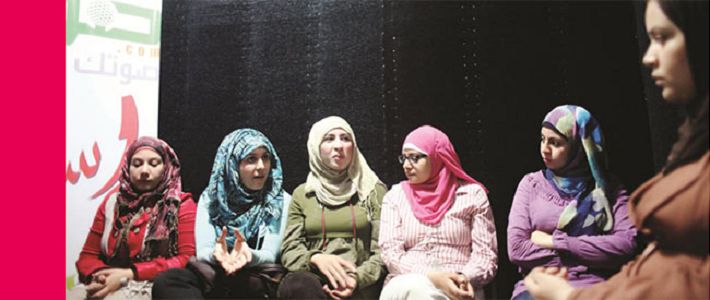
The pilot and impact assessment aimed to investigate whether active participation in listening groups and debates could successfully increase knowledge and change attitudes and perceptions of social norms with regards to women's empowerment and VAWG in Tunisia. Oxfam and Tunisian partners identified 389 project participants within their local communities, who were randomised into target and control groups. A baseline and endline survey was conducted with all groups, and the quantitative data was supplemented by the collection of 20 in-depth interviews using the "Most Significant Change" methodology.
After listening to episodes, project participants engaged in a debate on the topics covered by the series. Participants were from different social backgrounds: trade unionists, unemployed, students, and those coming from marginalised neighbourhoods. Some had been previously exposed to Oxfam partners' women's rights work, while others were approached for the first time. Participants listened to a total of 30 episodes of around 8 minutes each, over a period of 6 to 10 weeks.
The evaluation finds evidence of impact on:
- Awareness: Following the series, participants were more likely to report personally knowing someone who had suffered from violence. (Among the intervention group, there was a rise from 2.7 to 3.1 from baseline to endline, as compared to a decrease from 2.6 to 2.4 in the control group.)
- Attitudes: After having listened to the series, participants were less likely to justify violence against women. (Among the intervention group, there was a decrease from 1.7 to 1.1, as compared to a decrease of only 1.6 to 1.5 in the control group.)
- Intention to take action: Following the series, participants were more likely to intend to advise others who suffer from violence to speak out. (Among the intervention group, there was a rise from 2.6 to 4.5, as compared to a rise of only 2.6 to 2.8 in the control group.)
There was no difference in impact between men and women.
No impact was found on attitudes that justify women staying in violent relationships, or on changes in perceptions of social norms, such as how participants think others in their community think about violent relationships or the way participants thought about the role of women in society. This may have been due to the short implementation span of the project, or that the project did not link up with a wider campaign in society.
Survey results showed that both men and women liked the series and discussions and identified with the main characters. Evidence from the in-depth interviews indicated that impact is likely produced through engaging in the discussions, where participants critically reflect and attitudes are challenged, rather than exposure to the series alone. This suggests that scale-up should not focus exclusively on national broadcasts but also on social mobilisation.
Another mechanism seems to be the participants' increasing confidence and motivation to discuss issues and have an opinion on them. Facilitators of listening sessions should therefore first work on building self-confidence amongst participants to enable them to participate fully in the debates. In-depth interviews also showed that participants who felt more confident were even more likely to discuss the issues with friends and family, which indicates the potential for spill-over effects.
There was evidence that despite the Egyptian dialect and context of the series, many listeners in Tunisia appreciated the character of Noha. Many identified with Noha and used her experiences to make up their own minds on specific issues, even though the series was not adapted to the local context. Savings could be made by using the same Arabic language products throughout the region. However, even more impact could potentially be achieved with either a regional series produced with the intention of broadcasting throughout the region, or a locally-produced contextualised series.
In conclusion, the evaluation produced some evidence that listening to an edutainment radio show and engaging in a debate on its topics can have impact on knowledge, attitudes, and intentions to take action on violence against women and girls. Changes are likely produced by active participation in the debates following listening to the series, rather than just listening. Edutainment programmes should therefore include social mobilisation components, rather than expect widespread changes through broadcasting on the radio alone.
Email from Valentina Di Felice to The Communication Initiative on July 15 2016; and "Can a Radio Series Change Attitudes and Norms on Violence Against Women?", blog by Caroline Hodges, May 18 2016 - accessed on July 15 2016. Image credit: © Myriam Abdelaziz/Oxfam Novib
- Log in to post comments