
























Development action with informed and engaged societies

After nearly 28 years, The Communication Initiative (The CI) Global is entering a new chapter. 

Following a period of transition, the global website has been transferred to the University of the Witwatersrand (Wits) in South Africa, where it will be administered by the Social and Behaviour Change Communication Division. Wits' commitment to social change and justice makes it a trusted steward for The CI's legacy and future. 

On the transfer, co-founder Victoria Martin expressed her pleasure to see this work continue under Wits' leadership, knowing that co-founder Warren Feek (1953–2024) would have felt deep pride in The CI Global's Africa-led direction. 

As Wits, we honour the team and partners who sustained The CI for decades and look forward building from that strong base. This includes co-founders Warren Feek (1953-2024) and Victoria Martin as well as La Iniciativa de Comunicación (CILA), which continues independently at lainiciativadecomunicacion.com with links to The CI Global site. We are also eager to forge new partnerships and entertain new ideas as we consider how best to contribute to social and behaviour change in our rapidly evolving environment.

If you are joining the International Social and Behaviour Change Communication (SBCC) Summit in Panama, please join Wits and CILA on Monday, 22 June, to share your thoughts and suggestion for the relaunch of the Communication Initiative. We will be in Pacifica 5 from 12-1:25 for the Refuel, Reflect, and Renew Lunch Series: The Communication Initiative: celebrating a driving force for Communication for Social Change and the way forward. We will reflect on the legacy of Warren Feek and family in creating the Communication Initiative, consider the contributions of CI over the years and then turn our attention towards the future in this dynamic session. 

If you are unable to join us in Panama, we still want to hear from you. Please contribute your thoughts by following this link: https://redcap.link/CommunicationInitiative2026 or reaching out to ci_surveys@commint.com

You can also follow the QR Code:

 https://redcap.link/CommunicationInitiative2026

Time to read
1 minute
Read so far

Caravan of Hope

0 comments
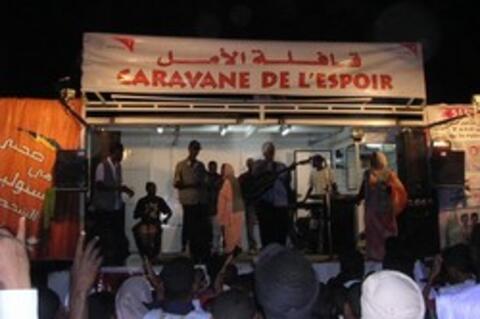
Caravan of Hope is a road show theatre project that travels through Mauritania raising awareness and delivering information about HIV/AIDS and other health issues. Nedwa, the Mauritanian organisation implementing the project, hopes the tour will trigger dialogue about the pandemic across the Mauritanian countryside and help break down taboos about HIV/AIDS.
Communication Strategies

The Caravan of Hope team aims to communicate life-saving lessons about issues such as child health, malaria prevention, and HIV/AIDS awareness through entertainment-education. The mobile theatre travels in a truck equipped with a sound system and a giant screen. It serves as the vessel for a show featuring music, locally produced short fiction movies, and sketches by entertainers from SOS Peer Educators of Nouakchott. These entertainers, who usually number 25 on board the truck, speak local languages in order to reach a wider audience. Every night there is a performance that addresses different issues related to HIV/AIDS, such as abstinence, fidelity, responsibility, and condom use. During the day, a car equipped with a loud speaker cruises the streets to announce the evening show. By evening, a crowd gathers to watch the event, sitting on the ground or standing and clapping their hands.

After every show, the project organisers assess the public's reaction to find out what interests them. "Priorities and interests are different depending on populations. Adaptation is essential to get the message through." At times, they might invite a doctor up on stage to reinforce the message, or ask an authority such as the Hakem (county administrative leader) or the mayor to play host to give the evening more weight.

The organisers have chosen not to distribute condoms due to conservative social pressures. However, they are trying to set up a network of local peer educators in every town to support their activities.

Development Issues

HIV/AIDS, Health.

Key Points

Three new short movies have been produced, and 200,000 basic information folders were produced in order to be distributed to the public during the 2005 tour.

In Tiguent - as well as in other river valley towns such as Mbagne, Rosso, Bogué and Kaedi - the show has attracted big crowds of up to 7,000 spectators an evening. "Our dream has come true," said Jon Shadid, co-founder of the initiative. "We never thought AIDS and sexually transmitted diseases would keep people listening for four hours at a time."

Partners

World Vision, Nedwa, national secretariat of the fight against AIDS (SENLS), United Nations Children's Fund (UNICEF).

Sources

Irin News website on June 9 2005 and February 10 2009.

Teaser Image
http://www.irinnews.org/images/2005593.jpg