










































CARE's Social and Behavioural Change Communication (SBCC) Efforts to Reduce COVID-19 Vaccine Hesitancy
Many communities have legitimate questions about the COVID-19 vaccines and are not yet ready to be vaccinated. CARE sought to improve shared understanding of how to apply social and behaviour change communication (SBCC) strategies to social media campaigns and drive positive public health outcomes on Facebook. In particular, the organisation wanted to understand what communities want to know about COVID-19 and the vaccines and what messaging and creative approaches work best to increase people's willingness to get the COVID-19 vaccines. Thus, beginning in 2020, CARE partnered with Facebook's health team on SBCC campaigns to promote COVID-19 prevention behaviours and to reduce vaccine hesitancy worldwide. As one part of that global effort, CARE USA created social media campaigns to learn what messaging resonates with which community group to address their questions and concerns around COVID-19 vaccines in the United States (US).
This endeavour centres around collaboration between a social media company and an international non-governmental organisation (INGO) to build capacity in use of SBCC in the digital/online space for vaccine acceptance. The effort began in February of 2021, when 89 CARE country office staff members from 28 countries enrolled in an 8-week workshop series teaching best practices for running culturally-appropriate and -relevant SBCC campaigns on the Facebook platform. Participants discussed Facebook advertising techniques, design of behaviour change messaging, creation of compelling content and awareness campaigns, and interpretation of campaign insights for future efforts. Staff from CARE country offices then developed locally led campaigns leveraging the best practices learned during the 8-week series. The process:
- Country offices research vaccine hesitant populations in their local context and formulate a plan to reach hesitant populations with messaging that is designed to change knowledge, attitudes, and/or behaviour.
- Country offices devise campaign plans and testing objectives.
- Facebook awards CARE ad credits.
- Evaluation studies are set up.
- Campaigns are run.
- Study results are compiled and reviewed.
- Country offices submit a new campaign plan based on learnings.
- The process repeats.
Specifically, 19 country offices that completed the course are in various stages of running SBCC campaigns to reduce vaccine hesitancy: Bangladesh, Benin, Burundi, Cambodia, Czech Republic, Ghana, Guatemala, Haiti, India, Mali, Nigeria, Pakistan, Palestine/West Bank/ Gaza, Philippines, Sierra Leone, Somalia, Turkey, US, and Yemen. Click here for various examples of videos, animations, images, and the like that these countries created, tailored to their context. For instance, CARE Philippines tapped into a cultural value related to the greater good to encourage social norming around the importance of getting vaccinated. CARE USA provided technical and creative support to these country offices.
In developing a campaign plan, each country office makes the behavioural change goal the centrepiece: What knowledge, attitude, or behaviour is this campaign trying to change, and how will that change be measured? The measurable goal needs to be an indicator such as clicks (e.g., clicking on the ads might send people to a website with vaccine information) or conversions on an owned website or some offline data point that can be connected to the work such as a survey. For example, even though the vaccine was not yet available, CARE Haiti aimed to build trust and tested message cadence. People either saw two preventative ads, a single vaccine message that says, "We are ready for the vaccine! Are you?" or they saw all three. Combined, these posts received 33,000 engagements - reactions, comments, shares, and clicks.
Efficacy is attached to reaching out to hesitant populations with messages tailored specifically to their concerns. This will mean each campaign will reach fewer people overall, but those reached will have a higher overall rate of change (CARE hopes) than more generic campaigns. Campaign plans will have to show whom the country office wants to reach with its messaging, and why.
CARE USA's own campaign began its first phase (April 9 to May 7 2021) with the goal of learning: (i) what messages are most successful to promote COVID-19 vaccine awareness/acceptance in states with low, medium, and high vaccine hesitancy; and (ii) what are the differences between different age groups and between men and women? In producing the campaign, CARE USA:
- Used Carnegie Mellon data from the COVIDCAST map to segment different audiences by vaccine acceptance rates on the Facebook platform.
- Applied the UNICEF Vaccine Messaging Guide (see Related Summaries, below best practice of using a trusted messenger for a specific community (e.g., a healthcare worker) based on Johns Hopkins Center for Communication Programs (CCP)'s KAP COVID Trend Analysis for 23 Countries.
- Used comment moderation best practices to protect people from being exposed to vaccine-related misinformation, having learning upon campaign launch that the politicised nature of the COVID-19 vaccine in the US context would generate hundreds of negative/anti-vaxx comments.
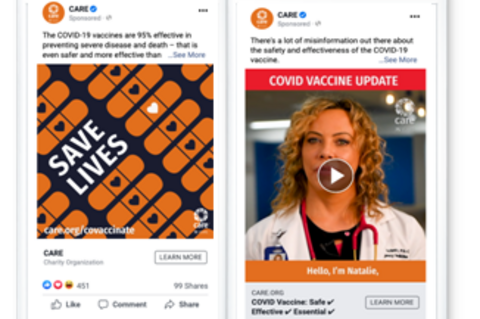
- Developed Facebook ads - graphic images and a video series featuring a female physician's assistant - and tested three different messages among populations (in specific US states) with high (80-90%), medium (70-80%), and low (60-70%) vaccine adoption rates by geography: Vaccines are safe; Vaccines are effective; and Vaccines are safe and effective.
As noted above, the process of running the campaigns - both for CARE USA and other country offices - is iterative and evidence based. CARE USA ran its first ad series for three weeks, starting April 16 2021, supported by a study to test the campaign's efficacy in addressing community concerns and changing attitudes towards the vaccine. At the campaign's conclusion, the control group and those who experience the campaign were asked: (i) How safe do you think a COVID-19 vaccine is for people like you? Hoped-for answer(s): very safe, somewhat safe; and (ii) How important do you feel a vaccine is to prevent the spread of COVID-19? Hoped-for answer(s): very important, somewhat important.
CARE USA's second ad series is testing which messengers are most effective in increasing vaccine acceptance, as well as which format (video vs. still image) is effective in decreasing COVID-19 vaccine hesitancy among vaccine-hesitant residents of states with median vaccine adoption/hesitancy. Messengers in this series include celebrities, medical professionals, and faith leaders. The ads were produced in both English and Spanish and targeted towards individuals with the highest vaccine hesitancy, which data show includes politically conservative adults ages 18-49 in states with COVID-19 vaccine adoption rates between 78-82%. The hypothesis is that social norming in states with median hesitancy/adoption will help more conservative adults make the choice to vaccinate. Click here to read about, and see videos from, this second phase of the campaign. One notable finding (for more data, see below): The most effective ads in this series were by far those with faith-based leaders delivering the message. As a result, CARE USA re-ran them in states with the highest levels of vaccine hesitancy and expanded the campaign by running it in 12 additional states selected as the next-most hesitant. For more on what happened, click here.
CARE plans to use the combined learnings from the first two ad sets to inform a third, again applying best practices to reach specific communities with messages that build trust, call for equal access to vaccines, reinforce vaccine safety and efficacy, stress that vaccines are free to everyone regardless of insurance or immigration status, direct people to vaccine distribution centres, and dispel myths about getting vaccinated. In light of hesitancy data showing that conservative adults continue to have the most reservations about the vaccine, CARE will include some ads appealing to this audience's values around freedom, choice, duty, and responsibility to protect family, community, and nation. In fact, the ad series will test messages, on the one hand, that promote the truth about side effects while dispelling (without reinforcing) the myths about them, against messages appealing to one's sense of duty, on the other hand, to see which performs better.
COVID-19, Immunisation and Vaccines
Impacts to date:
The first pro-vaccine ad series in the US reached 27 million people with 47 million impressions. Sample results:
- In states with low vaccine acceptance rates, people who saw the campaign with the message focused on vaccine safety were 2 percentage points more likely to perceive the COVID-19 vaccine as safe compared to people who did not see the campaign.
- Women between the ages of 25 and 34 years who saw the safety-focused messaging campaign in these low-vaccine-acceptance states were 4.1 percentage points more likely to express confidence that the vaccines are safe compared to those who did not see the campaign. (Note: Safety of the vaccines for younger females was an important topic to address during the campaign period because a pause in distribution of the Johnson & Johnson vaccine campaign was happening in the US at that time due to adverse events following immunisation (AEFIs) in this population of women.)
- The CARE USA messaging campaign that stressed the vaccines' safety and effectiveness reached 1.58 million people in high-vaccine-acceptance states. In these states, people who saw the campaign were 2.6 percentage points more likely to perceive the COVID-19 vaccine as important to prevent the spread of COVID-19 compared to people who did not see the campaign.
- Overall, compared to the control group, people who saw the campaign were 1.5 percentage points more likely to perceive the vaccines as safe and 1.2 percentage points more likely to perceive the COVID-19 vaccines as important to prevent the spread of COVID-19. Based on the population reached, that potentially means 260,600 additional people expressed confidence on COVID-19 vaccines’ safety and 210,000 additional people saying that vaccines are important to prevent the spread of COVID-19 because of the campaign.
The second ad series in the US reached 2 million people with 13 million impressions. Typically, a benchmark for success using Facebook's lift study tool is to achieve a +3 point lift or better. In this series, CARE saw the following increases in belief that the COVID-19 vaccine is safe: +7.9 point lift among 25- to 34-year-old men and +10.4 point lift among 35- to 44-year-old women. During this campaign, CARE also included an outbound link to a vaccine information page on CARE's website. From there, viewers could click through to the US Centers for Disease Control and Prevention (CDC)'s website, where people can find a vaccine appointment. This ad set drove 37,000 unique pageviews to CARE's web page and led to 2,500 outbound clicks to the CDC's website, demonstrating a 5.4% conversion rate. For the third ad series, CARE intends to monitor the outbound clicks and conversions more closely in order to learn more about the correlation between online and offline behaviours.
As of September 2021, CARE country offices had collectively reached 270 million people in 19 countries through their SBCC campaigns to promote COVID-19 prevention behaviours and increase trust in the vaccine. Click here for more information and data. A second round of campaigns from these country offices is anticipated.
Facebook, CARE
"COVID-19 Vaccine Confidence: CARE Launches Pro-Vaccine Ad Campaign", by Jessica Kirkwood and Mary Kate Wilson, July 1 2021; email from Rachel Kent to The Communication Initiative on July 9 2021; "Social and Behavioral Change Communications Campaigns to Reduce Vaccine Hesitancy", by Jessica Kirkwood and Mary Kate Wilson, July 30 2021; "COVID-19 and Social Media: Using Facebook to Drive Social and Behavioral Change in 19 Countries", by Jessica Kirkwood, Mary Kate Wilson, and Brandie Feuer, September 2 2021; and "Faith Leadership and Vaccine Hesitancy Reduction", by Jessica Kirkwood and Mary Kate Wilson, September 8 2021. Image credit: CARE
- Log in to post comments