










































Certifying the Interruption of Wild Poliovirus Transmission in the WHO African Region on the Turbulent Journey to a Polio-Free World
"[C]hallenges were dealt with via sustained political leadership...; country-level ownership of the Polio Eradication Program; strong and committed national and international partnerships; effective community engagement; focused attention to improve surveillance and routine immunisation; fearless and determined health-care workers; and innovation and ingenuity."
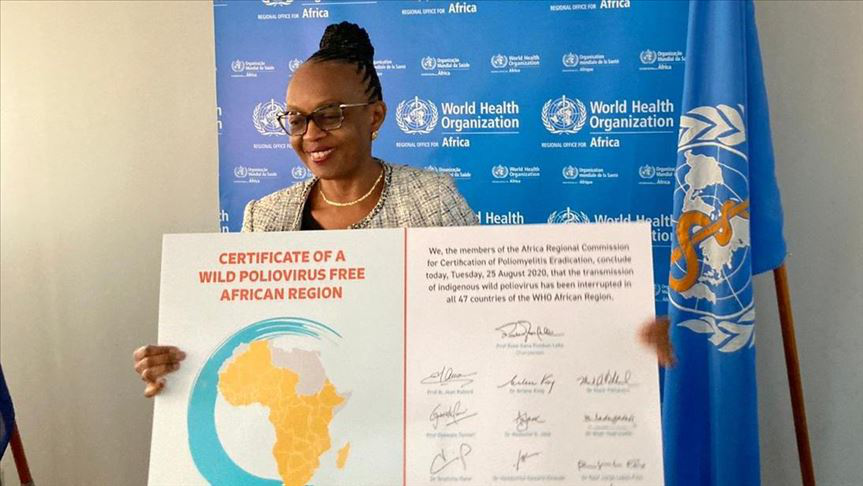
Following the Yaoundé Declaration on Polio Eradication in Africa by heads of state and governments in 1996, Nelson Mandela launched the Kick Polio out of Africa campaign (see Related Summaries, below). After years of effort on this front, on August 25 2020, the Africa Regional Commission for the Certification of Poliomyelitis Eradication declared that the World Health Organization (WHO) African region had interrupted transmission of wild poliovirus (WPV). This paper describes the process that led to certification, focusing on activities conducted in the years 2016 through 2020, lessons learned, and the strategies and analyses that convinced the Regional Commission to make its declaration.
The paper begins by explaining the certification mechanism, noting that, to facilitate sharing of information and best practices, the Africa Regional Commission includes members from the Regional Commissions of the WHO region of the Americas (PAHO), Eastern Mediterranean region, European region, and South-East Asia region. During the journey to certification, the Africa Regional Commission met annually and, since 2013, 2-3 times a year to review the required annual country progress reports for those not yet certified as polio-free, national documentation of polio-free status for those claiming polio-free status for the first time, and annual country updates for those whose national documentation of polio-free status had previously been accepted. Among other activities: Regional Commission members conducted advocacy visits to ministers of health or heads of governments to ensure political commitment to elimination and to discuss any perceived barriers to meeting the certification requirements.
As detailed here, several setbacks occurred along the way. For example, in August-September 2016, 2 years after the most recent WPV case was reported in Nigeria, 4 cases of infection with WPV1 were detected in a remote and security-challenged area of Borno State in northeastern Nigeria. (The importance of countries meeting the requirement of achieving certification-standard surveillance for a period of at least 3 years was illustrated by this experience.) In response, political, military, traditional, and community leaders were engaged; communities were mobilised; and information and communication technology (ICT) was used. Here are some examples:
- Throughout northern Nigeria, government officials and partners engaged traditional leaders and associations such as the Federation of Muslim Women's Associations in Nigeria, youth groups against polio, the Journalists Initiatives on Immunisation Against Polio, or JAP (see Related Summaries, below) , and groups of polio survivors, community health workers, and traditional birth attendants, who used their networks to advocate, engage, and sensitise communities to advance polio immunisation efforts.
- In Borno State, Nigeria, special surveillance and immunisation initiatives were introduced, including recruiting community informants residing in inaccessible areas who regularly report cases of acute flaccid paralysis (AFP) and have ongoing contact with adjacent secured areas in which surveillance activities have been intensified.
- Global Positioning System (GPS)-based tools with mobile phone technology were used in highly security-compromised areas for surveillance of AFP. On the GPS front, from September 2016 to January 2020, estimates of the number of children younger than 5 years living in settlements unreached by GPS-tracked immunisation activities in Borno State had decreased by 89% from approximately 434,000 being immunised to approximately 48,000.
- An initiative called Reaching Inaccessible Communities was launched by the polio programme and the Nigerian military to improve the reach of immunisation and surveillance activities in areas truly inaccessible to the polio programme. Through this ongoing initiative, and as of February 2020, 57% of targeted settlements had been reached at least once, and 46% of those that are inhabited had been reached at least 5 times.
- The Reaching Every Settlement initiative, which employs civilian teams accompanied by armed security to access partially accessible settlements monthly, had reached 99.6% of all target settlements at least once as of February 2020.
- Regular and rigorous supervision, evaluations, and reviews focusing on surveillance performance at subnational levels were implemented.
Based on such examples, and the entire process outlined here, the Africa Regional Commission asserts that "Certification of the African region shows the feasibility of elimination in areas that are inaccessible because of chronic insecurity, with resultant movement of refugees and internally displaced populations, nomadic populations, and difficult terrain. It also shows that elimination is possible even in the presence of fragile health systems, in which large proportions of the population are unimmunised or children are under-immunised; vaccine refusal is high; management and resource risks are present; and multiple, competing, urgent priorities are present, including large communicable disease outbreaks..." They call the certification "one of the greatest achievements of the continent and a clear demonstration of what is possible through commitment and collaboration."
Lancet Global Health 2020; 8: e1345-51. https://doi.org/10.1016/S2214-109X(20)30382-X; and WHO news release, August 25 2020 - accessed on December 11 2020. Image credit: Anadolu Agency
- Log in to post comments