










































Time to read
less than1 minute
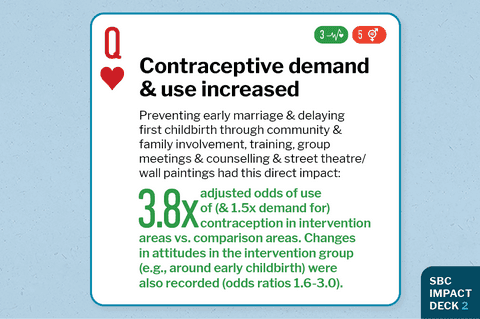
Changing Norms Related to Early Childbearing - 3.8x More Likely to Use Contraceptives
Strategy researched
Preventing early marriage and delaying first childbirth within marriage through: involvement of community leaders, parents, and in-laws; training of unmarried adolescents, newlywed couples, and health service providers; group meetings and counselling for young people; and general messaging through street theatre and wall paintings
Impact achieved
The increase in demand for contraception between surveys in the intervention area was 1.5 times that in the comparison area, and the increase in contraceptive use was even more pronounced (odds ratio, 3.8). Demand for contraception increased from 25% at baseline to 40% at follow-up in intervention areas, but remained virtually unchanged in comparison areas. Similarly, among women with one child, contraceptive use increased fourfold, from 6% to 25% (p<.001) in the intervention areas, but the change in the comparison areas (from 4% to 7%) was not statistically significant. Following the intervention, 39% of women knew about fertile days in the cycle, compared with only 18% at baseline. The intervention group also showed a higher rate of agreeing that early childbirth can be harmful and that contraceptive use is necessary and safe for delaying first births (odds ratios, 1.6-3.0).
Country of study
India
Research methodology
RCT - Editor's note: One research expert involved in reviewing these studies is of the opinion that this study is not an RCT but, rather, a pre-post design (as it does not measure effects on the same participants). It is The CI's decision to include.
Journal
International Family Planning Perspectives; 2008
Journal paper title and link
The effect of community-based reproductive health communication interventions on contraceptive use among young married couples in Bihar, India
Excerpt from Abstract
"Contraceptive use was very low (2-6%) at baseline in both comparison and intervention areas. Demand for contraception increased from 25% at baseline to 40% at follow-up in intervention areas, but remained virtually unchanged in comparison areas. At follow-up, contraceptive use had risen in both areas, but the adjusted odds of use in intervention areas were 3.8 times those in comparison areas. Women in intervention areas had elevated odds of knowing that fertility varies during the menstrual cycle, and of agreeing that early childbirth can be harmful and that contraceptive use is necessary and safe for delaying first births (odds ratios, 1.6-3.0)....Culturally appropriate, community-based communication programs that target youth and those who influence their decisions can create demand for contraception among young couples and lead to increased contraceptive use."
Summary at this link
Preventing early marriage and delaying first childbirth within marriage through: involvement of community leaders, parents, and in-laws; training of unmarried adolescents, newlywed couples, and health service providers; group meetings and counselling for young people; and general messaging through street theatre and wall paintings
Impact achieved
The increase in demand for contraception between surveys in the intervention area was 1.5 times that in the comparison area, and the increase in contraceptive use was even more pronounced (odds ratio, 3.8). Demand for contraception increased from 25% at baseline to 40% at follow-up in intervention areas, but remained virtually unchanged in comparison areas. Similarly, among women with one child, contraceptive use increased fourfold, from 6% to 25% (p<.001) in the intervention areas, but the change in the comparison areas (from 4% to 7%) was not statistically significant. Following the intervention, 39% of women knew about fertile days in the cycle, compared with only 18% at baseline. The intervention group also showed a higher rate of agreeing that early childbirth can be harmful and that contraceptive use is necessary and safe for delaying first births (odds ratios, 1.6-3.0).
Country of study
India
Research methodology
RCT - Editor's note: One research expert involved in reviewing these studies is of the opinion that this study is not an RCT but, rather, a pre-post design (as it does not measure effects on the same participants). It is The CI's decision to include.
Journal
International Family Planning Perspectives; 2008
Journal paper title and link
The effect of community-based reproductive health communication interventions on contraceptive use among young married couples in Bihar, India
Excerpt from Abstract
"Contraceptive use was very low (2-6%) at baseline in both comparison and intervention areas. Demand for contraception increased from 25% at baseline to 40% at follow-up in intervention areas, but remained virtually unchanged in comparison areas. At follow-up, contraceptive use had risen in both areas, but the adjusted odds of use in intervention areas were 3.8 times those in comparison areas. Women in intervention areas had elevated odds of knowing that fertility varies during the menstrual cycle, and of agreeing that early childbirth can be harmful and that contraceptive use is necessary and safe for delaying first births (odds ratios, 1.6-3.0)....Culturally appropriate, community-based communication programs that target youth and those who influence their decisions can create demand for contraception among young couples and lead to increased contraceptive use."
Summary at this link