










































Children's Radio Bridges: Radijojo
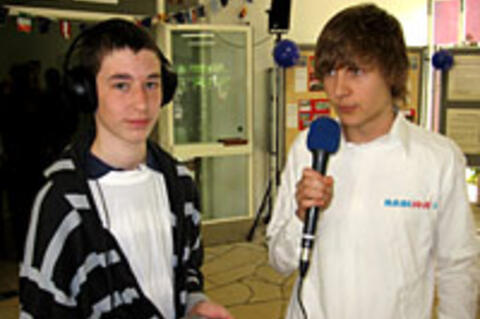
This information and communication technology (ICT)-based initiative draws on the cooperation and collaboration of children and youth, and the organisations with which they are connected, in Europe and around the world. Children are encouraged to send in audio files, radio shows, photos, videos, drawings, plain text emails, and/or printed letters that may be of interest to their peers in different places. Participation is key; children create their own shows with educational and cultural content focusing on topics such as early music education, transnational understanding, health education, ethics, environmental education, science programmes, language learning, promotion of peace, political awareness, children's literature, children's rights, family life, etc. They interview peers in other countries through face-to-face meetings/exchanges, sharing the connection they have made through various internet sites featuring audio files, photos, and written details about how each particular "radio bridge" has been built and sustained.
To cite one example, a radio bridge was built between children in Berlin and those from 5 schools in Poland, who gathered for a week-long workshop that enabled them to learn about each other's cultures as well as to explore topics such as: What is a good interview and what are the right questions to ask? How are moderations written and what does it mean when you 'cut 'an interview? How should a person speak on the radio? The children interacted not only in formal settings (e.g., by taking part together in voice training sessions) but also informally (e.g., by talking about each other's everyday lives, and by creating songs together).
ICT is a tool for connecting children from very different places. For instance, a Skype conference between youth with learning disabilities at Berlin, Germany's Gutzmann School and those from Beacon College in Florida, US, enabled participants to speak about their experiences and brainstorm together about ways to overcome challenges. Also, the US principal spoke about his own experiences as a child with learning disabilities.
Radio broadcasts, photos, and interactive websites emerge from such exchanges. For instance, the Across the Ocean page on the Radijojo website connects children from Europe and the United States to ask each other questions - gleaned from such school visits as that of Dagmar Roth-Behrendt to a primary school in Berlin; a radio programme and photos that resulted from this experience is then used as a launching point for online discussion designed to foster comparisons between, and reflections on, what political life is like in these different countries. Similarly, a radio broadcast and photos are available online that share the experience of Radijojo reporters from a primary school in Berlin who interviewed the German Minister for Family Affairs about differences between learning and finding a job in Germany and the United States/Canada.
Participants in these exchanges emphasise action as well as the sharing of information interculturally and the joining together (in person and/or online) in fun experiences. For instance, one student from Brandenburg, Germany, writes on the project website about his mission with students from many other countries to the G8 Summit in Japan, where these youth sought to "tell the leaders of the most powerful industrial countries what WE think about their politics and what they should do differently." The young broadcasters also share their action ideas such as the yearly visit by Radijojo and other peers to the Berlin House of Representatives, where they "take over" the place where the Berlin Parliament normally gather. The kids from Radijojo personally interviewed the chairman of the House of Representatives Walter Momper. The interview, in which Momper stressed the need for kids to get involved in demanding change rather than just complaining about it, may be listened to online.
Plans for action have actually taken shape through such connections, as illustrated by Radijojo's radio bridge of children in Germany and Namibia. Amongst the topics covered in the 60-minute segments produced for kids by kids was colonial history. To prepare for this, marginalised children from migrant families in the African quarter of Berlin did some research on a street named after the German colonialist Luederitz. They found out about the unfair ways in which Luederitz had seized Namibian land, then discussed their findings with the district mayor of the Center of Berlin. He agreed with them that the street should be renamed. Although this process has not yet led to a political decision, the kids symbolically renamed the street themselves with a self-painted street sign made out of paper reading "Namibia Street". Such ideas were fomented and reflected upon during direct call-in phone sessions (via the internet) between German and Namibian children.
Children, Intercultural Education.
May 2009 update: In Africa, Radijojo has projects underway in Ethiopia, Kenya, Tanzania, and Uganda. As a consequence of intense and ongoing demand, Radijojo plans to implement an African chapter of the World Children's Radio Network: Radijojo Africa. In Asia, collaborations are focused on India, Kyrgyzstan, and Thailand. Elsewhere, Radijojo is making linkages in Cuba, Jamaica, and Saudi Arabia; expansion into Latin America, in particular, is contingent on donations.
Emails from Thomas Roehlinger to The Communication Initiative on May 15 2008 and May 19 2009; "Across the Ocean: The First Transatlantic Children's Radio Bridge" [PDF]; Across the Ocean website; European Children's Radio website; and Radijojo website.
- Log in to post comments