











































Chitambo Film Education Project
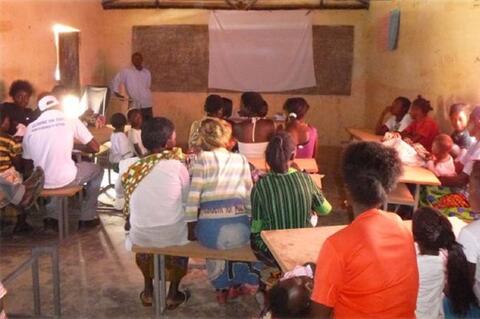
MAF films were used to support maternal and child health education as part of both community outreach programmes and hospital antenatal sessions. According to MAF, Chitambo district has an extremely high rate of maternal and neonatal mortality, with only one doctor for over 100,000 people. Two out of three women do not deliver their babies in a hospital, and awareness of key health issues – such as identifying warning signs in pregnancy and the importance of good nutrition – is often low. Many health workers struggled to deliver these key health messages for a range of reasons, such as language barriers, low levels of literacy among mothers, lack of specialist knowledge among health workers and time constraints.
Working in partnership with Chitambo Hospital, MAF provided the films, training materials, necessary equipment and additional support to enable staff to facilitate film screenings at both the antenatal care clinic at Chitambo Hospital and during outreach sessions which were held at each of the 14 rural health posts once per month. A project coordinator was also appointed as a point of contact between MAF and Chitambo. He was in charge of training health workers to screen the films, the maintenance of all equipment and collating data for evaluation.
These screenings enabled the health workers to deliver life-saving maternal and child health education to a wide range of people in the community, including mothers, traditional birth attendants, and community health workers. Having been given access to the entire suite of films, the following five were chosen by the nurses after an initial six-month period:
How to plan a pregnancy
Warning signs in pregnancy
Management of Postpartum hemorrhage (PPH)
What and when to feed your child
Breastfeeding
The project ran over a 12 month period; the first six months acted as a trial of all the films for their suitability in this context and the final six months, from March to August 2013, was the evaluation period. Over the six month period of the evaluation, 43 screenings took place, with an average of 7 screenings per month. A total of 2,111 people attended film screenings between March and August 2013, with great variability in the attendance numbers for different screenings at the same site.
The health workers participating in the project evaluation, "all confirmed their feeling that 'it was much easier to get health messages across' using films. The films provided focus to their health education sessions and enabled them to give consistent messages. They found community women were more engaged with the films and believed that use of film (both seeing an image and hearing a message) made it more likely that community members would retain the key information."
According to the evaluation, "the films also engaged their target audiences, conveying relevant and appropriate content with evidence that some community members were able to act on what they have learnt. Community members reported their enjoyment of the films, and their entertainment value which, coupled with the novelty of film in Chitambo, contributed to high levels of interest."
Following this pilot, Medical AID is now working with the Zambian Ministry of Health to scale up the project, taking into account the issues that were raised during the course of the evaluation. They plan to translate into local-languages, such as Bemba and Nyanja, in order to make the films more accessible. They are also looking at producing films for male audiences, as demand for such films was frequently expressed.
Maternal and child health
Medical Aid Films is a charity, producing and distributing films for training and education at the grass-roots level in the most underserved areas of the world. So far, MAF has produced and distributed 34 films in 80 countries to more than 1,200 partners. The partnership with Chitambo Mission Hospital constituted the pilot phase of a project which will be rolled out across Zambia, delivering community-level education at outreach programmes and antenatal sessions.
Click here to view the full range of Medical Aid Films.
Chitambo Hospital and Medical Aid Films
MAF website and Chitambo Film Education Project Evaluation Report [PDF] on August 21 2014, and email received from Medical AIDS on August 29 2014.
- Log in to post comments