










































COVID-19 Vaccine Communication Strategy [India]
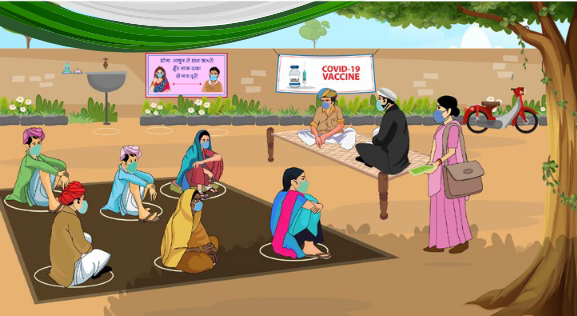
"...steer the spirit of the Prime Minister of India through Jan Andolan or people's movement such that citizens feel confident to engage and participate in the vaccination process."
The Union Ministry of Health and Family Welfare (MoHFW)'s communication strategy is designed to support the rollout of the COVID-19 vaccine in India by alleviating apprehensions and managing rumours and mis/disinformation about the vaccine. The strategy guides national-, state-, and district-level communication activities so that timely, accurate, and transparent information on the COVID-19 vaccines and vaccination process reaches all people, across all states in the country. The aim is to foster trust and acceptance and encourage uptake.
Opening sections of the strategy document provide guidance on how to fulfill the needs to:
- Mitigate any potential disappointment expressed by unmet demand for the vaccine or "eagerness" amongst people [vaccine eagerness (VE)];
- Take suggested action (e.g., develop articles with support from influencers about the safety and efficacy of the COVID-19 vaccine in national, state, and regional media) to address vaccine hesitancy (VH) and/or myths, misconceptions, or crises (e.g., adverse events following immunisation (AEFI) clusters) that could arise during the introduction and rollout; and
- Emphasise the continued practice of COVID-Appropriate Behaviours (CAB) - frequent and thorough handwashing with soap and water, wearing a mask/face cover, and physical distancing of 2 Gaj (6 feet) - through messaging using local/vernacular languages and leveraging existing official WhatsApp groups, the Telegram platform, and mass (including local cable radio and community radio networks) and social media.
Based on the learnings of previous national immunisation campaigns (Mission Indradhanush (MI)/Intensified MI/measles-rubella), the strategy outlines key elements to support the rollout and introduction of the COVID-19 vaccine, with suggested actions at the national, state, district, and block levels. These elements fall into the categories of: advocacy; capacity building; media engagement and social media; social mobilisation and community engagement; and AEFI crisis communication.
To achieve wide reach for the messages and garner engagement from all intended audiences, communicators are urged to leverage a variety of trusted sources, channels, and platforms in both urban and rural areas. Each platform will have specific communication tools and materials for activation, mobilisation, and broadcast, including mobile games, songs, prayers, pledges, posters, flipbooks, dialogue cards/interpersonal communication, videos, interactive and community radio programmes, TV commercials, tweets, scripts and stories, ringtones, wall paintings, bus panels, and LED (light emitting diode) scrolls.
The MoHFW plans to:
- Use the social influence of or endorsements from experts and official voices to spell out the process of immunisation (where, how, who, when), emphasissing the safety and efficacy of vaccines and explaining the decision to conduct the drive in a phased manner;
- Establish a National Media Rapid Response Cell (NMRRC) at MoHFW to ensure preparedness through media monitoring and social listening and respond in real time, while also shaping media and public discourse through extensive monitoring of print, electronic, and digital media; and
- Involve community mobilisers and frontline workers to engage with the community at various levels through community consultations, religious meetings, youth engagement, and involvement of civil society organisations (CSOs), self-help groups, Panchayats, and other community-based platforms.
The monitoring and evaluation (M&E) framework outlined in the document supports the implementation of communication and demand generation strategies, facilitates any mid-course corrections, and measures the impact of the communication interventions. Relatedly, a documentation framework is provided to assist MoHFW and its partners to generate, disseminate, and apply knowledge and best practices effectively.
Annexures related to communication planning, preparedness, and reporting for COVID-19 vaccine rollout in India conclude the document; they include:
- Annexure A: Communication Training Plan
- Annexure B: Communication Planning
- Annexure C: Communication Preparedness
- Annexure D: Detailed Media Engagement Plan
- Annexure E: Reporting Template
- Annexure F: M&E Framework
- Annexure G: Roles and Responsibilities of Different Ministries/Departments
- Annexure H: Key Messages
- Annexure I: Leaflets
- Information for Population below 50 Years of Age
- Role of Religious Leaders
- Role of Influencers
- Role of Social Mobilisers
- Role of Volunteers
- Beneficiary Identity and Importance of Photo ID
"COVID-19 Vaccine Communication Strategy Released", Express Healthcare, and "Centre's COVID-19 Vaccine Communication Strategy OUT Amid Wait For Approval; Document Here", by Jay Pandya, Republicworld.com - both on December 31 2020.
- Log in to post comments