










































Decision-Making on Maternal Pertussis Vaccination among Women in a Vaccine-Hesitant Religious Group: Stages and Needs
Radboud University Medical Center (de Munter, Ruijs, Ruiter, van Nimwegen, Oerlemans, Hulscher, Hautvast); GGD Gelderland-Zuid (de Munter, Ruijs, van Nimwegen); Maastricht University (); Fruits of Passion - Together Fighting Human Suffering (van Ginkel)
"The decision-making framework resulting from our findings can be used by health care professionals to provide women with information and consultation in the decision-making process."
As of December 2019, the maternal pertussis vaccination - designed to prevent pertussis in newborn babies - is included in the Dutch immunisation programme. However, in the Netherlands, similar to other Western countries, various groups of people question or refuse vaccinations for ideological, philosophical, or religious reasons. One of these groups is the Dutch orthodox Protestant community, which has a long history of vaccine hesitancy. This research, conducted in an effort to understand the information and decision support needs of this vaccine-hesitant religious group, was carried out in a hypothetical situation, as the maternal pertussis vaccination had yet to be implemented in the Dutch immunisation programme at the time of the study.
The study population consisted of 18- to 40-year-old orthodox Protestant women, representing a broad variety regarding pregnancy status, number of children, age, membership in various orthodox Protestant church denominations, and residence in different regions of the Netherlands. Twenty-five women participated in semi-structured in-depth interviews (conducted between March and August 2017), online focus groups (conducted in April and May 2018), or in both.
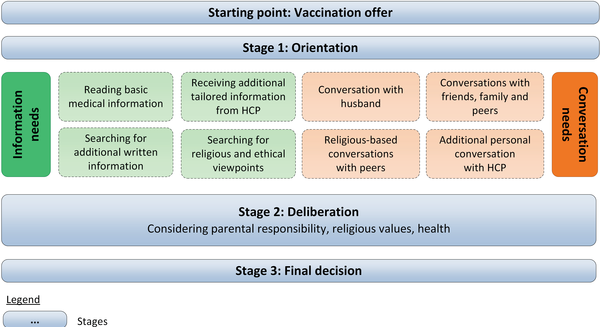
A preliminary framework that contained multiple stages and corresponding needs in the decision-making process was constructed from the results of the individual interviews. The final decision-making framework included:
- Starting point of the decision-making process: Vaccination offer - Women presumed that their midwife would notify them about the vaccination in one of their regular appointments during pregnancy. Some women, who refused childhood vaccinations on religious grounds, pointed out they would probably also refuse maternal vaccination. Nevertheless, they indicated they would like to be informed about the vaccination offer and other possibilities to protect their unborn or newborn child against pertussis.
- Stage 1: Orientation
- Information needs: Women indicated they would first need basic, factual medical information that would answer their questions about pertussis and the vaccine - e.g., about vaccine safety and effectiveness. Participants expected that this information would be provided in a brochure or website by the healthcare provider (HCP) or national public health service. However, women expected the standard information would provide a one-sided viewpoint: one in favour of vaccination. Several participants wanted HCPs to tailor the information and/or motivation to vaccinate to their personal situation. Midwives were seen as the most trustworthy persons to provide this information. To fulfil their needs for information on religious aspects of the vaccination, e.g., themes of divine providence and trust in God, participants would seek answers in the Bible and opinions written by representatives from their own religious constituency in books, on websites, or in newspapers.
- Conversational needs: Participants considered their husband to be the most important person with whom to discuss vaccination. Some couples read medical and religious information together and/or pray together for God's support in their decision-making. Other preferred conversation partners were women who were close to them. Discussions about religious and ethical topics were confined to one-on-one or group conversations with other orthodox Protestants or Protestant Christians. Several participants felt the need for an open, personal consultation with their HCP, in which they would like to hear the HCP's personal experiences with pertussis and/or personal viewpoints on the vaccination. However, women disliked it when HCPs imposed their opinion on them, in light of their strong desire to make a personal decision.
- Stage 2: Deliberation - Participants mentioned an overall need for a time out moment during the decision-making process to contemplate the information and viewpoints they gathered in their Orientation stage. In this stage, 3 themes could be identified: parental responsibility, religious values, and health. Many highly conservative orthodox Protestant participants mentioned they considered their trust in God (religious value) to be most important and, therefore, they might choose not to vaccinate.
- Stage 3: Final decision - Even though this study was based on a hypothetical situation, most women indicated that, if they were given enough time for Orientation and Deliberation, they would be able to make a well-considered decision. Overall, all women considered it to be of great importance that husband and wife would make the final decision together.
This study supports evidence from previous studies showing that vaccine-hesitant parents follow a thorough deliberation process by carefully weighing the pros, cons, alternatives, and consequences of accepting or refusing vaccination, compared to acceptors. Considering the observed attitudes of the women who participated in this study, it is notable that the present generation of orthodox Protestant women follows the rising trend of self-determined parents who want to take responsibility for their child's health and take a proactive role in decision-making.
The researchers conclude that future studies that build upon the results of these findings, accompanied by experiences in clinical practice, could be used to determine in which manner HCPs and other professionals can facilitate women in moving through different vaccine decision-making stages. As HCPs' communication skills and content knowledge are important in addressing vaccine hesitancy, the researchers indicate that healthcare policies and programmes should be organised to ensure that HCPs have sufficient time, skills, and opportunities to strengthen their vaccination consultations. Future studies could also investigate whether the stages of decision-making in the framework described herein can be applied to the experiences of other vaccine-hesitant subgroups - and vaccines - as well.
PLoS ONE 15(11):e0242261. https://doi.org/10.1371/journal.pone.0242261
- Log in to post comments