










































Defining and Uniting the Global Ecotourism Movement through Improved Communication

ECOCLUB.com
"...[R]ather than, or at least in addition to, the three p's of Marketing 'Price, Product, Place', Ecotourism advocates must also think in terms of Policy, Partnership, People and Power, and of course in terms of the big E, Earth."
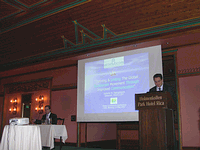
Starting from the conviction that ecotourism is not a business niche but, rather, a broad movement with the goal of promoting ecological and social justice through tourism, this 8-page presentation advocates for giving individual ecotourism practitioners, academics, and enthusiasts communication tools to foster transparency and knowledge diffusion, such as through online meetings. The paper was given by Antonis Petropoulos, Editor of ECOCLUB.com, an international network promoting "an ecosocially just tourism", at the May 14-16 2007 Global Ecotourism Conference in Oslo, Norway, which was attended by some 450 participants representing around 70 countries.
Petropoulos stresses the role of bi-directional communication in strengthening the independence of the ecotourism movement and preserving its core values - i.e., providing a social service rather than selling something. For example, he explains, "There is no argument that we must still inform the general public large sections of which have still not heard about Ecotourism, however we must focus our efforts on those who have already heard about Ecotourism and are keen on practicing it. On the supply side also, we need to give priority in communicating with, informing and assisting those who are really sincere about Ecotourism, those who practice Ecotourism, and those who risk their lives even, protecting communities and the environment through tourism in some of the world's last great but also dangerous places."
Referencing communication that flowed around the International Year of Ecotourism (2002), he points to the need for proponents of this movement to band together and defend the philosophy through careful communication - e.g., "few realise that damage is...done when one of us unwittingly gives an interview, or writes an article, and their comments are taken out of context and turned around to hit Ecotourism [branding it, for example, the human or ecological face of 'hedonistic neo-colonialism']." Petropoulos characterises ecotourism advocates as not only talkers but also as listeners. He notes the "combination of principles, professionalism, intelligence and an open mind" that ecotourism practitioners cultivate as they meet with community representatives to "listen to the desires of the local people, rather than merely pontificating in an office or a library. Ecotourism and participatory democracy go hand in hand."
Petropoulos goes on to address the many types of communication tools at the hands of the ecotourism movement; as an example, he discusses the various features of the ECOCLUB.com website. Despite the various communication tools available (including, but not limited to, that website), he returns to the basis of communication: "the human curiosity to see what is in the other side of the hill, the ambition and ability to improve and the need to cooperate and form social contracts in order to achieve these goals. Ecotourism serves these three human attributes well."
The concluding section offers 7 recommendations for unity and strength of the ecotourism movement. For example, "Ecotourism associations should not compete with their own members for the provision of tourism services & products but instead lobby for our common ideals and promote change through appropriate national & international legislation & self-regulation."
Global Ecotourism Conference website and ECOCLUB.com website - both accessed on May 13 2010.
- Log in to post comments