










































Determinants of Ebola Preparedness in a Representative Sample of the Populations in Vulnerable Areas in Guinea-Bissau and The Gambia: Abstract
Eawag [Swiss Federal Institute of Aquatic Science and Technology]
"The objective of this study was to find the relevant socio-psychological factors of behavior intentions related to the prevention of an Ebola outbreak and hand washing with soap in a representative sample of the populations in vulnerable areas in Guinea-Bissau and The Gambia."
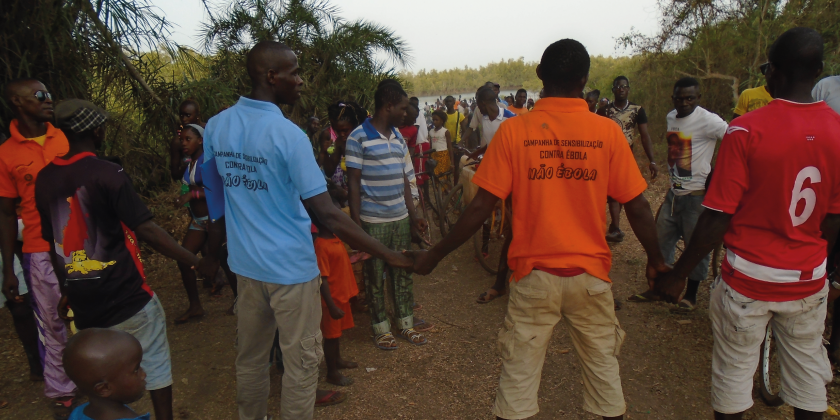
The focus of this Eawag (Swiss Federal Institute of Aquatic Science and Technology) presentation for the International SBCC Summit 2016, Addis Ababa, Ethiopia, February 8-10, is on Ebola prevention in Guinea-Bissau and The Gambia.
From the abstract:
"The outbreak of the Ebola virus disease (EVD) in West Africa (Guinea Conakry, Sierra Leone, Liberia) is the largest and most complex Ebola outbreak since the Ebola virus was first discovered. There have been over 11,000 reported deaths, and are still new infections in these three countries. The vulnerability for an Ebola outbreak in Guinea-Bissau and The Gambia is given due to several reasons: their geographical location, the cross-border market activity, inadequate water and sanitation systems, poor hygiene practices in some communities and risky burial ceremonies, which are extremely conducive to conditions of contamination. The objective of this study was to find the relevant socio-psychological factors of behavior intentions related to the prevention of an Ebola outbreak and hand washing with soap in a representative sample of the populations in vulnerable areas in Guinea-Bissau and The Gambia.
Key highlights:
The results showed that hand washing with soap and water in Guinea-Bissau is mainly related to the knowledge about the Ebola virus disease, the affect liking, the descriptive norm and the commitment to wash hands with soap and water. In The Gambia, the perceived vulnerability, the response belief, the cost perception and three social norms (injunctive norm, descriptive norm and personal norm) were found to be predictors for hand washing with soap and water. In both study countries, similar factors led to a higher intention for calling the Ebola hotline, if there would be a suspected Ebola case in the household: the response belief, the injunctive and the descriptive norm, the commitment and the communication frequency."
International SBCC Summit 2016 website, February 20 2016.
- Log in to post comments