










































Digital Revolution: A Value Addition Platform to the Agricultural Ecosystem
Daily Nation
"ICT and agriculture have now found a home in each other and this is radically changing the face of a sector..."
This article describes a "revolution, buoyed by advances in information and communication technology (ICT)" which "is creating a renaissance in Africa's and other developing countries' agricultural value chain systems in ways unheard of before." It was written by a journalist attending the International Conference on ICT4ag, which was co-hosted by the Technical Centre for Agricultural and Rural Cooperation (CTA) and the Rwandan Ministry of Agriculture and Animal Resources (MINAGRI), November 4-8 2013, Kigali, Rwanda. The event drew close to 500 participants from the government, private sector, non-governmental organisations (NGOs), intergovernmental bodies, and development agencies from 66 countries.
As Joshua Masinde explains, during the conference, innovators showcased approximately 40 ICT solutions (mobile, video, web, and radio, applications - apps) addressing different aspects of the agricultural value chain in the African, Caribbean and Pacific (ACP) countries. Through his interviews with some of those involved in these ICT efforts, Masinde learned that these new tools are "empowering farmers and producers...by providing information on production practices, inputs, prices, markets, and weather." Here are a few examples:
- Kenya's MFarm uses simple data in a way that, according to Susan Oguya, a co-founder, has created "armchair farmers" and drawn young people into the sector as producers, marketers, input suppliers, and/or content developers.
- Esoko is an app enabling farmers to access market prices, weather forecasts, agricultural tips, bids, and offers for their produce. It has over 2.5 million users across 16 African countries; according to the chief executive, usage of the app has seen returns to many smallholders increase by between 10-15 percent annually.
- The Rural eMarket, a Madagascan app, offers not only information on prices, productivity, and market access, but also offers details on how to access financial services to enhance farmers' agricultural engagements.
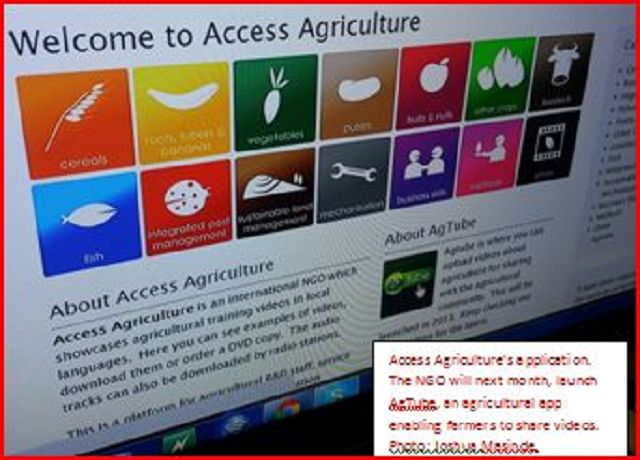
- Access Agriculture, an international non-governmental organisation (NGO), is preparing to unveil a network of YouTube farmers through its AgTube application to help farmers interact with each other by uploading videos for sharing with the agricultural community.
- ojoVoz is a mobile and web app allowing farmers in South Sudan to send voice recording and images using their phones to the internet. The app also helps in mapping water points, which are usually hotspots of conflicts by warring clans, to make it easy for conflict reporting and resolution mechanisms. "Smartphones are also to be issued to cattle camp and state leaders as part of the initiative to encourage people into the agricultural value chain," says Eva Yayi, IT Officer at Community Empowerment for Progress in South Sudan.
- In Kenya, there are about 25 agricultural applications listed by the ministry of agriculture to offer credible information and act as extension services by availing information to farmers with access to mobile phones even in very remote areas of the country. Some of them have created a network of young Facebook farmers as a market place of ideas and transactions.
On the matter of engaging youth in agriculture, Masinde notes that, during the ICT4Ag event, young people from Kenya, Uganda, Tanzania, Rwanda, Ethiopia, and Madagascar participated in an Agri-Hackathon Championship to develop ICT applications addressing specific needs in the agricultural ecosystem. Some of the apps are tailored to run on mobile and web technology to increase access to finance, to connect and harmonise stakeholders in agriculture, to enhance farmers' creditworthiness, to collect and share market price data, and to connect and harmonise key youth stakeholders along the agricultural chain. "The rural - urban migration of youth is a major problem across ACP countries where CTA works, but ICT can play a key role in stemming the trend by creating employment opportunities for the youth and also improving the quality of life in rural areas," Masinde says. He suggests that broadband connectivity and access to mobile phones not only presents an opportunity for increasing agricultural productivity, even in remote villages, but also for drawing youth back to the farms. A CTA project, Agricultural Rural Development and Youth in the Information Society (ARDYIS) [see Related Summaries, below] is one example of a project promoting ICT use among rural youth. Masinde writes that, since its launch in 2010, "it has had a major impact on the information sharing front, capacity building on all aspects of ICT innovations and entrepreneurship in agriculture."
Email from Stéphane Gambier to The Communication Initiative on December 6 2013.
- Log in to post comments