










































Dr Edna Adan Ismail, Edna Adan Maternity Hospital - DFID Girl Summit 2014
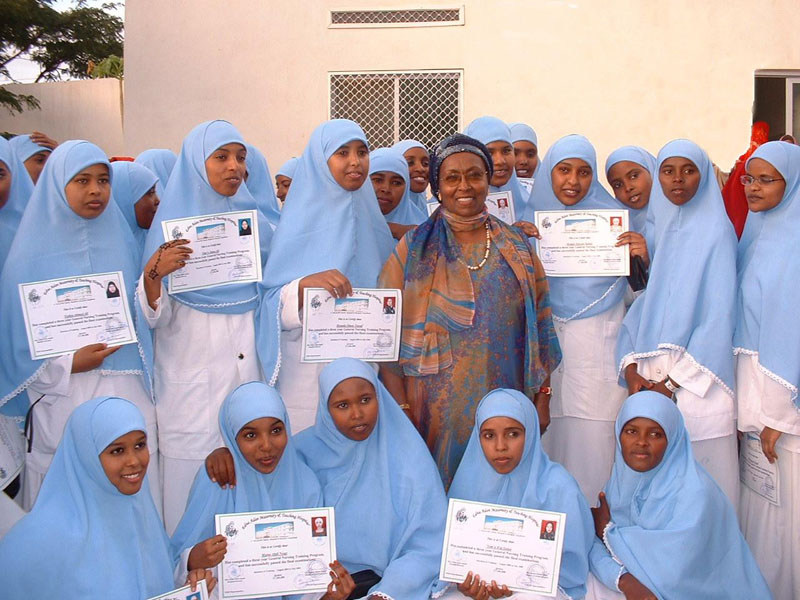
"I was going to work to get babies out through a closed door..." - Dr Edna Adan Ismail
Panel Discussion: Spotlight on Progress A6 - Supporting and Empowering Those Affected by FGM and Child, Early and Forced Marriage
Context
This is one of the 14 "Spotlights on Progress" video-recorded sessions that took place at the Girl Summit 2014 in London on 22nd July. The sessions were organised to spark conversations and share best practice between practitioners from around the world, between grassroots activists and ministers, and across all the issues of female genital mutilation (FGM) and child, early, and forced marriage (CEFM). Girl Summit is a project of the Department for International Development (DFID), UK.
A featured panelist of this Spotlight session was Dr Edna Adan Ismail, Founder and CEO, Edna Adan Maternity Hospital and Chancellor, Edna Adan University who talked about "Improving maternal health care and working to end FGM in Somaliland".
Profile of Speaker
Dr Edna Adan Ismail is the Founder and CEO of the Edna Adan Maternity Hospital and Chancellor at the Edna Adan University. She was one of the first Somali women to study nursing in the UK. In 1965, Edna was appointed by WHO to train midwives in Libya but returned home when her husband became Prime Minister of Somalia in 1967-1969 and served as her country’s First Lady. She built and opened the Edna Adan Hospital in 2002 in her home country, Somaliland. In 2012, Edna opened the Edna Adan University which trains nurses, midwives, laboratory technicians, pharmacists, anaesthetists, and public Health students.
Project strategy and key points made in the presentation:
Dr Edna Adan Ismail spoke about the complications of FGM and the work she has done at Edna Adan Hospital in the last 10 years. She starts off by talking of her work as a midwife and the stark contrast between giving birth in the UK, where she studied, and in Somaliland, where she came to realise the damaging effects of FGM.
In March 1977, during the formation of the Somali Women’s Democratic Organization (SWDO), Edna Adan Ismail was the first Somali person to publicly denounce FGM and pioneered the campaign for its eradication in Somalia and in Somaliland, and also campaigned widely at international conferences and seminars.
She talks about the damaging effects of the practice: the pain and risk of death to the girl, the haemorrhage, shock, and sometimes incontinence, pelvic inflammations, and obstetric fistula.
When campaigning against the practice, she stresses that it is important not to offend but to use reason. We need to ask why we are doing this to our girls despite the fact that it is contrary to Islam, it is harmful to their health, it prolongs labour and endangers the lives of the babies, and it can affect women's ability to conceive due to the repeated pelvic infections caused by FGM. She also believes it is important to give examples of other Islamic countries who have stopped FGM.
She stresses that the fight must happen everywhere and explains that no staff and students are accepted to her hospital or university unless they commit to fighting FGM.
With the establishment of her maternity hospital and with the still much needed services to deal with FGM, the hospital has become a key player in the campaign against FGM. It is fast becoming a repository of all information relating to FGM in Somaliland and the region, and has started an auditing process to record baseline data about the prevalence of FGM. This is considered key to understanding why the practice continues and to informing eradication efforts.
The hospital also holds educational and sensitisation seminars for concerned groups, and at a patient level, counselling services are provided to the victims of FGM and their families.
The hospital website offers more information on the research being conducted and includes an outline of a recommended strategy to fight FGM which should involve religious leaders; health professionals; the community, including youth girls, parents, men, business people and professionals; and the media. Click here to find out more.
Dr Edna Adan Ismail mentions that in the past, she didn’t have a platform to speak on in the UK because FGM was too controversial. She said that she welcomed the current support from the UK government and congratulated them and British taxpayers for their support. She emphasised that voices must not just be heard in conference halls but commitments must reach people doing work on the ground, those working with mothers and grandmothers, who are supporting the practice and who need to be counselled. She also calls on initiatives to include fathers because unless fathers come on board as heads of families, we will not see the end of FGM.
Overview of the "Supporting and Empowering Those Affected by FGM and Child, Early and Forced Marriage" session:
As outlined in the programme summary document handed out at the summit:
"This spotlight discusses the different types of services that we must ensure people affected by FGM and child, early and forced marriage have access to, highlighting the importance of providing a holistic package of support. The spotlight will showcase initiatives which provide medical, counselling and advocacy support, and programmes dedicated to supporting the needs of married girls. This spotlight will hear others’ experiences and discuss what we can learn from them."
As summarised by the panel organisers following the panel discussion:
"The panel of speakers shared their experiences of frontline service provision or programming to support those affected by FGM and CEFM. In discussions on FGM and CEFM, the need to break the cycle of shame were emphasised, and the need to listen to those affected. There was a lot of positive reflection that after many years of campaigning on these issues, people were finally getting a platform to share the reality of girls’ and women’s experiences. However it was agreed that much more needed to be done. There was consensus that a holistic response was needed, that services and programmes needed to consider women and girls whether pregnant or not, and married or not, and that although there were workable models out there to eliminate both practices, these needed to be scaled up."
The session was opened by Leyla Hussein, activist and founder of Daughters of Eve and Dahlia Project.
The speakers, in order of appearance, are:
Isobel Shirlaw Head of Justice Initiatives, Refuge
Dr Venkatraman Chandra-Mouli Department for Reproductive Health and Research, World Health Organisation
Jasvinder Sanghera CBE Chief Executive and Founder, Karma Nirvana
Dr Edna Adan Ismail Founder and CEO, Edna Adan Maternity Hospital and Chancellor, Edna Adan University
Juliet Albert Specialist FGM Midwife, Queen Charlotte’s and Chelsea Hospital (Imperial College Healthcare NHS Trust), London
Doris Bartel Senior Director of Gender and Empowerment, CARE USA
The session is moderated by Susan Bookbinder, journalist, broadcaster, columnist and media consultant with a particular focus on FGM.
Footage of this (available below) and other "Spotlight Sessions" are available on DFID’s YouTube channel.