










































Early Morning Market Initiative
In 2001, dala launched a project on CityWalk, which is (in the words of one of dala's 3 founding members), "a 7 km. walk that dissects the city psycho-geographically through one of the major existing informal pedestrian routes, and thus evidences the prevailing cultural and economic divide." The walk starts from the informal settlement of Umkhumbane, Cato Manor, and proceeds via a shopping mall in suburbia, along the major highway, through the heart of the city, and on to the port. For this reason, organisers claim, "the CityWalk opens a window for local and international society to take a peep at a state of inbetweeness often looked at but hardly seen."
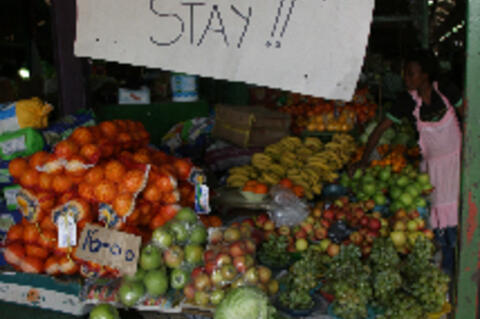
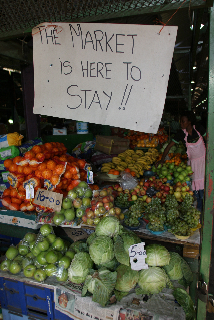
The Early Morning Market has been integrated into the Walk, and dala has worked to develop strong relationships with the traders. These relationships have given dala an "in" for this effort to interview traders. For instance, the 77-year-old Valima Pillay is a trader of fresh produce at the Early Morning Market. She arrived there as an orphan at a very young age, and was raised by farmers and traders. "...this [Market] is my mother and father, this is my piece of bread, I am not moving anywhere", she explained in an interview videotaped by dala.
dala claims that the shopping mall the city is proposing is a "utilitarian architecture with rational motives - easing traffic congestion in the precinct during the 2010 soccer world cup, where architectural space will become physical space rather than lived space." They claim that "Such [a] proposal is a classic example of modern town-planning theories organised in line with capitalistic ideologies, which are replacing socio-cultural energies that define spaces in the city. The organic richness is very rapidly being 'sanitised' by a homogeneous surface, a fragmented space lacking character."
In the documentaries, one of which may be viewed below, the traders complain that they have not been consulted, that their rights to democratic participation have been disregarded. dala explains that the videos highlight the fact that the behaviour of Durban's city manager seems to be reinforcing the marginalisation of Africans - blacks and Indians, in this instance - by alienating them from their livelihoods and by having excluded their participation in this urban process. "In addition, no tendering procedure was followed, no Environmental Impact Assessment was done, and no application was submitted to the heritage council (following public exposure, the municipality is now hurriedly trying to rectify these issues)."
The videos have been used within academic institutions to spark discussion and further action toward a more inclusive process to the proposed development plan. For instance, an educational programme saw 2nd-year design students and 4th-year brand strategy students conducting research into the area and catalysing public debate - both locally and internationally.
Subsequently, dala facilitated a public art project with artists in southern Africa with the KZNSA Gallery focusing on creatively unpacking the relationship between the notions of a market and a mall. "The presence and participation of artists in this struggle has had a profound effect on the traders and affiliated social movements, and we are seeing a re-linking of arts and activism in South Africa."
Rights.
dala's initiatives all revolve around re-imagining the use and expression in and of public space, and are grounded in the belief that sustainable change can only happen through democratic participation and collaboration. dala therefore facilitates creative initiatives between creative practitioners from a variety of backgrounds (artists, architects, researchers, performers, urban planners, designers), the municipality, and the people and organisations that live and work within and around the city. All 3 of dala's founders are practicing artists and educators who have been involved in a number of local and international projects and exhibitions.
As it stands today, the matter of mall versus market is in court. Another hearing was scheduled to be held at the end of October 2009, in the context of widespread and mounting support for the market.
Market versus Mall: Catalysing Public Debate through New Media Technologies", by Doung Anwar Jahangeer, in Glocal Times, Issue #13, November 2009; and dala website, January 4 2010; and email from Doung Anwar Jahangeer to The Communication Initiative on January 5 2010. Photo courtesy of Peter McKenzie
- Log in to post comments