











































Effectiveness of the School-based Social and Behaviour Change Communication Interventions on Insecticide-Treated Nets Utilization among Primary School Children in Rural Ethiopia: A Controlled Quasi-Experimental Design
Jimma University (Abamecha, Sudhakar, Abebe, Kebede, Birhanu); United States Agency for International Development (USAID)/Ethiopia Office (Alemayehu)
"Effective behaviour change interventions require enhancement of social support and this is the ultimate goal of SBCC strategy which influences community norms, social factors, and reinforcements to bring about sustained behaviour change..."
Malaria remains a major health problem among school-aged children, affecting a critical period of learning and development. One of the strategies being used to engage communities and schools in malaria preventive programmes is social and behaviour change communication (SBCC). The idea is that school-based SBCC interventions could help to achieve behavioural changes in the school and equip students and teachers to act as health messengers in local communities. This study examined the effectiveness of a school-based SBCC approach on insecticide-treated net (ITN) utilisation among primary school students in malaria-endemic settings of Ethiopia.
To guide the SBCC content and intervention, concepts and principles drawn from several behaviour change theories were combined and applied, including Motivation Protection Theory (MPT) and the health belief model (HBM), which explain the cognitive mediation process of behavioural change in terms of threat and coping appraisal. The theory of diffusion of innovation (DOI) was applied to complement these individual-based theories. According to the DOI, the population can be broken down into five different segments, based on their propensity and the time it takes them to adopt a specific behaviour. In this intervention, emphasis was given to promoting social and group norms rather than just the health benefits of interventions; messages focused on the risks of being left behind for those who are late and laggards to adopt the behaviours. Thus, the group members reinforce each other, and households who do not practice the recommended behaviour begin to model a new behaviour and change themselves as a result of pressure from the group members and social networks.
Grounded in these theories, various participatory, educational, and communication interventions were implemented from 2017 to 2019 in 75 primary schools and respective villages in Jimma to promote malaria preventive practices. The programme was initiated through participatory consultations of stakeholders or representatives of the community including key peoples from health offices, education offices, health extension workers (HEWs), and village leaders and schools. The results obtained from a formative assessment were used to guide the malaria communication activities (e.g., peer education activities on malaria issues) and to monitor behavioural change progress indicators in schools and target villages. (A summary of the intervention process is presented in Figure 1; additional details are available at Related Summaries, below.)
The study employed a quasi-experimental evaluation design to collect post-intervention data from 798 primary school students (grade 6-8). Students in intervention schools (n=399) were considered exposed (intervention group) and those selected from non-intervention schools (n=399), adjacent schools to the project area of the same cluster, served as the control group.
The results showed that the number of respondents who reported having at least one ITN in the household was nearly three times higher in the intervention group (odds ratio (OR) = 2.909; 95% confidence interval (CI) 1.132, 7.479). ITN utilisation was 6.857 times higher in the intervention groups compared to the counterpart (OR = 6.857; 95% CI 4.636, 10.1430); effect size (ES) = 39%). These data imply that ITN use was 39% higher in the intervention group, which was attributed to the intervention.
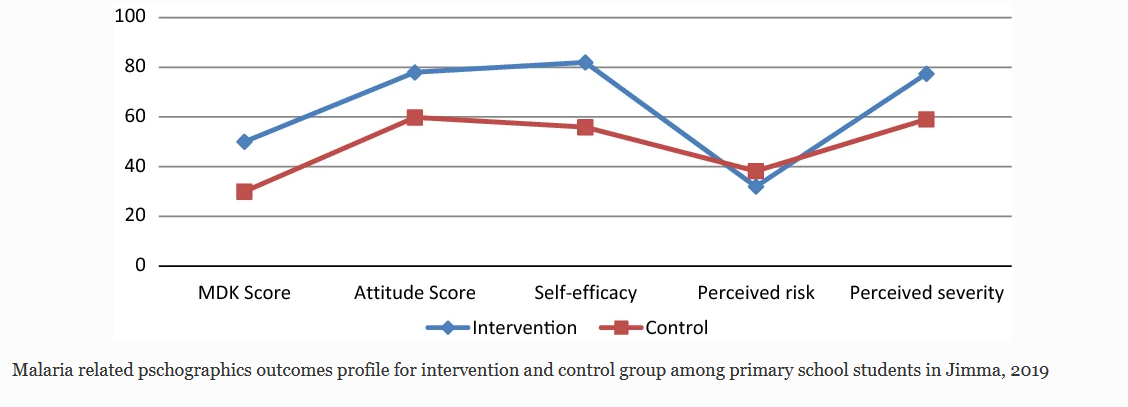
Mean differences (MDs) of self-efficacy (MD = 15.34; 95% CI: 13.73 to 16.95), knowledge (MD = 5.83; 95% CI: 5.12 to 6.55), attitude (MD = 6.01; 95% CI: 5.26 to 6.77), perceived malaria risk (MD = 2.14; 95% CI: 1.53 to 2.76), and perceived family supports (MD = 6.39; 95% CI: 5.57 to 7.22) were observed favouring the intervention. Multivariable logistic regression modelling results showed that knowledge (β = 0.194, 95% CI: 1.09 to 1.35) and perceived family supports (β = 0.165, 95% CI: 1.11 to 1.25) and self-efficacy (β = 0.10, 95% CI: 1.22 to 2.32) predicted ITN utilisation among the school children.
Reflecting on the findings, the researchers point to the integrated peer education networks and community-led SBCC approaches in the programme. Parents actively participated in the programme through what is locally called "geengoo qulqullina barnootaa", which means the circle for quality of education. The circles are made up of members representing the community, teachers, students, and school directors, who have the ultimate task of improving the quality of education. Engaging parents was one of the key components of the intervention aimed to enhance family supports for improved adoption and sustained malaria prevention in the community and schools. Consequently, the result showed higher mean scores in perceived family supports among the intervention group.
In conclusion, this study suggests that "the school-based SBCC approach combined with peer education activities advanced the malaria-related knowledge, attitude, self-efficacy, risk perceptions, and family supports, which have ultimately improved the sustained use of ITNs among school-going children....[Further] research should be conducted to...understand the mechanism by which the SBCC approach affects students' behaviours given the influences of social, health services, and school systems."
Malaria Journal 20:41 https://doi.org/10.1186/s12936-020-03578-x - sourced from email from Sue Goldstein to The Communication Initiative on December 10 2021.
- Log in to post comments