










































Ending Child Marriage in a Generation: What Research Is Needed?
GreeneWorks
"Mobilization around the problem of child marriage has been very successful. A shared vision and narrative of the promising or successful program examples at all levels will help drive resources toward programs and research that will contribute to ending child marriage."
By mapping current knowledge of child marriage and the programmes (including communication-centred programmes) designed to address this practice, and, by highlighting gaps in the research on child marriage in which additional investment could catalyse change, this paper is intended to generate discussion in the field. It offers a coordinated research framework - in dialogue with programmes - and recommendations for ending child marriage.
The opening pages of the report outline in detail why child marriage - sometimes called "early and forced marriage" because minors, by definition, are unable to give formal consent - is a problem. In sum: "Girls' rights, health and development are undermined by the impact of early marriage, pregnancy and childbearing on their mortality and morbidity, the early termination of their schooling, and the ripples of girls' poor health and limited human capital on their future productivity and the lives of their children, families and their nations."
As noted here, "[o]ver the past five to ten years, many organizations, researchers and donors have developed, implemented and, to a lesser extent, evaluated programs to delay or prevent child marriage and mitigate its harmful effects on the lives of girls and their families. Concentrated in specific sectors (health, education) and tending to emphasize specific approaches to working with girls (life skills, awareness raising), these programs have taught us a lot about where we should be focusing our efforts to prevent, delay, and mitigate child marriage." The paper cites a number of programmes and research, such as a review conducted in 2011 by researchers at the International Center for Research on Women (ICRW), who looked at evaluated programme strategies for preventing child marriage, classifying them into 5 categories:
- Empower girls at risk for early marriage with information, skills, safe spaces, and support networks. An example is the Maharashtra Life Skills Program in India, which met with girls for one hour each weekday over one year, teaching them about social institutions, life skills, and health, including child health and nutrition.
- Enhance girls' access to school and improve the quality of that education. An example is the 2-year Ishraq programme in Egypt, which prepares out-of-school girls for re-entry into the formal school system, teaching literacy and numeracy, life skills, and sports.
- Offer economic training, support, and sometimes incentives that address families' economic reasons for marrying their daughters early. An example is Berhane Hewan in Ethiopia, which provided families with a goat as long as their daughters remained in the programme and remained unmarried until age 18.
- Educate and mobilise parents and community members to change social norms. An example is Tostan in Senegal, which has implemented long-term, informal community education and awareness-raising that has led to community mobilisation, sometimes around public declarations against harmful practices including female genital cutting and early marriage.
- Foster an enabling legal and policy framework. An example is Afghanistan's Community-based Rural Livelihoods Program, which has convened groups of women to mobilise for action on local issues of gender inequality and strengthened local shura councils to respond to problems including child marriage. (Shura is an Arabic word for "consultation". The Quran and Muhammad encourage Muslims to decide their affairs in consultation with those who will be affected by that decision.)
Drawing on programmatic lessons that have emerged from research such as that detailed in the paper, the investment framework presented here advocates for additional research into 4 interrelated categories: (i) programmes that focus on girls themselves (prevention and mitigation); (ii) norm change; (iii) advocacy for legal and policy change on child marriage; and (iv) making the case that child marriage is a fundamental issue to address in the context of development (See Figure I - Research Investment Framework). Each section starts with a description of major conceptual or research issues in that area and moves on to enumerate key research questions.
To cite only one example, within the "promoting norm change" component of the framework, one suggestion is to invest in the positive deviance (PD) approach as part of efforts to engage gatekeepers to prevent child marriage. (PD is based on the idea that specific individuals or groups who face the same limited resources and challenges as everyone else engage in uncommon behaviours and strategies that enable them to find better solutions to problems than their peers.) "In the context of child marriage, this might mean families who take steps to keep their daughters in school or who resist the pressures to marry their daughters as early as others. Opportunities exist to apply this framework to specific gatekeepers within many communities where organizations have been implementing interventions. Recent research on informal literacy training among mothers suggests that it may contribute to delaying daughters' marriages through the mechanisms of changes in these literate women's communication skills, their ability to influence family decisions, and their knowledge about women's legal rights and children's health." In this specific realm, the paper then presents priority research questions, such as: "What values and beliefs held by community members and leaders allow them to champion girls' rights, education and delayed marriage? At the girl, family, community and gatekeeper level, what do we know about those who resist early marriage compared to those who do not? How might lessons learned contribute to peer-to-peer dissemination of such messaging with the faith-based community, for example? How could the positive deviance approach be applied to other 'gatekeepers' including fathers and adult women who were once child brides themselves."
Though developing a set of common indicators across different kinds of programmes working to end child marriage is beyond the scope of this paper, the closing section shares ideas for evaluation strategies in order to open up a conversation amongst researchers, such as: "Collect data on innovative families' and communities' primary motivations for changing behavior regarding child marriage. Do such data exist? Have any polls or surveys covered this? Was it the influence of religious leaders? Grandmothers? Shifts in the marriage market? Desire to have girls complete school?"
In concluding, the paper stresses the need for a "high-level perspective", which "can easily be seen to include the development and dissemination of a shared theory of change. Other institutions working in the child marriage space also have much to contribute. In the longer term, this kind of partnership can facilitate collaboration and coordination in program research. A consensus is developing that bringing an end to child marriage requires coordinated, multi-sectoral efforts that empower girls, mobilize their families and communities, change gender-inequitable social norms, and strengthen and implement laws and policies. This collaboration will help drive the extension of programs in other related to address child marriage." Suggestions are offered, such as developing a concerted advocacy strategy focused on drawing people working in maternal health, education, sexual and reproductive health, livelihoods, and so on into the child marriage arena.
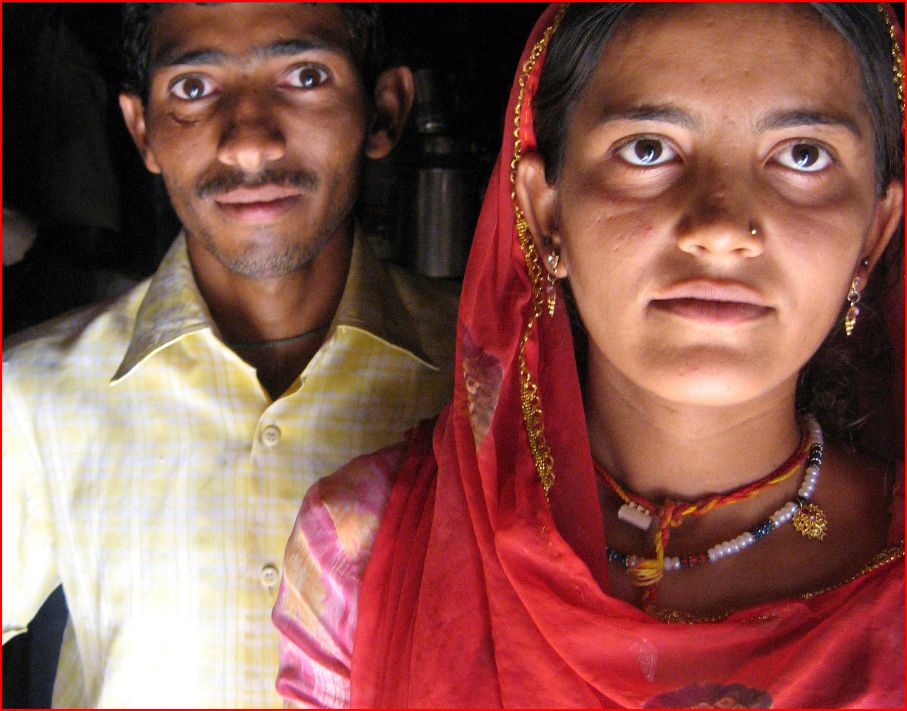
Ending Child Marriage in a Generation: What Research Is Needed? [PDF], accessed from the GreeneWorks website, August 18 2014. Image caption/credit: "A pregnant 15-year-old with her older husband, who is a migrant worker in Mumbai, India, meet with The Veerni Project. They were wed when she was ten in his village near Jodhpur. ©2006 Rose Reis, Courtesy of Photoshare"