










































The ESCULAPIO Project
"Health education can be defined as a set of intentional activities designed to transfer or construct knowledge about health to or for a person, a social group, or a community."
The Italian National Plan for the Vaccination Prevention 2012-2014 articulated the need for improved information and communication in order to update health professionals and to spread vaccine-preventable culture as an aware and responsible choice for each citizen. This inspired a project called ESCULAPIO, which is the Latin name of the mythological Greek god of medicine and the Italian acronym chosen to synthetise its extensive title: "Elaborating strategies and actions of multi-purpose health communication on vaccine preventable infectious diseases in order to increase vaccination coverage in the population". The 6 Operative Units (OU) participating in the project were located in 6 different Italian regions: Apulia, Liguria, Sardinia, Sicily, Tuscany, and Veneto. The main aims of the project were: (i) to increase awareness on vaccine-preventable infectious diseases (VPID) and vaccinations in different populations; (ii) to spread the culture of prevention; (iii) to develop information/training interventions on VPID; and (iv) to counter the spread of misinformation about vaccines through the internet and social networks.
Different activities were performed by each OU in order to achieve the project's objectives. The school, for its privileged role and function for the education of people, was often the chosen setting in which to develop communication activities in order to clarify and increase knowledge on VPID. For example:
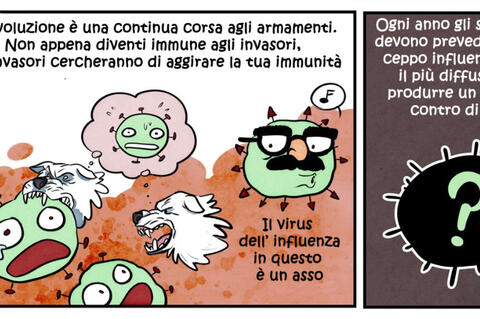
- The OU of Tuscany created and implemented training and information packages for more than 50 teachers and 775 students of high schools (14-20 years of age), by means of peer education activities. For the final competition, 25 project works were submitted for 3 categories: 5 for the human papillomavirus (HPV) diseases (2 comics, 1 PowerPoint presentation, 1 video, 1 poster), 12 for meningococcal diseases (6 comics, 2 videos, 2 illustrated stories, 1 brochure, 1 educational game), and 8 for exanthematic diseases (5 comics, 2 videos, 1 brochure). During the award ceremony, a seminar entitled "Myths and Reality on vaccines" was held order to offer another moment of education for the participating students. Representatives of the Ministry of Health and of the Communication office of the Tuscany Region attended the ceremony. According to project organisers, the high quality and originality of the project works submitted for the competition confirmed the potential of this approach to encourage students to themselves become promoters of the culture of prevention.
- Educational games for school pupils were organised in Liguria, with the aim of increasing awareness and knowledge of vaccination among primary school children (8-10 years of age), their families, and teachers through meetings and the distribution of information material, including flyers and educational games. Specifically, the educational card game called "Vaccine at the Fair" (in Italian, "Il vaccino infiera") was developed and used for schoolchildren together with educational material containing colourful images. The activities consisted of meetings featuring slideshows and the distribution of information material on VPID for parents and teachers. Organisers say that communicating information on infectious diseases and their prevention can guide parents and children in their health choices and also helps to create a whole-school culture of health by involving schoolteachers.
The OUs of Sicily and Apulia used research as a means for increasing awareness on VPID and vaccinations of the general population and the media.
- The Sicilian OU had the main objectives of: identifying determinants of vaccination uptake in the general population, developing and validating a questionnaire to collect data on the main factors influencing vaccine uptake in a population from Southern Italy, and spreading information on vaccines to the general population. A total of 632 questionnaires were collected in the shopping centres of Palermo. (Organisers say that, sometimes, approaching people with a questionnaire in such a setting was challenging due to their vaccine hesitancy or their lacking interest or time, but using gadgets (like the reproduction of the Sicilian Regional Immunization Schedule) and wearing a white jacket with an appropriate identification card frequently allowed a change of mind in the population willingness.) A general framework that emerged from the interviews was characterised by a frequent need of the population to receive homogeneous and correct information on vaccines; complaining and hesitancy were often observed in the sample population. Despite an increased use of the internet and social networks, people knowing about the Società Italiana d'Igiene Medicina Preventiva e Sanità Pubblica's VaccinarSi website are still very few (6%).
- The OU of Foggia, Apulia, organised a Vaccine Open Day, a meeting with the public to collect opinions, feelings, and information gaps about vaccinations. A report with the main results of the Vaccine Open Day was published in December 2015 in "Epicentro", the national portal of the Italian National Institute of Health. In October 2015, the OU activated a toll-free national telephone line, designed as a direct consulting point on VIPD that is freely accessible and addressed to a wide audience.
The objective of the OU of Sardinia was to increase knowledge on VPID and adherence to immunisation campaigns in health care workers (HCW) by realising traditional and e-learning training courses and initiatives of health promotion in healthcare and hospital settings. Examples:
- A music video played by HCWs was created and used in the University Hospital of Cagliari to promote the anti-flu vaccination campaign in HCWs in the seasonal vaccination campaign in 2015-2016. The video, as well as being mentioned during the regional news and in the main newspaper of Sardinia, was loaded onto YouTube and on the website of the University Hospital of Cagliari, recording thousands of views. It was shown during the 47th National Congress of Hygiene and Preventive Medicina Society (Riccione, October 1-4 2014) and at the Course on Vaccines held at the School of Epidemiology at Erice (Sicily). It was also brought to the attention of some members of the World Health Organization (WHO) European Region in Copenhagen, Denmark, who are experts in communication. This has ensured a high visibility of the work done, raising interest and approval by the scientific community and the general population.
- Different slide sets and information packages on influenza and measles were created aimed at educating general populations on VPID. They included general information and epidemiological data in order to raise awareness and increase vaccine coverage.
- In collaboration with the OUs of Florence, Foggia, Genoa, a distance learning course for health personnel aimed at increasing knowledge and immunisation coverage in HCW was developed and launched in September 2016.
Activities of the OU of Veneto focused on the promotion of immunisation and vaccination culture in child-maternal care settings. For example, 21 meetings were organised with new parents to discuss paediatric vaccines, more than 100 interviews were conducted with parents to facilitate individual counseling, and 8 home visits were carried out. In order to support the health personnel of the 5 local health units (LHU) of Veneto who have collaborated in the realisation of home visiting, in December 2015, a training course addressed to 32 HCWs was offered to introduce home visiting as a tool for the promotion of children's health and prevention of infectious diseases (including vaccination), with the participation of speakers experts in this methodological approach.
Immunisation and Vaccines.
The percentage distribution of the main indicators of the meeting with the population in Apulia follows the "continuum model of vaccine hesitancy" defined by the Strategic Advisory Group of Experts (SAGE) of the WHO. Among those who accept all vaccinations without any doubt (complete acceptance: corresponds to the highest proportion in the Apulian activity, 50%) and those who completely refuse without uncertainty (total rejection: the lowest percentage, 15%), a heterogeneous group of uncertain people can be identified. People belonging to this group nourish certainties toward some vaccinations and doubts about others and, consequently, decide to delay vaccination uptake (35%). People allocated to this group constitute a gray area that, according to organisers, deserves to be better investigated with the purpose of recovering confidence.
The experience of the Vaccine Open Day in Apulia allowed them to evaluate, through a point of local listening, the public need to receive clear and convincing information on vaccinations. Yet the rise of conflicting information and the ease with which misinformation can spread - via old and new media channels - provide a confusing context for parents and for the general population seeking assistance from health workers, religious leaders, family members, or other trusted sources, many of whom may not be completely aware about the risks and benefits of vaccines. In this context, it is not surprising that some caregivers have become hesitant about decisions to vaccinate.
University of Florence; University of Foggia; University of Genoa; University of Cagliari; Regional Center for Disease Prevention and Control, Veneto Region; and University of Palermo. Funded by the Center for Disease Prevention and Control (CCM) of the Italian Ministry of Health.
Strategies and Actions of Multi-Purpose Health Communication on Vaccine Preventable Infectious Diseases in Order to Increase Vaccination Coverage in the Population: The ESCULAPIO Project [PDF], by Angela Bechini, Paolo Bonanni, Sara Lauri, Emilia Tiscione, Miriam Levi, Rosa Prato, Francesca Fortunato, Domenico Martinelli, Roberto Gasparini, Donatella Panatto, Daniela Amicizia, Rosa Cristina Coppola, Barbara Pellizzari, Garden Tabacchi, Claudio Costantino, Francesco Vitale, Stefania Iannazzo, and Sara Boccalini, Human Vaccines and Immunotherapeutics 2017, Vol. 13, No. 2, 369-375. http://dx.doi.org/10.1080/21645515.2017.1268008; and VaccinarSi website, May 8 2018. Image credit: VaccinarSi