










































Evidence-based Discussion Increases Childhood Vaccination Uptake: A Randomised Cluster Controlled Trial of Knowledge Translation in Pakistan
Universidad Autónoma de Guerrero (Andersson, Soberanis); Community Information and Epidemiological Technology/Centro de Investigación de Enfermedades Tropicales - CIETcanada (Cockcroft, Foster, Shea); CIET in Pakistan (Ansari, Omer, Baloch); Ottawa Heart Institute (Wells)
"The results support the hypothesis that evidence-based structured community discussions can increase vaccine uptake without relying on improvements of health service delivery."
Childhood vaccination rates are low in Lasbela, one of the economically poorest districts in Pakistan's Balochistan province. Where household resources are scarce and little public attention is paid to vaccine-preventable diseases (VPDs), the present costs of vaccinating can eclipse the discounted costs of the possible future disease. This cluster randomised controlled trial (RCT) tested a knowledge translation intervention that sought to increase vaccination uptake through evidence-based discussions with men and women on the cost of vaccination versus the costs of treating VPDs.
The researchers began by consulting communities not involved in the study, learning through focus group discussions (FGDs) that belief in the efficacy of the vaccine was not the problem; rather, the overwhelming concern was about the costs of having children vaccinated. It cost many times more to treat a child with measles than it did to vaccinate a child against measles (in a ratio of 33:1). Some families, however, paid much less for cases of measles they treated at home (as was the accepted traditional practice in some of the communities). Informed by the discussions in non-sample communities, we developed detailed guides for conducting discussions with community members, to take place in 3 phases.
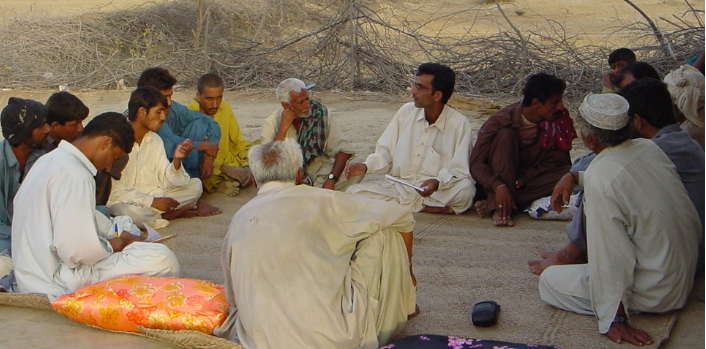
The researchers recruited and trained men and women from Lasbela to lead and record the 3-phased discussions in the intervention communities, which included 18 enumeration areas (EAs) with 3,166 children under the age of 5 years. (The 14 control EAs, also each of 4 or 5 villages, included a total of 2,475 children.) The first discussion shared findings about vaccine uptake from the baseline study; the second focused on the costs and benefits of childhood vaccination; and the third facilitated the development of local action plans. The field teams completed the discussions in the 18 intervention communities between August 2006 and March 2007.
More specifically, the activities of the field teams included: meeting community leaders to explain the purpose of the intervention and seek permission to work in the community; identifying suitable members for the discussion groups (e.g., people who were trusted within their community and able to convince others about important issues); scheduling and facilitating the 3 structured discussions, held separately with male and female groups; and assisting the groups to list local barriers to vaccination and develop action plans, which they encouraged group participants to discuss with other households in their communities. These action plans went beyond stimulating discussion about vaccinations within households and included, for example, sharing transport to vaccination points and providing care for some children while parents took others to be vaccinated. ("These community initiatives may have helped to maintain vaccination levels in the face of generally falling levels.")
Both intervention and control clusters received a district-wide health promotion programme emphasising household hygiene, implemented mainly through lady health workers (LHWs) and other local officers, who received specific training for this activity.
The baseline survey contacted 538 children aged 12-23 months in intervention and 373 in control communities. The follow-up survey contacted 536 in intervention and 420 in control communities, the increase in the control communities being because of fuller access to one of the control communities. The primary outcome was uptake of measles and full diphtheria, tetanus, and pertussis (DPT) vaccination of 12-23 month olds, as reported by the main caregiver.
In the follow-up survey, measles and DPT vaccination uptake among children aged 12-23 months was significantly higher in intervention than in control clusters, where uptake fell over the intervention period. Adjusting for baseline differences between intervention and control clusters with generalised estimating equations, the intervention doubled the odds of measles vaccination in the intervention communities (odds ratio (OR) 2.20, 95% confidence interval (CI) 1.24-3.88). It tripled the odds of full DPT vaccination (OR 3.36, 95% CI 2.03-5.56).
The analysis of secondary outcomes dealt with each of a "cascada" of precursors to vaccination uptake. Table 4 (see also Figure 2) in the paper shows a significant impact on conscious knowledge and attitudes about vaccination, subjective norms, intention to change, and discussion in the home. "The convincing impact of the intervention on these offers useful supportive evidence for a causal linkage between the intervention and vaccine uptake. The single exception was the variable used to measure self-efficacy or agency to take up vaccination....This could reflect a local lack of influence of women in decisions relating to the health of their children..."
Reflecting on the findings, the researchers describe the household cost-benefit equation on which this knowledge translation intervention as "a lens for understanding and negotiating parental decisions about vaccination: people weigh things up before making their health choices." They note: "It is possible that involving greater numbers of people in structured discussions directly in each community could increase the vaccination uptake further."
In conclusion, the Lasbela trial "set out to show an increase in the demand side of uptake....The remaining uncomfortable truth is that even if this is possible, it is often still important to increase the efficacy through improved service delivery quality. Future research should focus on both demand and supply side interventions, alone and in combination."
BMC International Health and Human Rights 20092009, 9(Suppl 1):S8 http://www.biomedcentral.com/1472-698X/9/S1/S8. Image credit: CIET
- Log in to post comments