










































Exploring the Behavioral Determinants of COVID-19 Vaccine Acceptance among an Urban Population in Bangladesh: Implications for Behavior Change Interventions
Helen Keller International (Kalam); World Vision International (Davis, Jr., Kanwagi); Institute of Epidemiology, Disease Control and Research, or IEDCR (Shano, Uddin); EcoHealth Alliance (Shano, Ariful Islam); SNV Netherlands Development Organisation (Md. Ariful Islam); Chittagong Veterinary and Animal Science University (Hassan); London School of Hygiene and Tropical Medicine (Larson); University of Washington (Larson)
"[This] study identified important beliefs and responses associated with different determinants of COVID-19 vaccine acceptance among urban population in Bangladesh which could be valuable to informing contextualized behavioral intervention and engagement strategies to support COVID-19 vaccination."
Vaccine hesitancy or refusal around COVID-19 vaccines is a growing concern worldwide. The Technical Advisory Group on Behavioral Insights and Sciences for Health of the World Health Organization (WHO) has identified a number of behavioural drivers of vaccine acceptance, including enabling environment, social influences, and motivation, and it has recommended contextualising these drivers into national COVID-19 vaccination plans. To that end, the aim of this study was to explore the behavioural determinants of COVID-19 vaccine acceptance and to provide recommendations to increase the acceptance and uptake of COVID-19 vaccines in Bangladesh.
This barrier analysis (BA) study was conducted in different urban areas of Dhaka from January 9-15 2021. The researchers examined twelve potential behavioural determinants (drawn from the Health Belief Model [HBM] and Theory of Reasoned Action [TRA]) of intended vaccine acceptance. They conducted 45 interviews with those who intended to take the vaccine ("acceptors") and 45 interviews with those who did not have that intention ("non-acceptors"). To guide the interviews, this study modified the standardised BA questionnaire from the Designing for Behavior Change (DBC) training manual.
The behavioural determinants associated with COVID-19 vaccine acceptance in Dhaka included perceived social norms, perceived safety of COVID-19 vaccines and trust in them, perceived risk/susceptibility, perceived self-efficacy, perceived positive and negative consequences, perceived action efficacy, perceived severity of COVID-19, access, and perceived divine will.
Namely, some of the strongest predictors of vaccine acceptance in this population are beliefs around both injunctive and descriptive social norms: who the respondent thinks approves or disapproves of COVID-19 vaccination, and the proportion of people they think will go for a COVID-19 vaccine when it is available. For instance, acceptors were 3.2 times more likely to say they would be "very likely" to get a COVID-19 vaccine if a doctor or nurse approved (p<0.001), while non-acceptors were 2.6 more likely to say it would be "not likely" they would get a vaccine if a doctor or nurse recommended it (p<0.001). Acceptors were almost twice as likely to say that "most people" they know will get a vaccine (p<0.001), whereas non-acceptors were 3.5 times more likely to say that "very few people" they knew would get a vaccine (p<0.001). In terms of respondents' impressions concerning who disapproves of their getting a COVID-19 vaccine, acceptors were 1.7 times more likely (than non-acceptors) to say that "no one" would disapprove (p<0.001). Acceptors were 1.3 times more likely to say that "most community and religious leaders" would want them to get a vaccine (p = 0.007), while non-acceptors were 1.5 times more likely to say that most community leaders and religious leaders would not want them to get a COVID-19 vaccine (p = 0.002).
When asked how safe the COVID-19 vaccines are, non-acceptors were 1.8 times more likely to say that COVID-19 vaccines are "not safe at all" (p<0.001), while acceptors were 1.4 times more likely to say that COVID-19 vaccines are "mostly safe" (p<0.001). In line with the HBM, beliefs about one's risk of getting COVID-19 disease and the severity of it were predictive of being a vaccine acceptor: Acceptors were 1.4 times more likely to say that it was very likely that someone in their household would get COVID-19, 1.3 times more likely to say they were very concerned about getting COVID-19, and 1.3 times more likely to say that it would be very serious if someone in their household contracted COVID-19. Other responses of acceptors on what makes immunisation easier may be helpful in programming to boost acceptance, such as providing vaccination through government health facilities, schools, and kiosks, and having vaccinators maintain proper COVID-19 health and safety protocols.
Acceptors were twice as likely to say they trust the COVID-19 vaccines "a lot" or a "moderate amount" (p<0.001). Conversely, non-acceptors were 1.7 times more likely to say they "trust them a little" (p<0.001) and 2.3 times more likely to say they "do not trust [COVID-19 vaccines] at all" (p = 0.001). Respondents were asked if there were any cultural or religious reasons that they would not get a COVID-19 vaccine. Acceptors were 1.3 times more likely to say that there were no such reasons (p = 0.01), while non-acceptors were 1.3 more likely to say there were reasons (p = 0.002). When asked what those reasons were, non-Acceptors were 1.6 more likely to say they had heard "the vaccines were made with pork fat which is not allowed (haram) by Islam" (p = 0.001) and 1.4 times more likely to say that "vaccines were made with haram ingredients" (p = 0.003). Personal agency also came into play: Acceptors were much more likely to say they did not believe that getting COVID-19 was purely a matter of God's will or chance.
One key finding of this BA study is that there are a multitude of determinants and barriers that may affect vaccine acceptance and that should be used in the development of vaccination and communication plans. For example:
- To increase perceived positive social norms, especially for those who found to be important influencers of this behaviour (e.g., medical staff and mothers), videotaping individuals giving testimonials in each neighbourhood on why they plan to get the vaccine and distributing the videos over media is one possible approach to leverage social norms. Other activities can be used to make acceptance more visible (e.g., stickers on households that say, "We plan to vaccinate!" or lapel pins with the same message).
- To increase the perception that COVID-19 is serious (to address low perceived severity), testimonials by people who have lost or almost lost family members due to COVID-19 disease could be recorded and shared.
- To address perceived divine will, religious leaders of all faiths could be assisted in creating sermon outlines on maintaining one's health (and linking that with COVID-19 vaccines) and/or radio spots to promote COVID-19 vaccines.
- While not repeating any misinformation, it will be important to provide clear information on the known minor risks of COVID-19 vaccination as a way to combat misinformation on side effects that were mentioned more often by non-acceptors (e.g., life-threatening conditions, new diseases, infertility). Clear and detailed information on how vaccines are made and tested should be disseminated to counter misinformation (e.g., that vaccines are made with pork fat or other haram ingredients).
In conclusion: "The results suggest that an integrated behavior change strategy, focused broadly on the behavioral determinants found to be associated with vaccine acceptance and hesitancy, needs to be incorporated into existing vaccination plans to increase the acceptance and uptake of COVID-19 vaccines and to end the pandemic."
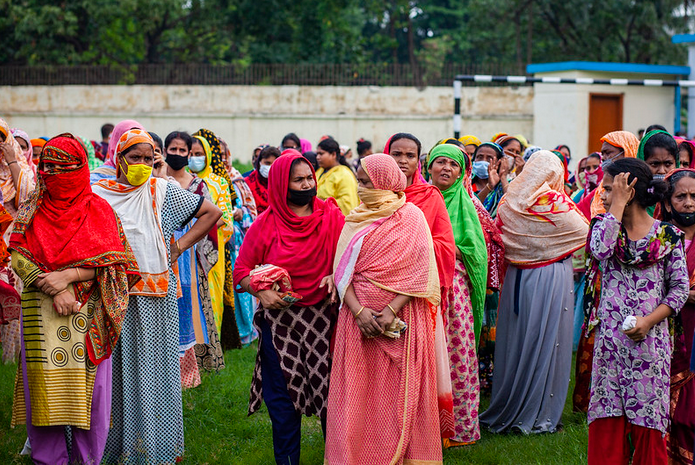
PLoS ONE 16(8): e0256496. https://doi.org/10.1371/journal.pone.0256496. Image credit: UN Women/Fahad Abdullah Kaizer via Flickr - (CC BY-NC-ND 2.0)
- Log in to post comments