











































Filles Eveillées
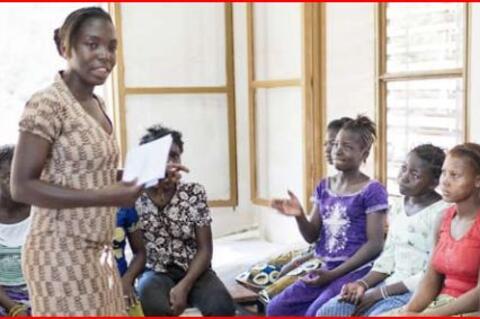
"It's because we feel comfortable with our mentor that we come and tell her what we think. With her, there's more security in communicating - you consider her like a friend." - 15-year-old participant
This 8-month, 30-session intervention for migrant adolescent domestic workers in urban Burkina Faso aims to: increase social capital; build adolescent girls' skills in health (including sexual and reproductive health), life skills, and financial capabilities; and link girls to services. By providing girls with a safe space, access to peers, and a female mentor, Filles Eveillées ("Girls Awakened") seeks to increase domestic workers' opportunities and reduce their vulnerabilities. The Population Council's 2011-13 pilot programme reaches out to 375 girls and has 2 programme cycles. The 2011-12 cohort was conducted in Bobo-dioulasso in partnership with Association Tié and included girls 11-16 years old. The 2012-13 cohort includes girls up to age 18 in Ouagadougou, and is being carried out in partnership with the Association d'Appui et d'éveil Pugsada.
In 2010, the Population Council conducted formative research to better understand the situation of migrant adolescent girls in domestic service in urban Burkina Faso. Findings revealed that once girls arrive in the city, they typically live with their employers and spend long days performing arduous work. This leaves them with little time for schooling, building social networks, and developing skills necessary for adulthood. The formative research also showed that girls' migration is typically seasonal; girls live and work in cities during the dry season and return home each year to help out with agricultural tasks during the rainy season. Furthermore, the research revealed that the majority of programmes designed for this population: intervene after something has gone wrong rather than building girls' protective assets; focus on teaching girls about their rights rather than imparting skills; are not designed around logical age segments; and focus on inputs (i.e., number of radio messages delivered) rather than measurable change at the level of the girl.
In response, Filles Eveillées was created to involve:
- Door-to-door recruitment to reach the most socially isolated: Female mentors drawn from intervention communities who are 20-30 years of age, able to speak the local language, and have achieved at least a few years of secondary education are trained on a skills-based curriculum that focuses on life skills, health and hygiene, sexual and reproductive health, and financial capabilities. Following training, mentors go door to door to identify girls eligible for programme participation (those who are 11-16 years old and employed as domestic workers in one of the selected project sites). Both participants and employers are asked to sign the programme permission form and to consent to girls' participation in programme surveys.
- Community engagement: Before launching Filles Eveillées, programme staff meet with community leaders to introduce the programme, identify safe spaces where the programme can be held, and respond to community concerns. Community awareness sessions are held 3 times during the course of the 8-month intervention to introduce community members to the goals and expectations of the programme, update them on what girls are learning, hear testimonials from girl participants, and respond to any questions or concerns. Mentors also make 3 home visits to each girl during the course of the intervention to strengthen the relationship between the mentor and the employer, strengthen the relationship between the employer and employee, and keep the employer informed of the programme and the employee's progress.
- Regular group meetings: Groups meet once a week on Sundays for about 2 hours in empty classrooms in local schools, in municipal buildings, at local non-governmental organisations (NGOs), and in semi-enclosed courtyards. Sessions are designed to be interactive and utilise group discussions, personal stories, exercises, and role-playing. In addition, girls who have never been to school or who have not finished school are given the opportunity to gain primary or secondary education through cours du soir (evening classes). One course correction that the programme team made for cohort 2, based on evaluation findings, was refining the curriculum in terms of organisation, content (with particular attention to illiteracy), and extra resources and exercises to reinforce learning. Given girls' interest in developing financial capabilities, it was decided to move this section toward the beginning of the curriculum so that girls can be encouraged to exercise their skills in savings, and mentors can more closely monitor progress.
The Filles Eveillées team refined the programme model before beginning with the 2012-13 cohort. Recognising that the success of Filles Eveillées depends on community engagement, the team added an element to directly engage employers in a few sessions in addition to their participation in community awareness sessions. Likewise, girl graduates of the programme who are still living in the city and engaged in domestic work are serving as assistants to programme mentors in the second cohort. In addition, Filles Eveillées is introducing girls to local health providers and covering the cost of needed health and/or medical services for those who are unable to pay for such care. Finally, given the importance of savings for economically active girls who are living apart from parents, the programme team is putting greater emphasis on introducing girls to financial institutions through guided visits with bank staff.
The team is also developing a toolkit that is designed to allow programme graduates to pass on their knowledge to peers and other girls in their urban neighbourhoods and villages.
Girls, Health, Reproductive Health, Population, Economic Development
This programme was designed to coincide with the seasonal migration of the intended population and reach girls when they are living and working in cities. Participants from the programme's first cohort were found to be highly mobile, and internal migration was far more common than international as is typical among adolescent girls. The majority of participants were born in Burkina and moved to Bobo-dioulasso. More than 60% at baseline reported living in their current neighbourhood for less than one year. Four-fifths of the girls reported moving to the city for economic and employment reasons.
Population Council, Association Tié, and the Association d'Appui et d'éveil Pugsada
"Filles Eveillés ("Girls Awakened"): A Pilot Program for Migrant Adolescent Girls in Domestic Service in Urban Burkina Faso" [PDF], by Sarah Engebretsen, Gisele Kaboré, and Leah Jarvis, The Population Council, 2012. Image credit: Ollivier Girard
- Log in to post comments