At First Sight

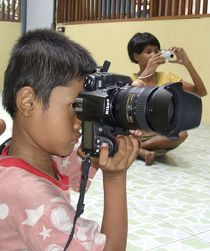
At First Sight was premised on involving the entire community in a process of community identity and learning. It worked through weekly collective photography sessions and symposium community lunches to share commentaries and pictures taken during the previous sessions. "In the beginning," said Ratchakorn Kulsawet, a Thai volunteer from the Friends of ATD Foundation, "we planned to start with a small group of teenagers, to train them in basic photography so that they could capture objects or scenes that represented their idea about the identity of themselves or their community - as well as their point of view for development to share with Thai citizens and international community in Bangkok. As it turned out, at the first training session at the community centre, some children who heard about the activity came to observe and requested the opportunity to learn taking photos as well."
At First Sight's education for international understanding goal was pursued through giving members of the Saphan Phut community opportunities to get in touch with similar community photography for development projects worldwide through an online social network (no longer active).
In the second phase of At First Sight, through a participatory approach, environmental protection priorities of the Saphan Phut community were identified. Two discussion groups were organised to discuss how the community could volunteer to improve its own environment. One discussion group was composed by representatives of the community. The second one involved the youth who took part in the photography project. The representatives identified tangible improvements needed in the community - for example, building a warehouse for recycled materials or buying a water pump to prevent flooding during the rainy season. The teenagers were required to identify tangible improvements needed in the community as well. Furthermore, they were asked to think about the most effective way to report on the environment-related activities to be developed. They then developed a small photography record titled "I report...on my environment".
The formal output of the project was a 92-page e-book (click here to access it) containing pictures taken and commentaries given by the youth of Saphan Phut about their identity, values, and challenges. Its first section tells the story of the project including its inspiration, actions, partners, and methodology. The second section is compiled as a coffee table book presenting two series of photos. In the first series, "A Selection From The International Community", volunteers from UNESCO Bangkok were asked to collect pictures from the web that represent their feelings about Bangkok and to comment on their choices. The second series is composed of photos portraying lives in the Saphan Phut Community, captured and commented on by its young dwellers.
Editor's note: While the project has ended, the e-book is still available at the URL above. Also, more information on At First Sight can be found at these URLs:
- "At First Sight: Community Photography for Development in Action", by Linda Germanis
- "Pictures Tell a Thousand Words - Photography Project Highlights Hardships of Neglected Community"
- Project Photo Gallery hosted by UNESCO
- "Cameras Click in Recognition of UNV Volunteer"
- "IVD Story Competition Runner-up: The Environment - At First Sight"
Children, Youth, Environment.
The young photographers have participated as a team in different photo contests on social and development issues at national, regional, and international levels. Some of the photos taken by its young residents were selected by an international organisation in Geneva, Switzerland, for a slide show exhibit.
UNV, UNESCO, International Movement ATD Fourth World Thailand, and the Friends of ATD Foundation.
"Pictures Tell a Thousand Words - Photography Project Highlights Hardships of Neglected Community", in the UNESCO Asia and Pacific Regional Bureau for Education's News on ICT in Education, January 22 2010; At First Sight website (no longer in operation), February 23 2010; and emails from Linda Germanis to The Communication Initiative on August 1 2011 and April 7 2013. Image credit: UNV/ATD Foundation