










































"Flag it!"
"The mapping tool should not be something that journalists should be afraid of, it is just a matter of being resourceful to know free, good apps, combined with imagination on how to use these tools to tell the story." - from a "Flag it!" participant
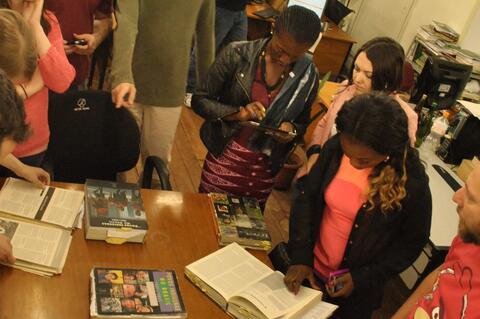
This European Youth Press project aims to train young media makers from all over the world on how to report on environmental issues at local level with a global impact by using digital visalisation tools that are available in open source (free license/universal access). In 2013, 48 young journalists from Africa, Asia, Europe, and South America (12 at a time) took part in a training course as follows: in São Paulo, Brazil (May 20-26 2013), Lagos, Nigeria (July 1-7 2013), Manila, Philippines (September 9-15 2013), and Bucharest, Romania (October 7-13 2013). At the end of "Flag it!", in November 2013, these young journalists were able to use free digital mapping tools to cover environmental issues in their regions. Each of them produced a report using the tools learned during the course.
The "Flag it!" training course was based on the best practice provided by the Brazilian association "O Eco" in mapping deforestation in the Amazon basin through the use of tools such as: Google Maps, Google Earth, Google Fusion Tables, Crowdmap, Ushahidi, and Geocommons, among others. The course integrated field trips for the participants to apply the tools in reporting on specific on-the-ground environmental issues. The modules focused on: (i) Sourcing/Mining and Cleaning Data; (ii) Visualising and Analysing Data; (iii) Mapping Data; and (iv) Crowdsourcing and Mobile. Click here to read bios of all 48 of the young participants. For example, one of them is described as "a science communicator and an enthusiast on using tools in knowledge management for development. With skills in writing, media production and publication, and web content development, she handles themes such as agriculture, climate change, and natural resource management. Currently, she works at the International Rice Research Institute. As part of her advocacies, she also has personal projects related to youth development and environmental conservation."
In addition to the young journalists' reports - available here - "Flag it!" aims to continue its mission through its own follow-up events and development of working groups in order to help foster a new global trend in environmental reporting. For example, the project also resulted in an online handbook through which anyone can learn to use these tools. (Please see Related Summaries, below, to read a summary of this handbook and to access it.)
In addition to details about the project, the "Flag it!" website offers a page that collects tips and online sources for journalists who want to integrate their reports with tools for data mining, analysis, and visualisation.
Environment, Youth
Post-training surveys from 3 of the 4 training sessions may be downloaded in PDF format from this page on the "Flag it!" website. For example, one São Paulo participants said of the course: "I have been a multimedia journalist for a few years now offering a mix of photo, video and text to tell the story; adding map s and layers of information in the story gave me a fresh take on multimedia journalism."
The training course was organised by the European Youth Press in partnership with: Internews, the association "O Eco", the Young Friends of the Earth Europe, the Philippines Network of Environmental Journalists, the Nigerian Association of Science Journalists, YouthPress Romania, and the Latvian Forum for European Journalists Students. "Flag it!" is funded by the European Commission through the Youth in Action Programme.
"Flag it!" website, April 7 2014.
- Log in to post comments