










































Future Priorities for Development Informatics Research from the Post-2015 Development Agenda
Centre for Development Informatics, University of Manchester
"[I]f the post-2015 agenda reflects what matters and what works in delivering socio-economic development, then there can be no better guide for prioritising research that makes a difference, and that has a real-world impact."
What should be the future priorities in researching information and communication technology for development? On the cusp of the shift in focus from the Millennium Development Goals (MDGs) to the so-called post-2015 development agenda (PTDA), the paper presents results from a content analysis exercise which compared the content of the PTDA against the content of 116 papers published in 2013 researching information and communication technology for development (ICT4D). The purpose of this exercise was to find possible research gaps in the current ICT4D research agenda compared to the PTDA agenda.
The field of development informatics (DI) was used to identify "roughly 200 terms that provided a specific and meaningful sense of direction within the international development agenda" (details are provided in the paper) and then the terms were used to compare text content between 2 sets of documentation: (i) DI research collated from 116 papers presented during 2013 in 3 key DI research outlets; and (ii) 4 key documents that "provide the foundation to date for the post-2015 process (for example, the report, "A New Global Partnership", which was produced in mid-2013 by a High-Level Panel set up by UN General Secretary Ban Ki-moon). Each set of documents was combined into a single overall document, and then textual analysis was undertaken via comparative word counts.
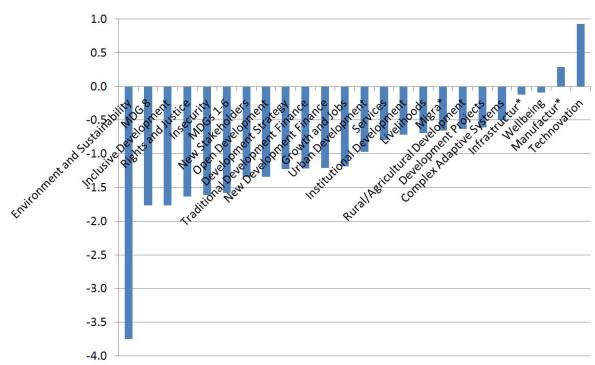
The basic comparison is shown in the figure above (see page 7 of the paper to view a larger version). It plots the extent of difference between the DI papers and the post-2015 text, aggregated into a set of development issues. Issues above the line are more highly represented in DI documents than in the post-2015 agenda; issues below the line are less highly represented. The larger the indicator the greater the over- or under-representation. This chart, in addition to a whole set of other analytical data (see the paper for details), produces a DI research priority map that, laterally, sorts research issues in terms of their relation to development - mainly by type of goals (e.g., environmental, economic, social, political, or "cross-cutting") but also including mechanisms of development (e.g., ICTs and development management). Vertically, it sorts research issues in terms of gap (e.g., ICTs and poverty or ICTs, rights and justice). The higher up in the diagram a topic appears, the greater the gap between its presence on the post-2015 agenda and its presence in current DI research.
The result of this combined analysis led author Richard Heeks to assert the "fifteen for post-2015" largest DI research gaps in terms of topic (with what he calls "Development 2.0" shown where he feels it should appear in priority terms but without being numbered): (i) Environment and Sustainability, (ii) Poverty, (iii) Development Management, (iv) Food and Agriculture, (v) Development Finance, (vi) Inclusive Development, (vii) Rights and Justice, (viii) Data Revolution, [Development 2.0], (ix) Growth and Jobs, (x) Security and Violence, (xi) Gender/Women, (xii) Cross-Border Flows, (xiii) Resilience, (xiv) Governance, and (xv) Urban Development.
Heeks briefly describes some of the implications of the findings in each area. For example, although "sustainability represents a very strong theme throughout the post-2015 agenda", Heeks' analysis found that only 2 of the 116 DI papers address sustainability, and none address climate change or other environmental issues. There are many research sub-topics within this theme that Heeks argues require greater attention from those working in DI, such as: research to investigate specifically how ICTs can improve energy supply and energy security in developing countries, including greater use of renewable sources; analysis of the links between ICTs and water from modelling and mapping fresh and underground water systems, to reporting mechanisms on water supply points; research on ICTs and the components of disaster management (preparation, response, recovery, and reconstruction); efforts to understand ICTs' contribution to pollution (e.g., research on e-waste); and research on how to ensure fewer failures and greater sustainability of ICT4D projects.
In terms of the strategic process of undertaking DI research in these areas, Heeks uses as a launching point for his recommendations Rob Jensen's (2007) paper on mobile phone use by fisherman in Kerala (a state in the southwest region of India on the Malabar coast). Heeks points to the importance of:
- "a) Audience Focus and Dissemination: good ICT4D research identifies, focuses on and targets its particular audience. Jensen is an academic economist. He did this research and he wrote up this research for other academic economists. He chose an appropriate channel - a leading economics journal - to reach that audience. (And then reached much further through having the work summarised in The Economist.)
- b) Conceptual Foundation: good ICT4D research is founded on and structured around some conceptual framework or model. Without that, research struggles for coherence and consistency....Jensen's work is rooted in welfare economics theory, to which it also makes a contribution.
- c) Rigorous Methods: good ICT4D research has a methodology, and rigorously applies appropriate research methods. It also explains the methodology, methods and their application to its readers. Good narratives about ICT4D win hearts. Good quantitative statistics win minds. But too much ICT4D 'research' falls down in between....Jensen's research avoids this: it has a rigorous quantitative foundation built on shed-loads of longitudinal field data."
Email from Richard Heeks to The Communication Initiative on March 25 2014; and ICTs for Development blog, March 25 2014 (accessed April 1 2014).
- Log in to post comments