
























Development action with informed and engaged societies
After nearly 28 years, The Communication Initiative (The CI) Global is entering a new chapter. Following a period of transition, the global website has been transferred to the University of the Witwatersrand (Wits) in South Africa, where it will be administered by the Social and Behaviour Change Communication Division. Wits' commitment to social change and justice makes it a trusted steward for The CI's legacy and future.
 
Co-founder Victoria Martin is pleased to see this work continue under Wits' leadership. Victoria knows that co-founder Warren Feek (1953–2024) would have felt deep pride in The CI Global's Africa-led direction.
 
We honour the team and partners who sustained The CI for decades. Meanwhile, La Iniciativa de Comunicación (CILA) continues independently at cila.comminitcila.com and is linked with The CI Global site.
Time to read
less than
1 minute
Read so far

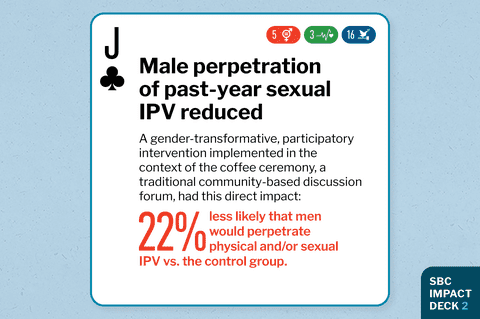
Gender-transformative, Participatory Intervention - 22% Less Likely That Men Would Perpetrate IPV
0 comments

Strategy researched

A gender-transformative, participatory intervention delivered to men, women, or couples in Ethiopia to prevent intimate partner violence (IPV) that was implemented in the context of the coffee ceremony, a traditional community-based discussion forum

Impact achieved

22% less likely that men would perpetrate physical and/or sexual IPV compared to those who did not participate in the intervention, and 19% less likely that women would experience physical and/or sexual IPV after their partner participated - compared to the control group.

Country of study

Ethiopia

Research methodology

Cluster RCT with 6,770 households

Journal

PLOS Medicine; 2020

Journal paper title and link

Effectiveness of a culturally appropriate intervention to prevent intimate partner violence and HIV transmission among men, women, and couples in rural Ethiopia: Findings from a cluster-randomized controlled trial

Excerpt from Abstract

"A gender-transformative intervention delivered to men was effective in reducing self-reported perpetration of sexual IPV but did not reduce IPV when delivered to couples or women. We found evidence of decreased sexual IPV with men's UBL across men's and women's reports and of increased HIV knowledge and condom use at last intercourse among women. The men's UBL intervention could help accelerate progress towards gender equality and combating HIV/AIDS."