










































Global Immunization Systems Strengthening through Pediatric Societies: The Promise of Private-Public Partnerships in Indonesia
Ann & Robert H. Lurie Children's Hospital of Chicago (Tan); Cipto Mangunkusumo General Hospital (Gunardi, Pulungan); American Academy of Pediatrics (Smith, Merchant, Carter, Patterson); Indonesian Pediatric Society, or IPS (Goentoro)
"Pediatricians and national pediatric societies (NPS) are trusted stakeholders in their countries and are uniquely qualified to promote vaccination programs."
According to the Indonesian Ministry of Health (MOH), low immunisation coverage can be attributed to cost, access to health facilities, vaccine hesitancy, and low education and knowledge around vaccines. In 2014, the country launched a healthcare policy known as Jaminan Kesehatan Nasional (JKN) that sought to use private-sector providers as a solution to help the country achieve universal health coverage. In order to meet the increased demand for private-sector vaccination services, private hospitals and clinics imported vaccines that were subsequently determined to be counterfeit. The scandal sparked public uproar. This article describes and evaluates an initiative to build the capacity of Indonesia's paediatricians and national paediatric societies (NPS) to strategically advocate for improved immunisation services across both public and private sectors.
In 2016, the American Academy of Pediatrics (AAP), with support from the United States Centers for Disease Control and Prevention (CDC), began a 3-year global project partnering with NPS across Sub-Saharan Africa and Asia. In Indonesia, 3 main priorities were identified: (i) integrating public and private vaccine service delivery data; (ii) combatting vaccine hesitancy; and (iii) improving patient and community communication. To work toward these aims, the Indonesian Pediatric Society (IPS) implemented a phased approach:
- Phase 1: advocacy training - IPS and AAP hosted a 2-day advocacy workshop in which 60 IPS leaders were trained as immunisation advocacy champions. It focused, for example, on practical skills related to using data (e.g., through the IPS-PEDIATRIC Online Immunization Reporting System:I-POINTS) to improve practice-level service delivery and strategies for combatting vaccine hesitancy.
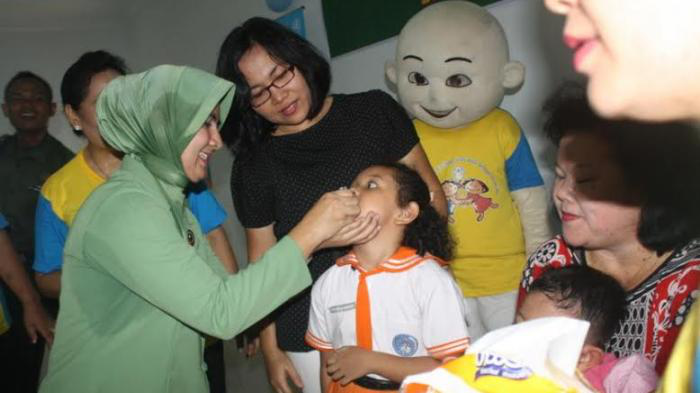
- Phase 2: advocacy in action - IPS trained an additional 143 paediatricians from districts across the country in improving immunisation advocacy and providing vaccine education in daily practice and the use of I-POINTS. IPS also held a virtual symposium on measles-rubella (MR) vaccination to improve paediatric engagement and support of the national MR Supplemental Immunization Activity (MR SIA). To reach the general public, IPS produced 3 immunisation advocacy public service videos and held press conferences on the MR campaign and common misconceptions about immunisations that aired on local television. The public-facing messages included coordination between IPS, MOH, and other national-level stakeholders.
- Phase 3: sustaining immunisation advocacy - IPS expanded its advocacy efforts by: (i) training "fresh graduate" paediatricians working in rural areas on immunisation advocacy and the I-POINTS reporting system; (ii) establishing linkages between IPS and the Indonesian Medical Association and Indonesian Midwives Association; and (iii) developing an immunisation reporting protocol connecting private practitioners and the MOH for quality assurance and advocacy. To support the trainings, IPS developed immunisation advocacy and reporting handbooks, as well as a video tutorial, on the I-POINTS platform.
Both qualitative and quantitative data were collected early- to mid-2019 from the following sources and stakeholders: IPS end-of-project reports, web-based survey, and in-person interviews and focus groups. The 3 broad themes that emerged from the data related to successes were (see also Table 2 in the paper):
- Increased coordination across public and private sectors - For example, based on the IPS advocacy training, IPS worked with chapters in each district to ensure that both private and public sector providers were sharing the same messages about the safety and benefits of vaccines during the 2018 public sector MR SIA campaign. Similarly, IPS has taken a lead role in training and providing ongoing supportive supervision to the Indonesia Medical Association and Indonesia Midwives Association. As a result of these activities, both general practitioners (GPs) and midwives have reported increased comfort and self-efficacy in discussing vaccines with patients and families.
- Improved service delivery - For example, in rural Way Kanan, the vaccine-advocacy-trained "fresh graduate" paediatrician worked with the health office to improve immunisation access and stakeholder knowledge of immunisations at all levels. This resulted in immunisation coverage rates increasing from 64.8% in January 2017 to an average of 100% in December 2018. As of April 2019, the rates remained at 100%. According to district health officials, this coverage increase is attributed to the on-the-job training and reporting and data management support the "fresh graduate" provided to both the district health office team and the Indonesian Ulema Council delegation for Way Kanan (Majelis Ulama Indonesia), which serves as the official interface between the Indonesian government and the Islamic community.
- Strengthened institutional capacity for advocacy and immunisation systems support - "IPS is now regarded as a key resource for immunization information among clinicians and private providers, as evidenced by the formal partnerships that have been established between GPs, nurses, midwives, as well as the ongoing supportive supervision and clinical education IPS provides....71% of the Champions surveyed feel very confident in their skills as an advocate (as compared to 56% at baseline) and 71% reported feeling engaged and supported by IPS in their advocacy activities."
Despite these successes, there have been 4 main challenges to ensuring IPS's work is sustainable: (i) varying needs and commitments due to the vast geography and a high level of decentralisation in Indonesia; (ii) bureaucratic turnover in national and sub-national immunisation programmes; (iii) long-term commitment to data collection and regular reporting; and (iv) community vaccine hesitancy. On the latter challenge, it is noted that the experience with counterfeit vaccines referenced above, which sparked not only public outrage but also provider arrests and an Islamic fatwa against the MR vaccine, "has eroded public trust that must be rebuilt. Combatting hesitancy is complex and requires a multi-pronged approach including coordination of the public and private sectors. Ongoing support to providers, immunization partners, religious organizations, and the community is needed."
The article outlines 10 concrete steps IPS plans to take going forward, including collaborating with Uelama to support and increase immunisation coverage and minimise vaccine hesitancy. It also offers findings that may be transferable across specific national immunisation programme and country needs:
- Collaboration with and training of non-traditional stakeholders across the health system is recommended to help increase and sustain immunisation coverage.
- Due to bureaucratic turnover, establishing long-term relationships with key stakeholders may be difficult but is critical to regional and national-level prioritisation and policy changes.
- Paediatricians can be a natural point for coordination of data, messaging, and services but require specific outreach from ministries of health and bilateral organisations to ensure engagement.
- Buy-in from community and religious leaders of messaging and outreach is essential to improved service delivery and declines in vaccine hesitancy.
- Continued opportunities to increase the knowledge basis of providers regarding both immunisation standards and advocacy skills are critical to sustainably addressing immunisation challenges, particularly around demand.
"In conclusion, building the capacity of National Pediatric Societies...through education empowers individual members, and other child health clinicians to strategically advocate for improved immunization services across both public and private sectors enable them to play a unique role in helping countries reach global immunization targets."
Human Vaccines & Immunotherapeutics https://doi.org/10.1080/21645515.2019.1697108. Image credit: Tribun Medan/ Array A Argus
- Log in to post comments