










































Grandmothers to Grandmothers Campaign
- Encouraging awareness in Canada about Africa's grandmothers and their struggle to secure a hopeful and healthy future for generations of children orphaned or made vulnerable by HIV/AIDS;
- Building solidarity amongst African and Canadian grandmothers in the fight against HIV/AIDS;
- Actively supporting groups of grandmothers in Africa who are dealing with the loss of their own children and struggling to care for AIDS orphans.
The Grandmothers to Grandmothers campaign centres around a call to action, which more than 220 groups of Canadian grandmothers have answered by joining together to raise awareness and funds. Groups have also been formed in Australia, New Zealand, and the United States. The groups are encouraged to:
- share their feelings about the plight of Africa's grandmothers by talking to family, friends, and their community and spreading awareness - or by participating in one of the blogs on the campaign website;
- use the materials on the campaign website to learn more about the issues and how people can become more involved and provide practical support - for example, the Grans in the Schools Initiative, which involves grandmothers working closely with teachers and boards of education to do presentations in elementary and secondary schools;
- subscribe to "Granny Bulletins", regular email updates on the campaign, intended to keep grandmother groups across Canada informed about, and connected to each other and the grandmothers and grassroots projects in Africa that are supported through their fundraising and awareness-raising efforts;
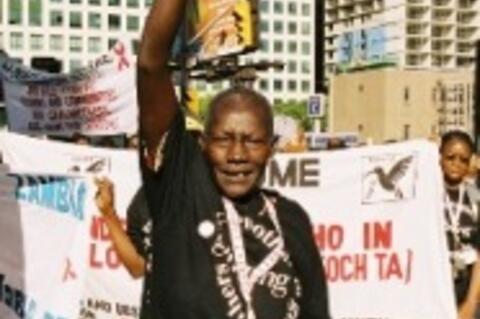
- plan activities such as the Grandparents Solidarity March on Parliament Hill, which was attended by 500 Canadian grandmothers on September 8 2007. SLF brought 2 South African grandmothers from the Treatment Action Campaign (TAC) to participate in the march. Elizabeth Mataka, United Nations (UN) Special Envoy for HIV/AIDS in Africa, also took part in the march.
- engage in online advocacy through the Canadian Grandmothers for Africa: A National Advocacy Network, which provides a non-partisan, collective voice on advocacy issues for members of grandmother groups across Canada. This advocacy work differs from, and complements, the awareness and fundraising initiatives undertaken by Canadian grandmothers groups in support of the SLF.
Here is an example of one group's activities, which illustrates some of the key communication strategies. The "Glacier Grannies" in Comox Valley, Vancouver Island (Canada), released a coffee table book titled "Planting Seeds of Hope: Textile Art from the Heart", a coffee table book produced by the North Island Quilters for Community Awareness to raise money for the Grandmothers Campaign. The quilters created 40 pieces of art in response to stories of grandmothers in Africa raising their orphaned grandchildren. The quilts respond to the question "Who Will..?" when a whole generation has been lost to AIDS. The works of art, with accompanying stories, are presented in an African motif soft cover book. The textile art was also displayed at a gallery; the individual art pieces were auctioned off in October 2008, with proceeds going to the Grandmothers Campaign.
Intercultural connection is encouraged. In October 2007, 8 African grandmothers from 4 countries visited British Columbia to meet with groups. Then, in March 2008, a delegation of 12 Canadian grandmothers traveled to Africa to visit SLF projects in Uganda, South Africa, and Swaziland. On March 25 2009, a Day of African and Canadian Solidarity drew more than 50 groups of Canadian and African grandmothers to different cities to perform a symbolic act of solidarity. Their goal was to draw attention to the crucial role that African grandmothers play in raising many of the 11.6 million children who have lost one or both of their parents to HIV/AIDS, and to call attention to the need for increased support.
A trilogy of films - "Grandmothers: The Unsung Heroes of Africa", "A Generation of Orphans", and "Women: The Face of AIDS" - illustrates SLF's support to grassroots HIV/AIDS initiatives.
Children, Women, HIV/AIDS.
As of May 2009, the campaign had raised more than US$6 million for African grandmothers and the children in their care.
According to organisers, Sub-Saharan Africa had an estimated 13 million children orphaned by AIDS in 2006; this number is expected to reach 18-20 million by 2010. Amidst the overwhelming needs, grandmothers have stepped up to take on the care of children left destitute and alone. With hardly any resources, the grandmothers of Africa are at the heart of the community response to the AIDS pandemic. In some countries in Sub-Saharan Africa, between 40% and 60% of orphans live in grandparent-headed households; the vast majority of them are cared for by grandmothers.
The United Nations Children's Fund (UNICEF), The Joint United Nations Programme on HIV/AIDS (UNAIDS).
AF-AIDS e-newsletter, March 14 2006; SLF website, September 4 2006; Grandmothers Campaign Fact Sheet [PDF]; and Grandmothers Campaign website on May 28 2009. Image: copyright Liz Marshall.

- Log in to post comments