










































Grupo Chaski

Grupo Chaski's approach is grounded in the Latin American tradition of collective filmmaking, yet envisions itself as going beyond. The strategy involves combining socially relevant filmmaking with efforts to make their films available not only through alternative screenings but also via commercial releases, television screenings, videos, and other more mainstream distribution outlets. An important aspect of this effort includes their commitment to promoting cinema in solidarity with (or at least a connection to) their vision made by different directors in both Peru and the greater Latin American region. Throughout its filmmaking work, Grupo Chaski has retained a commitment to working with remote and marginalised communities across the country.
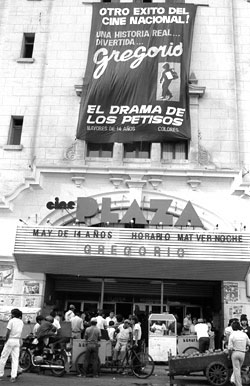
Grupo Chaski has a library of films with socially engaging themes and subject matters. Their first film, Miss Universo en Perú (Miss Universe in Peru; 1982) juxtaposes the 1982 Miss Universe pageant in Lima with the lives of lower-class Peruvian women. Their first feature film, Gregorio (1984), traces the effects of urban migration on a young boy from the Andes who joins a group of street kids only to later be rejected by them. Their second feature film, Juliana (1988), focuses on the life of a 13-year-old runaway girl who disguises herself as a boy in order to be part of gang that performs music for money. Many of their short- and full-length documentaries have an educational basis and are highlighted as potential paedagogical tools for communities that have limited access to education facilities. By mixing cinema with education, Grupo Chaski uses cinematic sites for social projects that go beyond entertainment.
In its filmmaking, Chaski seeks out non-professional actors and works closely with the populations they film, leaving scripts open to adaptation by the actors from the communities. In one example of the collaborative process, the group originally wanted Gregorio to have a happy ending, with the protagonist spending the money he has at the end of the film in a socially useful way, but the street child who played Gregorio said that ending was ridiculous and that no one in his position would give away money. So the group allowed the boy to script his own ending where he takes his stolen money and treats himself to a feast that includes steak and ice cream. After casting this film's child actors, Chaski established a house where they all lived during filming. When the films were completed, each of the children had a sponsor who mentored them after the film was over. (The protagonist of Gregorio went on to become an award-winning documentary director.)
Grupo Chaski seeks to challenge cultural homogenisation in language by respecting the varied idioms of the communities it works with - particularly as it sees language as a fundamental issue in preventing exclusion from the cinema. Although it can be difficult to find films that have dialogue in the indigenous languages of Peru, such as Quechua and Aymara, and although the cost of dubbing into these languages is high, Grupo Chaski still sees this as a goal to be met whenever possible.
In 2004, Grupo Chaski began working on a project of local, grassroots distribution and exhibition. Chaski began the early practice of public screenings accompanied by members of the group, who led after-screening discussions to provide communal spaces for debate and reflection around their films. In addition to bringing cinema to spaces that have no experience with film, Chaski also sets up screenings in urban shantytowns, showing films in public squares and community centres.
Chaski has extended its reach into mainstream formats, using digital media both to create and exhibit media, a move that corresponds to their desire to use inexpensive formats that are easily accessible to a broad community. Whereas it costs hundreds of thousands of dollars to build a new cinema in Peru, the group found that they could use digital projectors and screens costing only a few thousand dollars to bring films to local communities that are normally without access to cinema. The group developed the term "microcines" to describe both the makeshift cinemas they were creating with such digital technology and the overall project that networked these cinemas together.
The microcines generate events that are designed to engage local communities in a particular way. Rather than building standardised cinema sites that are contracted to screen similar films and produce similar publicity material, the group works in spaces such as community centres and public meeting places. The idea is that, in the economically poor, marginal regions where Grupo Chaski operates, a strengthening of community might take place when familiar faces are brought together in one location; spectators can be seen as they arrive and leave but also as they move and interact with the films throughout the screening. Unlike commercial cinemas where the screenings typically involve a run of advertisements and trailers followed by a single film, microcines allow space for discussion at the beginning and end of each film in order to enable audiences to interact with the themes of the film and articulate their reactions within a local community - leading to a pattern of exhibitions in which each event is made unique based on the particular geographical, social, and temporal specifics on the situation.
Because Grupo Chaski provides films that are independent and often filmed on a very low budget, the hope is that audience members can see that the production of cinema does not have to involve huge costs and Hollywood-like levels of expertise. This may act as an incentive to stimulate spectators into producing their own "copycat" work which is local in its production and engages with issues that are of importance to the communities in which microcines operate. This attempt to open production beyond the privileged minority who have the economic resources and technical tools to undertake cinema is another aspect of Grupo Chaski's work to generate the potential for further agency amongst the audience groups with which microcines work.
The directors of Grupo Chaski refrain from setting up a network of exhibition spaces that are managed top-down by the organisation and instead prefer to train members of the community so that they can take control of the exhibition space for their own local people. Envisioning the microcine as a locally driven cultural space, Chaski holds workshops to train community organisers. These workshops cover a range of issues including how to promote screenings, how to use screenings as a means to discuss and debate topics of importance to the community, how to develop critical media literacy skills, and more. The expectation is that new managers and their associated community groups will continue to be linked to Grupo Chaski and its microcine network, but will develop cinema screenings that are appropriate to the specific cultural background of their local community. To this end, microcines such as the Kancharisunchis Microcine in Abancay and Cine Narra Ñawy in Puno have their own website and a unique identity but continue to operate under the auspices of Grupo Chaski's network.
Grupo Chaski also fully uses the open access of the internet via its own website, connections with blogs, and video source sites like YouTube.
Another major component of the project relates to expanding their catalogue of films for distribution and working to develop "kits" that package groups of films together. Each "kit" includes one short, one feature, one documentary and one film for children. It is accompanied by a copy of Chaski's magazine "Nuestro Cine" ("Our Cinema") with information about the films, a guide to promoting the screenings, and a screening license. By 2007, Grupo Chaski had developed 7 "kits" and had over 60 films for digital distribution. The common thread that links all of these films is that they each exemplify the goal of "cine latino para gente latina" ("Latin American film for the Latin American people").
Rights.
The group takes its name from Quechua, the native language of the Inca. During the Incan empire the chaskis were messengers that carried information between communities. Along these lines, one of Chaski's primary goals has been to make films that communicate about Peru to Peruvians. Through film, Chaski politically confronts the long history of racism and exploitation that has characterised the status of Peru's indigenous cultures. One important aspect of their films, though, is their focus on urban spaces and their interest in a broad, heterogeneous demographic of oppression. This reconsideration of the identity politics attached to Peruvian marginal communities may be accounted for, in part, by the variety of perspectives and experiences of the founding members. Chaski, then, has two major themes dominating their work – a constructive effort to reshape the historically hegemonic narrative of national identity and a politically progressive project dedicated to exposing the socio-political structures that ruled Peru.
Grupo Chaski's 3 most well-known films have drawn large audiences, both within Peru and in the international community. For instance, by 1990, Gregorio had reached over 1 million viewers on the big screen in Peru, 7.5 million had seen it on Peruvian television, and dozens of millions had seen it on television worldwide. Chaski films continue to run on United States (US) television on channels like IFC and they also screen regularly on the pan-national channel Cine Latino, distributed in the US via Direct TV.
As of early 2010, Grupo Chaski was working with 32 micro cinema groups - 20 follow the advanced (2-year) training programme and 12 the basic training programme. Every group has 10 members. The network is decentralised and includes 8 different regions of the country.
Comment for The Future of ICTs and Development: "ICTs and Poverty Reduction?", posted by Stefan Kaspar, January 12 2010; "The Theory and Practice of the Peruvian Grupo Chaski", by Sophia A. McClennen, Jump Cut: A Review of Contemporary Media, No. 50, Spring 2008; and "Grupo Chaski's Microcines: Engaging the Spectator", by Miriam Ross, eSharp Issue 11: Social Engagement, Empowerment and Change. Lefthand image courtesy of Susana Pastor and Silvia García

- Log in to post comments