










































H1N1: Swine Flu's Collateral Health Benefits in Bolivia

From the online publication Time.com, this article points out some possible collateral benefits in Bolivia of the global H1N1 flu pandemic. Behaviours related to disease prevention may be increasing, prompted by a massive campaign by the country's public-health officials to contain the spread of the flu virus.
Public-health experts in Bolivia are speculating that the increase in handwashing across the country may have had some collateral benefits in helping to reduce the spread of common diseases unrelated to the H1N1 virus. For example, "We see a steady 10% to 15% drop in the rate of incidence of acute diarrhoeal diseases in all age groups, compared with last year's numbers at this time," says Dr. René Lenis, Bolivia's director of epidemiology. This is a reference to data collected on the number of weekly cases of diarrhoeal disease reported in medical centres nationwide in 2008 and 2009. Although there is a need for further research, there may be a potential link between the drop in cases of diarrhoeal disease and the rate of increase in handwashing. Diarrhoeal diseases are reported to be the biggest killer of children under age 5 worldwide; in Bolivia, 30,000 children die each year from such illnesses. (In comparison, this article reports 55 deaths - all age groups - from H1N1 from June - August 2009 in Bolivia.)
Beginning in April of 2009, "sudsy cartoon hands were everywhere, promoting handwashing on billboards, at soccer games, in classrooms and on TV." According to Therese Dooley, a senior adviser for the United Nations Children's Fund (UNICEF)'s Water, Sanitation, and Hygiene (WASH) project, children are key carriers of the handwashing message to their families and communities. One of the challenges cited here is that in Bolivia, 25% of the country still doesn't have access to water in the home. Health officials are cognisant that having a sink with water available in the home supports hygiene and reduction in disease.
Though the research has not yet been done to support the link between handwashing and disease reduction as a collateral effect of the H1N1 pandemic, the findings, according to Dooley, "'make a lot of sense, because behavior change like increased hand-washing happens quicker when there is a perceived threat....' She says she has not seen similar data regarding a drop in rates of diarrheal or other diseases on an H1N1 timeline from other countries (though at least one news report suggests that increased handwashing due to H1N1 has led to a sharp reduction of pinkeye cases in Korea)." The last time Bolivia witnessed a plummet in diarrhoeal-disease rates was during the cholera outbreak of 1992 and 1993, when better personal hygiene habits led to a reduction in the spread of infection. But as the threat of the disease died down, so too did people's standards of cleanliness. Dr. Lenis says that the Bolivian government is committed to continuing its media campaigns and that ongoing potable-water and sewage-system expansion projects will help make Bolivians healthier.
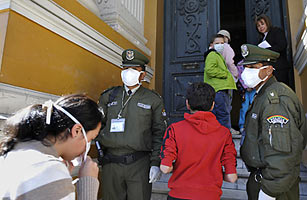
Global Health Weekly Update, October 26, 2009. Image source: Aizar Raldes / AFP / Getty
Comments

Collateral Health Benefits of hand washings
It is very interesting and new informative article especially applicable to my work settings. Results at my work place would be reviewed and shared soon.
From Dr.S.K.Badhan, Delhi, India
- Log in to post comments