










































How to Bypass Internet Censorship
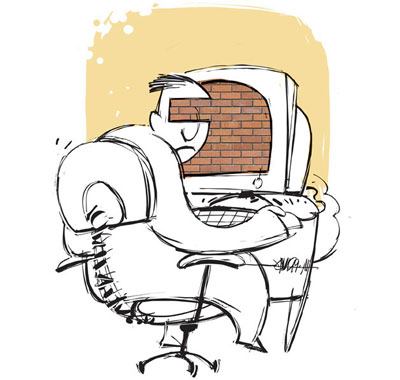
"In theory, the Internet has no boundaries....However, ...governments around the world are known to restrict their citizens' Internet access in a variety of ways. They may block all access to specific websites deemed undesirable; search for content on specific topics and cause it to be removed or blocked; and block access to certain applications such as social networks...or peer-to-peer software."
This manual offers an introduction to the topic of internet censorship and a presentation of techniques and tools used for circumventing this filtering. It is an outgrowth of concerns about the effect of internet blocking mechanisms, and the implications of censorship - concerns expressed by individuals and groups working to ensure that information available on the internet is freely available to everyone who wants it.
"How to Bypass Internet Censorship" is designed for a non-technical audience, with what the publishers characterise as clear, user-friendly explanations of software and methods for circumvention of online censorship. The book documents simple circumvention techniques such as a cached file or web proxy, and also describes more complex methods using Tor, which stands for The Onion Router, involving a sophisticated network of proxy servers. (Some solutions are more appropriate for certain applications (web, mail, chat, etc.); some are helpful in internet cafes; others offer varying levels of anonymity, protecting to different degrees the identity of users whose online activities could put them at risk.)
In addition to the core manual, there is a supplement proposing tutorials for Your-Freedom, Freegate, UltraSurf, and HotSpot Shield. These proprietary software could not be documented in the context of the core book because of the philosophy of one of the publishers - FLOSS Manuals Foundation, whose mission is to create free documentation for free (in a "free speech", or open source sense) software. However, the software presented in this supplement are free (in a "free lunch", or gratis sense) and efficiently defeat internet filtering, so it was thought they would be of interest to users in censored jurisdictions, in a field where diversity is a significant asset.
The electronic version of the book is free, and 100% of the net profits from the sale of the paperback version goes back into the development of additional manuals about free software.
"How to Bypass Internet Censorship" is a creation of FlossManuals, a project of the FLOSS Manuals Foundation that creates free, open source documentation across multiple languages for free, open source software, and Sesawe is an international consortium of software developers, organisations, and individuals working to support uncensored access to the internet.
Publishers
Arabic, Burmese, Chinese, English, Farsi, Russian, Spanish
203 for the manual; 38 for the supplement
Emails from Louise Smith to The Communication Initiative on February 25 2009 and March 11 2009 and from Freerk Ohling on May 25 2010; and How to Bypass Internet Censorship Facebook page, June 6 2012.
Comments

I'm using Freedur to bypass
I'm using Freedur to bypass the Great firewall. It is very fast and stable
- Log in to post comments