










































Human-Centred Design Bolsters Vaccine Confidence in the Philippines: Results of a Randomised Controlled Trial
Ruprecht-Karls-Universität Heidelberg (Reñosa, Wachinger, K. Bärnighausen, T. Bärnighausen, R.P. Chase, McMahon); Department of Health, Muntinlupa City, Philippines (Reñosa, Guevarra, Landicho-Guevarra, Aligato, Endoma, Landicho, Bravo, Malacad, Demonteverde, Silvestre); University of the Witwatersrand (K. Bärnighausen); Africa Health Research Institute (T. Bärnighausen); The Ohio State University (R.P. Chase); Johns Hopkins University Bloomberg School of Public Health (McMahon)
"...findings reaffirm the value of HCD as a meaning-making approach that influences attitudes and behavioural intent in general...including in relation to vaccination...[and] also provide concrete evidence of the opportunities of empathic-driven interventions, particularly for low-resource settings combating vaccine losses brought on by controversies..."
Dramatic declines in vaccine confidence and uptake in the Philippines are linked to a dengue vaccination controversy in 2017 that sparked widespread distrust in childhood vaccinations and led to the loss of a 20-year polio-free status in 2019. Human-centred design (HCD) has gained popularity in the field of global health as a means to prioritise end-user insights and engage with end-users throughout design ideation and iterations, thereby cultivating a sense of equity. "Salubong", a Filipino term, refers to welcoming someone back into one's life and elicits ideas about friendship and family relationships. The researchers incorporated this concept into an HCD intervention involving animated videos meant to re-welcome vaccines into homes after the 2017 controversy. This article presents the randomised controlled trial (RCT) results of testing the final story-based vaccine confidence intervention.
The researchers conducted an RCT among 719 parents or caregivers of under-5 children in urban and rural communities of Calabarzon region, where measles cases rose 300% in 2019. They purposively selected Dasmariñas City (urban arm) and Silang, Cavite (rural arm) to reflect both rural and urbanised conditions, and to capture different and varied sociodemographic factors and health facility-related experiences on child health and vaccinations. The stories and experiences of participating vaccine-hesitant caregivers served as the impetus for the Salubong video. Qualitative data collected amid HCD phases (see Related Summaries, below) outlined the role of sociocultural context in shaping vaccine hesitancy in the Philippines and the widespread consequences of the dengue vaccine scare across various population strata. These findings highlighted the potential of real-life narratives in developing and honing an intervention rooted in the local context.
Preliminary cartoon sketches and characters for the storyboards were presented and iterated along the way. The researchers performed think-aloud exercises with caregivers, healthcare workers (HCWs), and community leaders using analogue flipboards and/or screen-share digital photos of the paper-based storyboards. The full complexities of the design process, which lasted 12–15 months, entailed extensive discussions among various actors (scientists, policymakers, healthcare providers, community and local stakeholders, Filipino animators and cartoonists, health promotion experts, communication and social media officers, etc.).
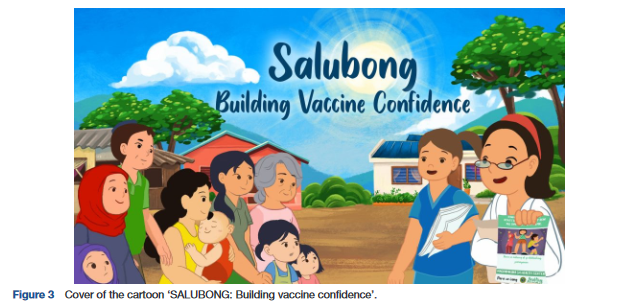
The final intervention video, which may be viewed below, is a 5-minute animated cartoon entitled: "Salubong: Building Vaccine Confidence", which features stories of Filipino families about vaccines. The cartoon uses a narrative and empathic format tailored to the Filipino cultural setting, featuring diverse characters of different ages, household compositions and income, and ethnic backgrounds, as well as appealing colours for optimal contrast. The original video is in Filipino, and there are two other versions with Filipino and English subtitles.
After completion of the baseline survey, the Salubong video was screened online for members belonging to the 396 member of the intervention group, while the "Paano labanan ang COVID-19 (How to fight COVID-19)" animated video, which was created by the Philippines Department of Health's Health Promotion Bureau, was screened for 323 control group participants. To avoid biases or contamination of the data, no interactions were attempted during the presentation of the videos. Following the video, the researchers conducted a follow-up to assess the binary improvement (improvement vs. no improvement) and the amount of improvement in vaccine attitudes and intentions after intervention exposure. Surveys were administered August 11 2021 and August 15 2022.
Although the intervention group began with marginally higher baseline vaccine attitude scores, 62% of the intervention group improved their vaccine attitude scores versus 37% of the control group (Fisher's exact, p<0.001). Among individuals whose scores improved after watching the assigned video, the intervention group saw higher mean attitude score improvements on a 5-point scale (Cohen's d=0.32 with 95% confidence interval (CI) 0.10 to 0.54, two-sided t-test, p<0.01). There were similar patterns among participants who stated they had previously delayed or refused a vaccine for their child: 67% of 74 in the intervention group improved their vaccine attitude scores vs. 42% of 54 in the control group (Fisher's exact, p<0.001). Among the subset of these individuals whose scores improved after watching the assigned video, the intervention group saw higher mean attitude score improvements on the 5-point scale that were marginally significant (Cohen's d=0.35 with 95% CI -0.01 to 0.70, two-sided t-test, p=0.06).
The intervention also showed vaccine confidence score improvements among those who did not trust HCWs. The intervention group had greater score improvement than the control group insofar as more intervention group participants saw improvements in their post-test versus pre-test scores (66% vs 28% among those who did not trust HCWs; 61% vs 39% among those who did trust HCWs), but among those whose scores improved, the amount of improvement was similar comparing intervention to control (0.35 vs 0.29 among those who did not trust HCWs; 0.38 vs 0.30 among those who did trust HCWs). The researchers then narrowed the analysis to people whose most trusted source of information was someone other than HCWs, as they are an important group to reach with vaccine confidence messaging. The results showed that the intervention group still reflected statistically significant improvements in post-test scores compared with the control group in terms of more intervention group participants' scores improving (66% vs 28%, Fisher's exact p<0.001), with the improvers among the two groups improving a comparable amount (0.35 intervention vs 0.29 among controls, two-sided t-test, p=0.35).
The researchers also assessed participants' affective responses to the videos both before and after they watched the intervention or control videos. They included declarations like "I feel that the people in the healthcare system respect my situation", "I feel that I am warmly welcomed by healthcare workers in the health facilities", and "I feel that agreeing to vaccines is a way to show my love for my children". The baseline values were extremely high, with an average of 1.47 (with a possible range of -2 to 2); these items therefore had very little space for improvement in a pre-test to post-test comparison. The intervention group, however, still included more people who improved their scores (34% vs 24%) and fewer individuals whose scores declined at post-test (20% vs 37%) than the control group.
In conclusion, this study finds that HCD is a promising approach to improving vaccine attitudes and intentions. It may help shape future initiatives and legislation aimed at regaining the public's trust in vaccinations. Yet, "[m]ore extensive studies are needed, especially in light of the prevalent misinformation about vaccines and the need to study actual vaccination uptake results in addition to intentions."
BMJ Global Health 2023;8:e012613. doi:10.1136/bmjgh-2023-012613.