










































Improving Maternal, Infant, and Young Child Nutrition and Hygiene through Community Videos in Niger
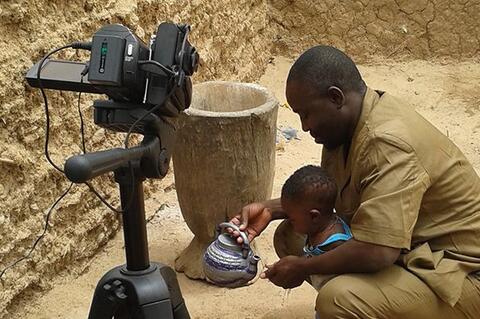
The intervention in Niger builds on a proof of concept conducted in 2013 to encourage better nutrition and hygiene practices in Keonjhar District of Odisha, India. SPRING and Digital Green adapted the approach for the resilience context of Niger in partnership with three USAID projects: the Resilience and Economic Growth in the Sahel-Enhanced Resilience Program (REGIS-ER), Livelihoods, Agriculture and Health Interventions in Action (LAHIA), and Sawki.
Videos feature friends, family, and neighbours demonstrating recommended MIYCN and hygiene practices in their households. These video "stars" are recruited from within the community as early adopters and the videos are designed to encourage pregnant and lactating mothers, adolescent girls, husbands, and other influencing family members to practice simple nutrition and hygiene behaviours that can prevent stunting and reduce maternal and child anaemia in the first 1,000 days. They emphasise barriers and facilitating factors that were identified through formative research with these same target groups.
The community-led video project follows these general steps:
- Rapid formative research
- Prioritisation of video themes
- Video production training
- MIYCN and hygiene training
- Video dissemination and data collection training
- Production of videos
- Pretesting/finalisation of videos
- Dissemination of videos
- Home visits and follow-up
- Quality assurance/supervision
The 10-part series of videos is being screened in the Maradi region of Niger. The four key audiences are women of reproductive age (15-49), men (25- 60+) who are considered model husbands selected by health centres, adolescent girls (12-18) in "safe space" programmes, and other key influencers, including grandmothers and other family members. The videos were disseminated through community groups in 20 villages in Niger from April to December 2015. They are recorded and disseminated in Hausa and the uploaded versions feature the option for French or English subtitles to facilitate understanding for a global audience of partners and donors. The work in Niger is currently being scaled up to include disseminations in over 100 villages, an expanded geographical scope, and the production of additional videos featuring new content, This work will continue in Maradi and be expanded to include the Zinder region of Niger and one region in Burkina Faso through at least September 2016.
The first videos focused on the role of nutrition in the first 1,000 days, the importance of handwashing, and active/responsive feeding of complementary foods from a separate bowl. For example, in the video A Good Start to Exclusive Breastfeeding, a woman delivers at a health centre and breastfeeds her baby immediately after the delivery. The midwife explains the importance of exclusive breastfeeding until 6 months, as well as proper positioning and attachment of the baby. She tells the new mother to breastfeed 8-12 times throughout the day and night. Upon returning home, the woman's family supports her while she breastfeeds. In How Can Working Parents Feed Their Young Children Frequently?, when Chima runs into her neighbours on the way to the field, her neighbour, Rakiya, explains that she is carrying a snack to the field for her baby to eat, even though her baby has already had breakfast. Rakiya explains that it is important to feed young children frequently.
SPRING and Digital Green trained a local community team to produce the videos, as well as 40 community volunteers and 3 supervisors to mediate the dissemination of the videos, facilitate discussions with community members, and conduct home visits to monitor progress and resulting changes in behaviour. After each video screening, each group organises at least one additional screening that month for others in their community identified as influencers for the particular behaviour. Volunteer community members began disseminating approximately one video each month in the pilot villages beginning in March 2015 and will continue through September 2016 with the expanded scope of activities.
Click here to view all ten videos.
Children, Nutrition, Health
According to SPRING, "the process of producing and disseminating the videos often elevates the role and influence of positive deviants or early adopters, who are the video "stars". Community-led video has been shown to be highly effective as both a means of conveying information and catalyzing social change and individual behavior change for improved agriculture, livelihoods, and health behaviors. The videos allow community members to observe practices in their own geographical context, demonstrated in their own language and by someone of similar means. Seeing practices promoted by their neighbors, community members realize that they, too, have the means to implement them."
For more information on this approach, see the Community Video for Nutrition Guide, which was produced to support the implementation of this project, and is based on the experiences of the projects in Niger and India.
SPRING website, Digital Green website, and Using Community Video to Promote High Impact MIYCN and Hygiene Practices in Niger - Presentation on January 16 2016, and email from Kristina Granger on February 18, 2016.