










































Independent Monitoring Board of the Global Polio Eradication Initiative: Seventh Report
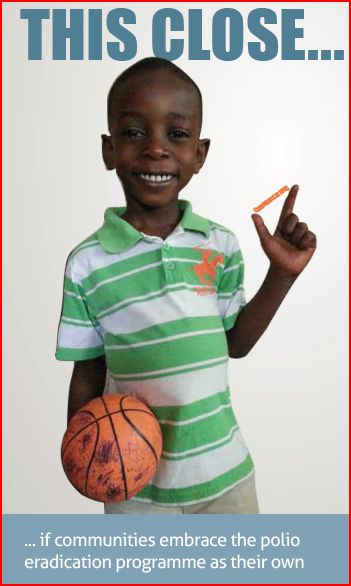
"The Independent Monitoring Board judges that stopping polio transmission by the end of 2014 is a realistic prospect....The Programme that finally stops transmission will not be the Programme as it exists today, but one that has rapidly and purposefully evolved from it. It will be a Programme that truly puts communities at its centre, and that sees communications as being key to its success, rather than as a mitigating measure..."
This seventh report from the eighth (May 7-9 2013) meeting of the Independent Monitoring Board (IMB) of the Global Polio Eradication Initiative (GPEI) sets forth a "system map" for polio eradication - with a strong focus on the importance of communication in ending polio for good. Some parts of this system have been designed and built over many years; others represent the complex natural environment in which the GPEI operates - with political, financial, and security factors (evidenced, for instance, by the tragic killings of polio workers in Pakistan and northern Nigeria) affecting its work in myriad ways. This map is based on observations such as this: "Regrettable though it is, the Polio Programme - and its vaccine in particular - are subject to great negativity in many of the places where the virus still circulates. Many communities regard the vaccine as being imposed from the outside and do not understand the benefit that it brings. Parents ask 'why so many doses?' and often get unsatisfactory answers. When anti-Programme campaigners recently produced a series of CDs to spread their message in Nigeria, these found a receptive audience, their messages spreading rapidly across the north."
Despite such examples, progress has clearly been made; at the time of the IMB's meeting, on May 5 2013, there had been 26 cases so far in the year, in just 3 countries: Afghanistan, Nigeria, and Pakistan. In the same period a year prior (January 1 - May 8 2012), there were 53 cases in 4 countries. Amongst other examples provided in the report, the IMB points to one of the 3 remaining polio-endemic countries, Pakistan, where communication - in the form of advocacy - was central to the transformation of its Programme in 2012: "Heightened political commitment drove through a raft of programmatic improvements. These had real impact, significantly reducing circulation of the virus. The country held elections in the days following the IMB meeting. Strong leadership of the Programme from those coming into power will now be crucial. Interrupting transmission in Pakistan never looked easy, and recent events [the killings of polio workers] make it harder still."
In areas where communication capability is strong, the IMB sees:
- rapid rebuttal of unfounded and unscientific claims about the vaccine;
- engagement in dialogue with communities and local groups to achieve widespread community support, particularly with women's groups and religious leaders;
- education of and explanation to parents and communities, as well as to vaccinators themselves (so that there is no question that they cannot answer in an informative and reassuring way);
- the incorporation of polio vaccine delivery with other health and social benefits that communities value; and
- consistent and effective advocacy of the benefits of the vaccine.
"The problem is that this is not happening on the scale and with the energy and focus needed to make a difference where it matters the most." The IMB is "deeply concerned by the Global Programme's weak grip on the communications and social mobilization that could not just neutralise communities' negativity, but generate more genuine demand. Within the Programme, communications is the poor cousin of vaccine delivery, undeservedly receiving far less focus. Communications expertise is sparse throughout. UNICEF [United Nations Children's Fund], the lead agency for communications, is underpowered. But communications is everybody's business and should be more prominently at the heart of the Programme's concerns. We have warned of this weakness for some time. It has not been addressed, and is now a real and present danger to eradication."
In a multi-page analysis of the approach to communications that the Programme has adopted (or failed to adopt), the IMB report notes that there has been "too much of a 'one-way' attitude to communications, wanting to bring people round to its view rather than concentrate on listening and on dialogue....In many places, there is clearly a disconnect between the services that people really want (such as measles vaccination, maternal and child healthcare, and basic primary healthcare) and what the Programme is offering them. This is a complex issue...[that] demands...nimble and sophisticated work, in which local communications teams are able to amend their approach in response to their particular community. It demands that the partners look more deeply within their own agencies, to strengthen the links between the Polio Programme and their many other endeavours, a number of which are far higher on parents' wish lists. It also demands that the Polio Programme reach out as widely as possible, to work through community groups that enjoy a level of trust not afforded to the Programme....It is communities themselves who understand best what they want, what they need and what they think. We are surprised not to hear the voice of the child more prominently within the Programme. It is difficult to imagine a more powerful unifier than communities hearing children ask 'Who will protect me against polio?'"
As noted here, the GPEI's strategic plan articulates that "experience throughout the GPEI has shown that polio virus circulation stands little chance of surviving in fully mobilized communities, even in the most difficult contexts". The IMB agrees: "The leaders of the Programme need to make this rhetoric a reality, which it currently is not. If not dealt with, the current communications shortfall is a deep threat to the Programme. But if gripped, and managed with ambition, stronger communications has the potential to transform the Programme's progress."
Click here to read a related summary/commentary of this report: "Global Body Rips Apart Polio Communication Strategies", by Shahina Maqbool, The News, June 4 2013.
Email from Ellyn Ogden to The Communication Initiative on June 3 2013.
- Log in to post comments