










































Interpersonal Communication and Risk Perception Determinants in the Polio Eradication Campaign in Zaria, Northern Nigeria
University of Malaya
"Interpersonal communication...played a very significant role in the way members of Zaria communities in northern Nigeria responded to (accepted or rejected) the polio eradication campaign."
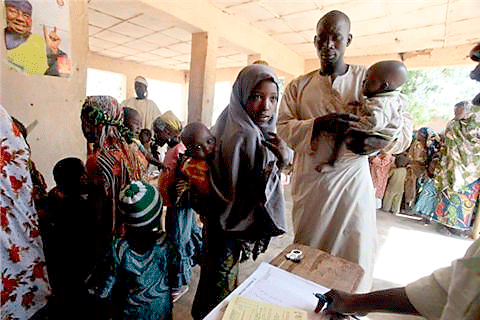
Ethnic and religious leaders are believed to have been largely instrumental to the success or failure of polio eradication campaign in various parts of northern Nigeria. To test the validity of this credence, this study examined the extent to which polio eradication campaign resistance in northern Nigeria is associated with leadership and personal persuasions. It was conducted in Zaria Local Government Area (LGA), one of the high-risk (wild polio virus (WPV)-endemic) areas in northern Nigeria where resistance to the global campaign on polio eradication is very high. The study is premised on the Risk Perception Model, which argues that various factors affect perception of risk and that these factors play a large role in determining levels of concern, worry, anger, anxiety, fear, hostility, and outrage, which in turn can significantly change attitudes and behaviour. This model further posits that levels of concern tend to be most intense when the risk is perceived to be involuntary, inequitable, not beneficial, not under one's personal control, associated with untrustworthy individuals or organisations, and associated with dreaded adverse, irreversible outcomes.
As detailed here, the circumstance of the polio eradication campaign in Nigeria coincides with existing hostility between Islam and the West. In northern Nigeria, being predominantly of the Islamic faith, "people tend to easily believe that the polio campaign in the region is part of a long-standing Western plot against Muslims all over the world. The local leadership is largely believed to work in close confidence with their people, thus raising the issue of trust and emphasizing the need for a risk assessment of leadership influences..."
The survey sampled 8 out of 13 wards, representing approximately 62% of the population of Zaria LGA, with response rate of 78.9%. Findings show that leadership (ethnic and religious) persuasions were of little significance in the campaign acceptance or resistance. Rather, the risk of vaccine contamination and related health consequences, based on personal persuasions of husband/wife and friends/relations, accounted for the resistance decisions of the individuals in the local communities. This outcome supports the Risk Perception thesis, which emphasises that individuals tend to resist risk events that are involuntary and not under their personal control. Thus, rather than blind obedience to traditional and religious leaders, the individuals tended to have taken the polio eradication campaign as a subject of a rather personal consideration. After, all the decision about whether or not to accept polio vaccine, as well as the risk responsibility on such a decision, is not shared between parents who make the decision and traditional or religious leaders who persuade people to make such decisions. The outcome of this study also points to active rather than passive audiences in the northern communities, particularly in public health campaigns.
Journal of Communication and Media Research, Vol. 1, No. 1, April 2009, 93-107. ©Delta Publications Ltd. Image credit: The Rotary Club of Barboursville
- Log in to post comments