










































Interpersonal Communication Strategies to Increase Iron-Folic Acid Supplement Consumption: Reduction in Anemia Through Normative Innovations (RANI) Project
The George Washington University (Ganjoo, Rimal, Bingenheimer, Jin, Talegawkar, Pant, Aluc); Johns Hopkins University (Rimal); University of California, San Francisco (Sedlander); Boston University (Yilma); DCOR Consulting (Panda)
"[T]he RANI Project increased interpersonal communication among women of reproductive age and significantly increased their self-reported iron-folic acid supplement consumption."
Anaemia outcomes can be improved through behavioural changes, including increasing the consumption of iron-rich foods and regularly taking iron-folic acid supplements. However, these behaviours can be difficult to change, and more than half of women of reproductive age in India are anaemic. Prior research suggests that interventions working to increase interpersonal communication may influence and empower individuals and the larger community in promoting behaviour change. This investigation uses data from a cluster-randomised intervention (see Related Summaries, below) to understand the pathways by which interpersonal communication mediates the consumption of iron-folic acid supplements.
The intervention itself was the Reduction in Anemia through Normative Innovations (RANI) Project, which was informed by the theory of normative social behaviour (TNSB). A key aim of the RANI Project - to increase the use of iron-folic acid supplements (to reduce anaemia) - was promoted through participatory interactions and interpersonal communication regarding anaemia, iron-folic acid supplement consumption, and diet diversity among women and their social networks. Beyond this instrumental function, the idea of RANI was that, by bringing people together, the intervention could stimulate ritualistic behaviours among community residents (e.g., engaging in discussions about broader issues beyond the intervention's narrowly-focused outcomes) - thus leading to greater behaviour change.
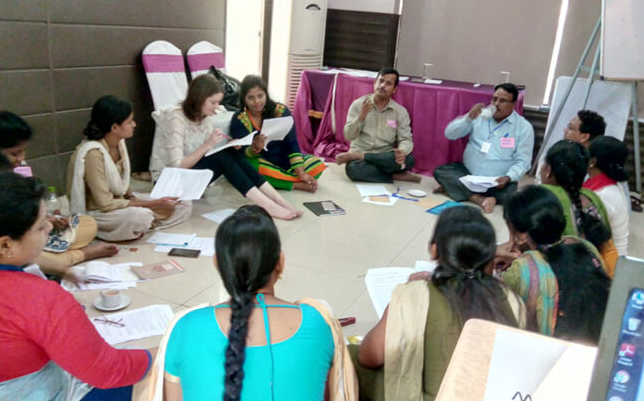
Specifically, the RANI intervention consisted of three principal components tapping into social norms: (i) promotion of interpersonal communication through in-person group participatory learning sessions delivered through activities and games that focused on iron-folic acid supplement consumption, anaemia, and social norms; (ii) locally developed health communication mobile phone videos, followed by group discussions, for pregnant women, non-pregnant women, husbands, and mothers-in-law showcasing stories of women who overcame social norm and iron-folic acid supplement consumption barriers; and (iii) monthly haemoglobin testing sessions at community engagement events that were followed by discussions regarding the results and a nudge toward positive behavioural changes.
Longitudinal data from control and intervention arms in rural Odisha, India, were collected at baseline (N = 3,691), 6 months later at midline (N=3,359), and 20 months later at endline (N = 3,394). Eighty-nine clusters of villages were randomly assigned to receive either the intervention or care as usual (control arm). COVID-19 occurred right after midline data collection, so the intervention was paused for 2 months. Thereafter, during the second half of the intervention, women were socially distanced outside, six feet apart, and wore face masks. Primary analysis involved a structural equation model, with general health interpersonal communication and anaemia-specific interpersonal communication as potential mediators on the pathway between intervention assignment and both midline and endline iron-folic acid supplement use.
Figure 1 in the paper demonstrates the significant increase in interpersonal communication in the intervention arms. Overall, a 1-point increase of anaemia-specific interpersonal communication was associated with 10% higher odds of taking iron-folic acid supplement (odds ratio [OR] = 1.10, 95% confidence interval [CI]: 1.09, 1.11, p < .01). In the intervention group, a 1-point increase in anemia-specific interpersonal communication was associated with 8% higher odds of iron-folic acid supplement uptake; in the control group, a 1-point increase was associated with 3% higher odds of iron-folic acid supplement uptake. It is important to bear in mind that the effect sizes were rather small, indicating that factors other than interpersonal communication also played key roles in promoting iron-folic acid supplement consumption behaviours.
The findings suggest a larger mediating role for anaemia-specific than general health interpersonal communication. Meanwhile, the direct or unmediated path from RANI to end-line iron-folic acid supplement use is substantially larger (0.79) than the direct path from RANI to midline iron-folic acid supplement use (0.32), suggesting that mediation by general health and anaemia-specific interpersonal communication accounted for a larger fraction of the intervention's effect on iron-folic acid supplement use at midline than at endline.
In short, this field trial demonstrated that interpersonal communication served to mediate intervention effects, but in a nuanced manner. In particular, discussions about general day-to-day issues (conceptualised as indicators of ritualistic communication) did not serve as direct mediators of intervention effects; rather, they augmented anaemia-specific discussions, so the intervention's effects on anemia-specific communication was partially mediated by general communication. In the field, the intervention brought people together as a group, where the ritual of interpersonal communication likely took place. The intervention also gave people a reason to reach out to each other more, beyond just in the group sessions. Specifically, the intervention provided new topics to discuss and potentially created new or deeper connections among participants. For example, the RANI health communication videos may have given women a reason to check in with their neighbours to see if they had a copy of the latest video. It was this gathering that, in turn, promoted anaemia-specific interpersonal communication.
Thus, this study illustrates that, even during social distancing due to COVID-19, strategic interpersonal communication can improve iron-folic acid supplement use. The analysis shows that interventions can increase both the ritualistic and instrumental functions of communication. There are cost-effective strategies to stimulate interpersonal communication, such as leveraging existing groups but extending the time they meet and the topics they discuss. Future interventions could leverage and expand the findings from this study in training health professionals to use communication - both via ritualistic and instrumental pathways - to reach and nudge people toward positive action.
Journal of Health Communication, 29: 481-489, 2024. https://doi.org/10.1080/10810730.2024.2355286. Image credit: DCOR Consulting
- Log in to post comments