










































Intrahousehold Power Inequalities and Cooperation: Unpacking Household Responses to Nutrition-Sensitive Agriculture Interventions in Rural India
London School of Hygiene & Tropical Medicine (Harris‐Fry, Beaumont, Allen, Kadiyala); University College London (Prost); Digital Green (Fivian, Pradhan, Sahu); DCOR (Development Corner) Consulting Pvt. Ltd. (Mohanty, Parida); Voluntary Association for Rural Reconstruction and Appropriate Technology (Padhan, Mishra); Ekjut (Sh. Rath, Su. Rath); JSI Research & Training Institute (Koniz‐Booher)
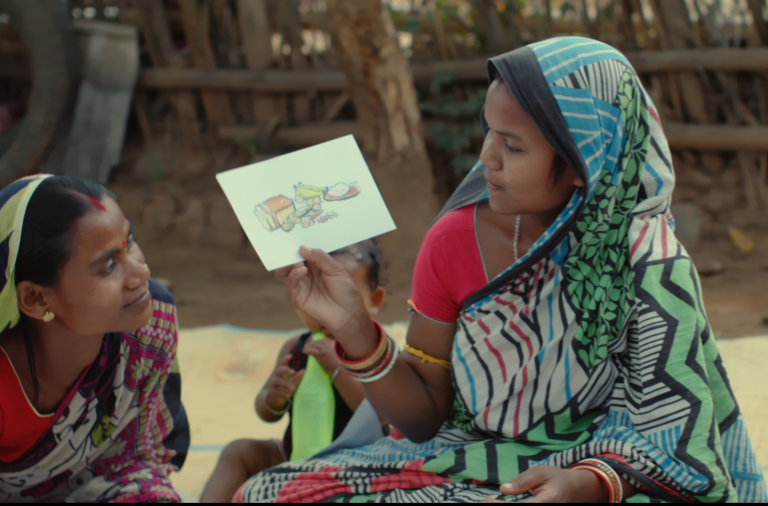
"Now after seeing the video we know many things. We are also sharing these in front of our family members....I feel happy about this because my family members respect what I say."
Cooperation among family members is increasingly being incorporated into the design of nutrition interventions in places like South Asia, where the burden of undernutrition is high. Cooperation may occur in several ways - for example, by sharing information, sharing tasks and gains from agricultural production, and sharing the responsibilities of raising children. This paper: (i) examines the role of intrahousehold cooperation and intrahousehold power inequalities in determining the dietary quality of mothers and children in rural Odisha, India, and (ii) unpacks the role these household dynamics play in determining the effectiveness of 3 nutrition-sensitive agriculture interventions that were tested in a 4-arm cluster-randomised controlled trial (RCT) called UPAVAN (Upscaling Participatory Action and Videos for Agriculture and Nutrition).
As detailed at Related Summaries, below, UPAVAN was implemented in 148 clusters (villages and surrounding hamlets) in Keonjhar district, Odisha. The core components of all 3 interventions that were tested were: (i) women's group meetings (2 meetings/month/group, over a 32-month period) that incorporated locally made videos (e.g., on NSA practices) and (ii) follow-up home visits to group participants if they were pregnant women or mothers of children aged 0-23 months. The group meetings were primarily run through women's Self-Help Groups (SHGs) - a platform for savings and credit - but with an added effort to increase group coverage and participation. The main impact evaluation of UPAVAN showed that each intervention increased maternal and/or child minimum dietary diversity. However, the main process evaluation found that land and water constraints, gender norms, and lack of support from family members prevented some households from changing their cultivation and dietary practices.
The present study uses quantitative data from cross-sectional surveys at UPAVAN's baseline and 32 months afterwards (endline), as well as qualitative data from 32 family case studies and 20 focus group discussions. To indicate intrahousehold power inequalities, the researchers used the following proxy indicators of women's relative power: women's share of household assets, women's share of education, and a count of decisions women make concerning domestic and farm management. They indicate intrahousehold cooperation using the father's share of time spent on childcare ("men's care share"). The researchers explored whether UPAVAN interventions were mediated by changes in one dimension of women's power that could change through UPAVAN: women's decision-making. To test for evidence of mediation, they reported whether all three of the following conditions are met: (i) The intervention affects the mediator (decision-making); (ii) the intervention affects the outcome (diets); and (iii) the mediator (decision-making) affects the outcome (diets), controlling for intervention.
The study found that households cooperated to produce and procure food for women and children, but some households were more responsive to changes due to pregnancy than others, and financial constraints also explain some heterogeneity. Gendered power inequalities were associated with women's dietary quality, but women's use of power was inhibited by several interlinked factors. Qualitative data suggest that viewing and discussing UPAVAN nutrition-specific videos gave women information about the importance of diverse diets, and motivation and confidence to ask for specific foods for themselves or their children. UPAVAN interventions were more successful in more supportive, cooperative households, and in some cases, the interventions increased women's decision-making power. For instance, many women discussed the content of videos and meetings to enlist support from their husbands, fathers-in-law, or mothers-in-law to start new, small-scale cultivation in their homestead garden by themselves, or with minimal support from others. A key supporting factor for this was having family members who were already interested and engaged in cultivation. However, women's decisions to enter into negotiations with family members depended on whether women deemed the practices promoted by UPAVAN interventions to be feasible, as well as women's confidence and previous cultivation success.
In summary, although quantitative analyses showed no evidence of effect modification by indicators of power inequalities and household cooperation, qualitative evidence indicates that interventions were more likely to lead to changes in agricultural practices in more supportive, cooperative households. Eliciting cooperation from the whole household will require a move towards more family-centric intervention models that empower women while involving other family members and accounting for the varied ways that families cooperate and negotiate.
In UPAVAN, the NSA interventions engaged family members in various ways. Mothers-in-law participated in meetings; participants were encouraged to discuss the intervention at home; and facilitators visited participants' homes, allowing interaction with other members. To further enhance the inclusion of other family members, additional intervention components could be integrated while ensuring that the "women's space" created by SHGs is not undermined. For example, home-based counselling interventions that facilitate intra-household dialogue and joint decision-making and mixed groups (e.g., nutrition education involving mothers, fathers, and grandmothers) could be incorporated.
The researchers conclude that further research is needed to identify how interventions can co-design socially acceptable ways to increase cooperation and reduce power inequalities, while alleviating resource and labour constraints where possible. "With this information, interventions could be designed so that all families can be engaged in an inclusive and empowering way."
Maternal & Child Nutrition 2023;19:e13503. https://doi.org/10.1111/mcn.13503. Image credit: Digital Green
- Log in to post comments