











































Ishraq

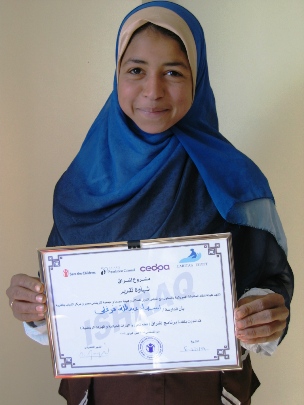
The programme consists of learning and recreational modules. The latter use sports to develop girls' leadership and decision-making skills. Ishraq also engages parents, adolescent boys, and community leaders, and works with schools and youth centres to provide a sheltered environment for girls. Ishraq collaborators Caritas Egypt and CEDPA provide schooling and other life skills to girls enrolled in the programme.
Caritas Egypt's approach to literacy emphasises active learning centred on dialogue. In the Learn to Be Free curriculum, which is part of the Ishraq programme, teachers introduce an issue by presenting a song, video, or picture to stimulate a discussion. Students explore the topic, define problems, suggest solutions, and then learn to spell and write related words. The core curriculum focuses on Arabic and mathematics. Additional subject areas include learning about health and the environment as well as developing income-generating skills.
CEDPA also emphasises participatory and active learning through New Horizons, an awareness-raising programme tailored for illiterate girls, ages 9 to 25 years. The curriculum focuses on life skills and covers identity, family, and community; girls' rights and duties; reproductive health; nutrition; and the environment. The reproductive health component covers topics such as adolescence, violence, marriage, maternal health, and pregnancy.
Ishraq teachers are called promoters. They are educated girls from participating villages nominated by local community leaders. Classes are held 4 days per week, for 3 hours each day. The classes accommodate the girls' schedules, according to arrangements made with the local institutions hosting programme activities. On two of the four days, girls participate in sports. The first phase of the recreational activities was designed to gain a better understanding of the needs and abilities of the girls. Those observations formed the basis for designing a new, locally developed sports curriculum, launched in February 2002. The new curriculum is designed to teach girls the basic rules and skills of 4 different sports: volleyball, soccer, basketball, and handball. After all 4 units have been introduced, girls select one sport to practice and compete in during the remainder of the programme. Ishraq's aim is to increase girls' participation in sports and help them to develop healthy values and attitudes. Besides providing recreational opportunities for rural girls, the Population Council developed a sports curriculum designed to nurture feelings of self-worth and self-confidence and to ensure that participants have fun in a safe and activity-based environment, acquire skills in a range of recreational activities, learn information and attitudes to help them live safer lives, and make lasting friendships.
Youth, Girls, Reproductive Health, Education
According to the organisers, extensive data from the quantitative research show the effect of Ishraq on the girls' educational level, the advantages of an integrated approach, and significant changes in attitudes toward marriage, female genital mutilation/cutting, and family roles. According to the Population Council, the results of this study show that, for illiterate girls on the verge of entering adulthood, intensive programmes can create change. In addition, regular physical activity helps to reduce girls' risk of developing many of the chronic diseases of adulthood, enhance girls' mental health, and reduce the symptoms of stress and depression. Moreover, female athletes tend to do better academically and have lower school drop-out rates than their non-athletic counterparts.
Caritas, Centre for Development and Population Activities, Ministry of Youth (Supreme Council for Youth), National Council for Childhood and Motherhood, Save the Children.
Population Council Project website on February 20 2009 and April 9 2010. Photo: Nadia Zibani/Population Council
- Log in to post comments